Costs of group living include greater energy expenditures, more competition for food, and higher risks of disease
In one study of group living, a European goldfinch (Carduelis carduelis) in a flock of six birds consumed (on average) 20% more seeds per unit of time than did a bird feeding on its own, because goldfinches in a flock spent more time eating and less time scanning for predators than did European goldfinches feeding on their own (Gluck 1987).
But the increase in the number of seeds eaten per unit of time by a goldfinch in a flock has a downside: as the group size increases, group members deplete the available food more rapidly, which means the birds must spend more of their time flying between feeding sites (FIGURE 8.21). Traveling in search of food takes time and energy, and it can increase the risk of being spotted by predators.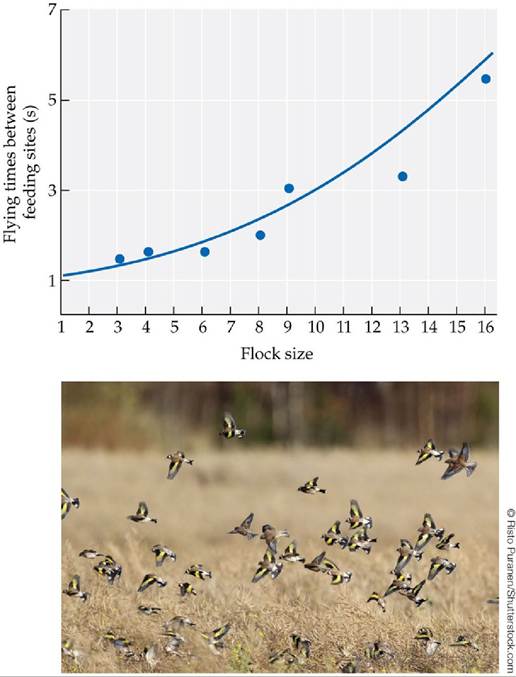
FIGURE 8.21 Traveling in a Group A study of European goldfinches (Carduelis carduelis) in groups of seven different sizes showed that the amount of time the birds spent flying between feeding sites increased with the size of the flock.
A goldfinch feeding in a flock eats more seeds per hour than does a goldfinch feeding alone. Can that benefit be compared directly with the cost shown in this figure? If not, what other information would you need to make this comparison?
(After E. Gluck. 1987. Ethology 74: 65-79.) View larger image
Competition for food can also become more intense as the size of a group increases. As a result, a member of a large group may spend more time and energy fighting for food than would a member of a smaller group (or a solitary individual). In particular, in groups with a dominance hierarchy, subordinate group members can spend much of their time and energy on interacting with group members. For example, in a study on the cichlid fish (Neolamprologus pulcher), subordinates spent more of their energy on submissive behaviors (appeasing dominant group members) than they did on any other activity.
Finally, members of a large group may live closer together or come into contact with one another more often than do members of a small group. As a result, parasites and diseases often spread more easily in large groups than in small groups; we'll return to this topic in Concept 13.5.
More on the topic Costs of group living include greater energy expenditures, more competition for food, and higher risks of disease:
- Group size may reflect a balance between the costs and benefits of group living
- Benefits of group living include access to mates, protection from predators, and improved foraging success
- Benefits and Costs of Higher Capital Requirements for Banks
- Chapter 2 reviews 27 studies of the costs and benefits of higher capital requirements for banks, several of which report research conducted at or for official institutions.
- Competition within the framework of food webs
- Interspecific competition in a food web context
- 21 Energy Flow and Food Webs
- Food web structure and its influence on competition
- CONCEPT 15.1 In positive interactions, no species is harmed, and the benefits are greater than the costs for at least one species.
- The second law of thermodynamics states that during any transfer of energy, some energy is dispersed as unusable energy because of the tendency toward an increase in disorder (entropy).
- CONCEPT 21.2 The amount of energy transferred from one trophic level to the next depends on food quality and on consumer abundance and physiology.
- 26 Inflammatory bowel disease and adverse reaction to food in a dog
- Though the rise of religious violence has been a global phenomenon in the modern period, perhaps nowhere is the arena of competition among contesting religious and secular politics greater than in South Asia.
- CONCEPT 23.3 Primary threats to diversity include habitat loss, invasive species, overexploitation, pollution, disease, and climate change.
- Energy flow between trophic levels can be depicted using energy or biomass pyramids
- A metabolic disease, or metabolic disorder, is the name given to a group of illnesses in dairy cows which are caused by an over-exertion of their normal metabolism.
- The vast majority of the autotrophic production of chemical energy on Earth occurs through photosynthesis, a process that uses sunlight to provide the energy needed to take up carbon dioxide and synthesize organic compounds, principally carbohydrates.