SUMMARY
CONCEPT 17.1 Agents of change act on communities across all temporal and spatial scales.
17.1.1 Define abiotic and biotic agents of change including disturbance and stress.
Agents of change include both abiotic and biotic factors.
Abiotic agents of change can act as disturbances (injuring or killing organisms) or as stresses (reducing the growth, reproduction, or survival of organisms).
Biotic agents of change include negative species interactions such as competition, predation, and trampling. Ecosystem engineers and keystone species are common agents of change.
17.1.2 Compare disturbance intensity with disturbance frequency and describe their differential effects on communities.
Agents of change vary in their intensity, frequency, and areal extent. Disturbance intensity is how much biomass is removed and disturbance frequency is how often it is removed.
Intense but infrequent disturbances produce entire community reassembly, whereas weak but frequent disturbances produce gradual community change.
CONCEPT 17.2 Succession is the process of change in species composition over time as a result of abiotic and biotic agents of change.
17.2.1 Compare primary succession with secondary succession.
Succession involves a series of stages that theoretically include a stable end point, or climax stage.
Primary succession involves the colonization of habitats that are devoid of life and can be slow because the early successional species typically face inhospitable conditions.
Secondary succession involves the reestablishment of a community in which most, but not all, of the organisms or organic constituents have been destroyed. More hospitable conditions and preexisting species can lead to faster successional change.
17.2.2 Discuss the early research and differential views of early ecologists with regard to succession.
Henry Chandler Cowles used a space for time substitution method to study succession in dunes.
Early ecologists were fascinated with succession but disagreed about whether it proceeded in deterministic or random ways and whether plants were the main drivers.
17.2.3 Outline the multiple models of succession and compare their differences.
In 1977 Connell and Slatyer proposed three models of succession, known as the facilitation model, tolerance model, and inhibition model.
The facilitation model proposes that early colonizers modify the environment in positive ways for later species. The tolerance model proposes that early colonizers modify the environment but in ways that neither benefit nor inhibit later species. The inhibition model proposes that early colonizers modify the environment in negative ways for later species.
CONCEPT 17.3 Experimental work on succession shows its mechanisms to be diverse and context dependent.
17.3.1 Analyze multiple studies to understand the diverse mechanisms involved in primary and secondary succession.
Multiple studies of succession have shown that no one model fits any one community. Aspects of the facilitation, tolerance, and inhibition models can be seen in almost all systems studied.
17.3.2 Summarize the results of experiments designed to determine the mechanisms of succession.
Generally, experiments show that facilitation tends to be important in early stages of succession, and competition in later stages of succession.
CONCEPT 17.4 Communities can follow different successional paths and display alternative states.
17.4.1 Define alternative stable states and stability using empirical data and models.
Alternative stable states occur when different communities develop in the same area under similar environmental conditions. In communities that experience alternative states, succession is typically controlled by strongly interacting species and may show an inability to shift back to the original community even when the original conditions are restored (known as hysteresis).
17.4.2 Describe how human activities have caused regime shifts.
Human activities have caused regime shifts in communities by changing the underlying biotic and/or abiotic conditions that determine community structure. The communities may or may not show hysteresis.
REVIEW QUESTIONS
1. List some abiotic and biotic agents of change in communities. Describe the intensities and frequencies with which they are likely to act.
2. Describe the differences between primary and secondary succession and what those differences mean for colonizing species.
3. Connell and Slatyer proposed three separate models of succession: the facilitation model, the tolerance model, and the inhibition model. Choose a hypothetical community and describe the different circumstances that would be required to support each of the models.
4. Why is it hard to determine whether a community is stable? Do you think John Sutherland was able to demonstrate alternative stable states on his ceramic tiles? Why or why not?
HONE YOUR PROBLEM-SOLVING SKILLS
The eruption of Mount St. Helens created a number of successional communities including primary, secondary, and climax stages. One study by Charles Crisafulli and colleagues (2005) considered the pace of recovery of small mammals in four of these successional communities: the Pumice Plain (primary succession), the blowdown zone (secondary succession), the scorch zone (secondary succession), and an undisturbed reference area 21 km away from the mountain (climax stage). To compare the recovery of small mammals in these successional communities, the researchers conducted extensive trapping between 1982 and 2000. Below is a graph of small mammal species richness over time in different successional communities, organized according to the degree of disturbance the communities experienced from the eruption:
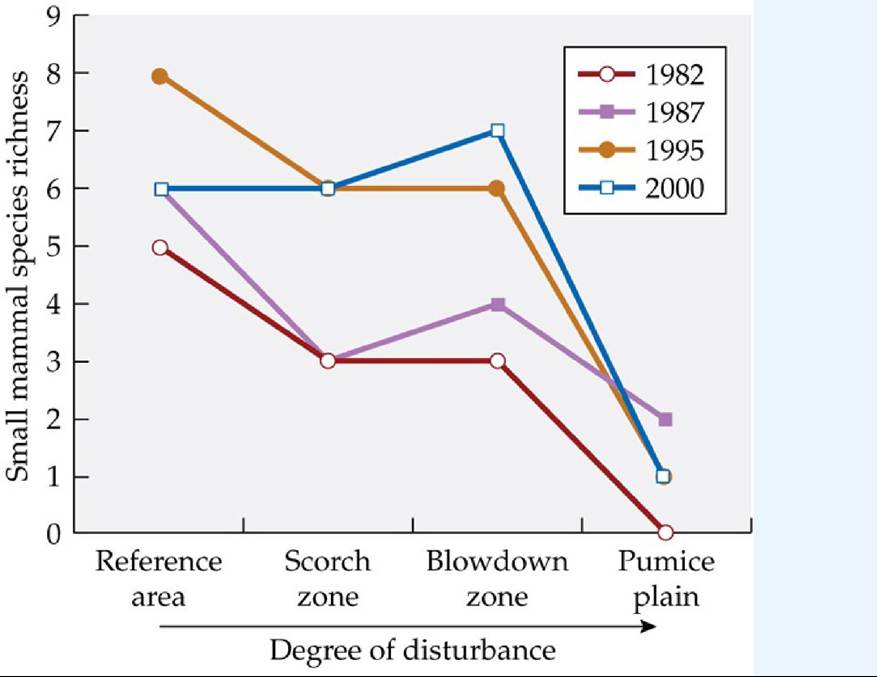
1. What happened to small mammal species richness over time and within the different successional habitats?
2. Did small mammals recover in all or some of the successional habitats, if you use the reference area as a standard for recovery? Describe what you think may have controlled recovery (or lack thereof).
3. The researchers recorded species composition of the small mammals they caught. They found that the deer mouse (Peromyscus maniculatus) was the only species present in all four communities. What does this suggest about the deer mouse and its role in succession?
4. The reference area, which served as a control for the small mammal surveys, increased in species richness over time. Give some plausible reasons for this increase.
LIST OF KEY TERMS
alternative stable states climax stage disturbance hysteresis pioneer stage primary succession secondary succession stability
Succession
More on the topic SUMMARY:
- CHAPTER SUMMARY
- Abel A.B., Bernanke B., Croushore D.. Macroeconomics. 10th Edition, Global Edition. — Pearson,2021. — 690 pp., 2021
- Consequences of Work-Life Conflict
- PREFACE TO THE SECOND ENGLISH EDITION
- Molecular Epidemiology of Bovine Tuberculosis in Uganda
- Mandate for Public Participation
- Oetzel John, Ting-Toomey Stella. The SAGE Handbook of Conflict Communication: Integrating Theory, Research and Practice. SAGE Publications,2013. — 912 p., 2013
- F The NHST Program: A Little of Both and a Lot of Shortcomings
- REVIEW OF FORENSIC ASSESSMENT INSTRUMENTS
- I PRACTICE MANAGEMENT ^20 ^110 ^140