Human Population Growth: A Case Study
Viewed from space, Earth appears as a beautiful ball of blue and white in a vast sea of black. If we use satellite images to explore the surface of this beautiful ball in more detail, we find clear signs of human impacts across the globe.
These signs range from the clear-cutting of forests, to the quilt-like patterns of agricultural fields, to the eerie red glow of fires burning out of control across the Amazon and other regions of the world (FIGURE 11.1).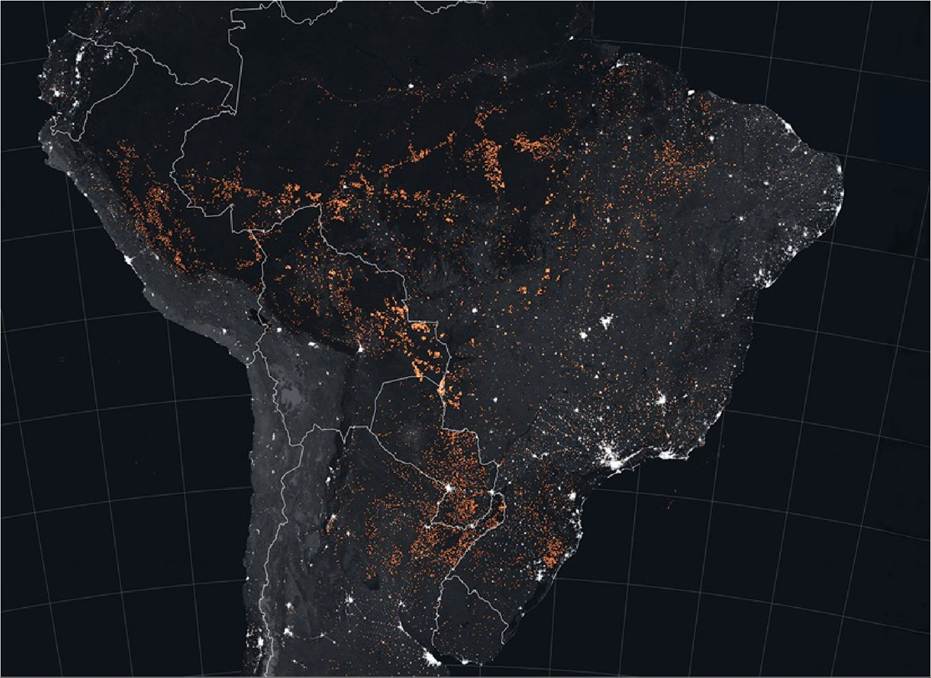
FIGURE 11.1 AmazononFire This late-night NASA satellite image of South America shows the vast area over which large, intense, and persistent fires are burning in this region of the world (red areas). Fire activity in the Amazon varies considerably from year to year, driven by changes in human activity and climate. The timing and location of fires in 2019 (when this photo was taken) suggest that they were associated with extensive land clearing that year rather than regional drought conditions. Courtesy of NASA Earth Observatory View larger image
People have a large effect on the global environment for two underlying reasons: our population has grown explosively, and so has our use of energy and resources. The human population crossed the 7.9 billion mark in 2022, more than double the 3 billion people alive in 1960 (FIGURE 11.2). Our use of energy and resources has grown even more rapidly. From 1860 to 1991, for example, the human population quadrupled in size, but our energy consumption increased 93fold.
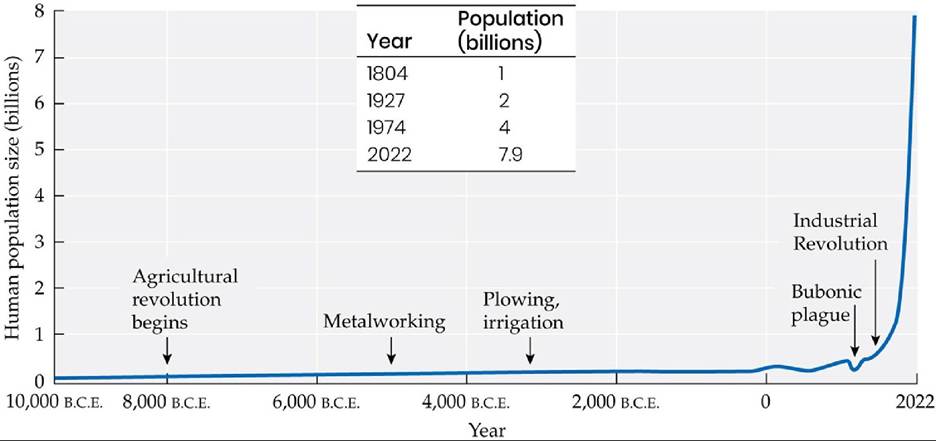
FIGURE 11.2 Explosive Growth of the Human Population The size of the human population increased relatively slowly until 1804, when the effects of the Industrial Revolution took hold. Since that time our population has increased in size to 7.9 billion people in 2022.
(Based on estimates by the History Database of the Global Environment [HYDE] and the United Nations.Visualization from (⅜1 OurWorldinData.org. CC BY-SA 4.0/Max Roser. Retrieved from https://ourworldindata.org/world-population-growth.) View larger image
The addition of nearly 5 billion people since 1960 is remarkable. For thousands of years, the size of our population increased relatively slowly, reaching 1 billion for the first time in 1804. The time we took to reach the 1 billion mark puts the current growth of our population in perspective: it took roughly 200,000 years (from the origin of our species to 1804) for the human population to reach its first billion, but now we are adding 1 billion people every 13 years. When did we switch from relatively slow to explosive increases in the size of our population?
No one knows for sure, given that it is difficult to estimate population sizes from long ago. According to the best information we have, by 1550 there were roughly 500 million people alive, and the population was doubling every 275 years. By the time we reached our first billion in 1804, the human population was growing at a very rapid rate: it doubled from 1 to 2 billion by 1927, in just 123 years. Forty-seven years later, it had doubled again, reaching 4 billion in 1974, at which time it was growing at an annual rate of nearly 2%. To appreciate what that means, a population with a 2% annual growth rate doubles in size every 35 years. If that rate of growth could be sustained, our population would almost double from 7.9 billion in 2022 to 14.9 billion in 2054 and would reach 31 billion by 2090.
What do you think the world would be like with 31 billion people? Already, with 7.9 billion people, we have transformed the planet. However, it is unlikely that there will be 31 billion people on Earth in 2090. Over the last 50 years, the rate of human population growth has slowed considerably, from a high of 2.2% per year in the early 1960s to the present rate of 1.0% annually. Even so, the current rate translates into a human population that is increasing by about 80 million people per year, more than 215,000 people each day. Five countries—India, China, Pakistan, Nigeria, and the United States—account for almost half of this annual increase.
If the current annual growth rate of 1.0% were maintained, there would be more than 14 billion people on Earth in 2080. Can Earth support 14 billion people? Will there be that many people in 2080? Or will annual growth rates continue to fall? We'll return to these questions in the Case Study Revisited.
More on the topic Human Population Growth: A Case Study:
- Can Species Diversity Suppress Human Diseases? A Case Study
- Some populations exhibit logistic growth, a pattern in which abundance increases rapidly at first and then stabilizes at a population size known as the carrying capacity, the maximum population size that canbe supported indefinitely by the environment
- In logistic growth, the population approaches an equilibrium
- The logistic equation models densitydependent population growth
- Can logistic growth predict the carrying capacity of the U.S. population?
- Patterns of Population Growth
- 11 Population Growth and Regulation
- Human capital and modern economic growth
- Investment behaviour in manufacturing companies in Indonesia: Study on leverage, company growth, and cash holding
- CONCEPT 11.3 The logistic equation incorporates limits to growth and shows how a population may stabilize at a maximum size, the carrying capacity.
- The First Farmers: A Case Study
- Developing company viability based on virtue and human potentials (Study on SME in West Java)
- Case Study: Darug Clan, Australia
- Case study
- The preservation of longleaf pine savanna at the Fort Bragg military base (described in the Case Study)