Introduction
Ecologists use population growth models to understand the ways in which populations change in abundance over time and what factors promote or limit population growth. What we learn from these models can surprise us.
We may find, for example, that current methods used to protect an endangered species are inadequate. Such was the case for loggerhead sea turtles, a rare species whose young often die as they crawl to the sea after hatching from nests dug in the sand (FIGURE 11.3). Efforts to protect loggerhead turtles initially focused on protecting newborns. However, researchers found, using population growth models, that even if newborn survival could be increased to 100%, loggerhead turtle populations would still continue to decline. Fortunately, the researchers were able to use their population growth model to inform management techniques that resulted in more effective ways of protecting loggerhead turtles (see Ecological Toolkit 11.1).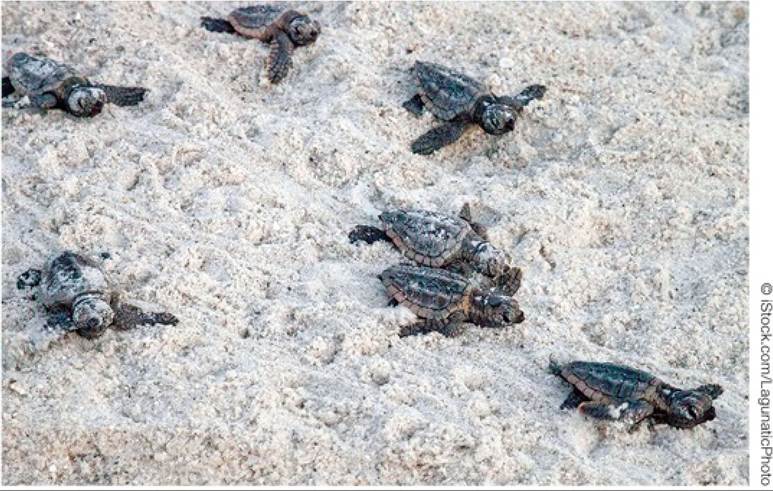
FIGURE 11.3 DashtotheSea These loggerhead sea turtle hatchlings have emerged from nests in the sand and must reach the sea to survive. On land, eggs and hatchlings face threats from predators, beach development, and artificial lighting (which can disrupt the hatchlings’ sense of direction, preventing them from reaching the sea). Loggerhead turtles also face threats in the marine environment from predators, commercial fisheries (turtles can be caught accidentally in nets and traps), collisions with boats, and pollution. View larger image
As we have seen in Chapters 9 and 10, populations can change in size as a result of four processes: birth, death, immigration, and emigration. We can summarize the effects of these four processes on population size with the following equation: 
where Nt is the population size at time t, B is the number of births, D is the number of deaths, I is the number of immigrants, and E is the number of emigrants between time t and time t + 1. As implied by this equation, populations are open and dynamic entities that can change from one time period to the next due to births and deaths. For simplification purposes, the population
growth models we consider here do not include immigration or emigration. Let's use this basic information about population change over time to consider two common observed patterns of population growth that were described in Chapter 10: exponential population growth and logistic population growth.
More on the topic Introduction:
- Introduction
- Introduction
- Introduction
- Introduction
- Theory and Practice
- Introduction
- III Timetable of important events and laws
- Hare C., Neo D. (eds.). Trade Finance: Technology, Innovation and Documentary Credit. Oxford University Press,2021. — 417 p., 2021
- AVIAN CHOLERA
- Easteal Patricia (ed.). Justice Connections. Cambridge Scholars Publishing,2014. — 322 p., 2014