Case Study: Darug Clan, Australia
In our second case study, we simulate the life of an Australian Aboriginal clan from the Darug tribe, living in the area of Parramatta, New South Wales, in times before the arrival of first fleet and the establishment of the European settlement.
This simulation was built in Unity 3D in the form of an educational video game and a virtual reality experience.The interactive 3D video game takes the player on a quest to explore the life of an Aboriginal clan in the Parramatta basin. A spiritual mentor and the guardian in the form of an aboriginal elder gradually introduces the participant to the daily life of native clans, the knowledge they possessed, rituals they performed, protocols they kept and their connection to dreamtime. The elder familiarises the player with various clan members as they perform their daily activities such as tool making, painting, fishing or preparing food. During these interactions the player also learns about the aboriginal medicine, arts, as well as ceremonies, such as the smoking ceremony and receives an introduction to their spiritual values.
The virtual reality simulation uses Oculus Rift (6) headset to take the user on an immersive journey in historical Australia. The information provided is the same as in the video game, yet the content is not interactive, and user partakes the role of a sole observer listening to the spiritual mentor. In the remainder of this section, we describe how we applied our methodology to deliver this historical simulation and discuss the believability of our approach.
14.5.1 Preparation: Designing the World
The initial step of the 3D simulation creation process was the artistic design of 3D assets that formed the simulation environment. This phase highly depended on the invaluable help from the Elders of the Darug clan, who consulted us on the believability of our simulation.
Elders selected the location of the simulation to correspond6https://www.oculus.com/ (last visited (06/2015)).
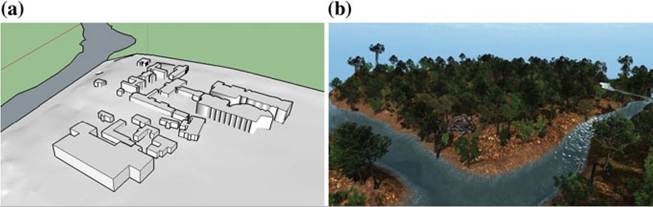
Fig. 14.17 Environment design. a Initial model (sketchup). b Final model (Unity)
with grounds, upon which the South Parramatta campus of the University of Western Sydney is located. The initial model of the environment was constructed from the GIS data using Google Sketchup[13] (see Fig. 14.17a). We have modified this initial model in Unity 3D and added local flora and fauna (see Fig. 14.17b). Then, we have implemented the animal behaviour (artificial intelligence), including the flocking behaviour of kangaroos, moving lizards and snakes, flying birds and bats and fish swimming in the river. While bats and lizards follow pre-defined paths, kangaroos show intelligence by fleeing from moving humans and placing bait in the water attracts fish. We implemented the animal behaviour using popular Unity 3D plugins: Playmaker[14] and NodeCanvas.[15] Use of these plugins facilitates the reusability of the developed functionality, and its visual nature helps the non-technical team members actively participate in its specification.
With the static 3D design of the environment in place, we apply our methodology to populate the simulation environment with autonomous agents.
14.5.2 Step 1: Design the Base Population
The population in this simulation consists of a single ethnic group. Therefore, we designed only two members of the base population to generate the rest. While both designed avatars carry typical aboriginal features, such as the wide nose or dark hair, we have also introduced variations of visual properties, such as skin colours or height. Maintaining consistent values (or just a minimal variation) of stereotypical features in all designed avatars, significantly increases the probability of their propagation to descendants, and their exclusion can only be affected by the mutation.
On the other hand, features that we wanted to vary, we assigned from both extremes of the feasible range. For example, we designed a strong and bulky male and thin and fragile female. Using the fuzzy operator to crossover genes, we obtain avatars with varied body and face builds (Fig. 14.18).Consequently, consulting aboriginal elders, historic literatures and photographies, we have designed traditional clothing, tools and wearables. Since aboriginal population in the simulated era wore clothing that often did not cover the private parts, in order to target wider audience in which some may be offended by nudity, we decided to use the design of more recent clothes. Figure 14.19 depicts the generated crowd
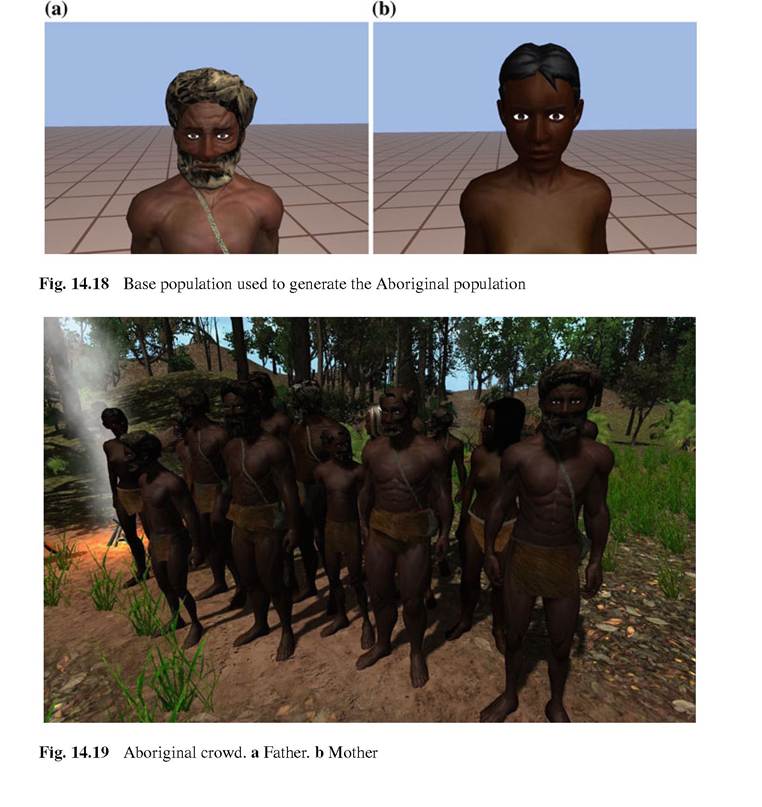
of males and females, wearing traditional hip or neck bags and variations of loin clothes from the kangaroo or possum fur. To assign random clothes to avatars, we have used the popular Unity Multi-Purpose Avatar (UMA) plugin.[16]
14.5.3 Step 2: Configure Motivational Modifiers and Step 3: Specify Personality Traits
Physiological motivation drives agents’ proactive goal creation. Motivational modifiers affect the pace in which they get hungry, thirsty or tired. Having varied values assures that agents take decisions at various intervals. Motivational modifiers and personality traits form the part of the chromosome that is used by the genetic reproduction. Since we used only two members of the base population, similarly to visual features, to gain variation in descendants, we have assigned motivational modifier values from both sides of feasible extremes. We created a male that was getting hungry at a high pace, needs to drink often, yet takes a long time to get tired. Female is humble on resources, yet fatigues quickly.
Concerning avatars personalities, we used the very same approach, providing significantly different OCEAN profiles for both avatars, with aggressive, yet timid male and submissive, yet social female.
14.5.4 Step 4: Formalise Social Norms and Roles
In this step, we defined components of the Electronic Institution. The dialogic framework contains roles of fisherman, spear-maker, hunter, tool-maker and gatherer (see Fig. 14.3b). All of these roles are sub-roles of person, which holds common properties for all roles, e.g. inventory of owned items.
Please note that this role hierarchy does not correspond to the actual tribe structure. In the real world, tribesmen perform various tasks, where individuals design their spears, create own tools and go hunting with them. This knowledge is incrementally passed onto by elders. We have separated the activities between various roles to isolate effectively agent behaviour and goals. Also, currently there exist only limited means for the dynamic plan creation with a large decision space. By dynamic plan creation we mean a possibility of agents to automatically generate and adapt plans that lead to the fulfilment of their goal (e.g. they do not need to re-start the whole plan, but continue from the last feasible point).
During the design of the Electronic Institution, we were able to re-use a large portion of scene protocols from the Uruk project (e.g. eating, gathering, fishing), supporting the usability of our approach. The reason we can reuse EI functionality is that protocols for action execution remained the same, what changed is their visualisation in the 3D environment. For example, in the fishing scene, one fisherman controls the boat while the other is using a spear to catch fish. The process is the same in Uruk as well as with Darug clan, but Darug fishermen no longer sit and stand in the boat, they kneel. Also, not a long paddle but a piece of bark is used to steer and row the boat. As a result, we only needed to record new animations for action execution, their control remained the same.
14.5.5 Step 5: Adaptation and Annotation of the
Environment
With the invaluable help from Aboriginal elders who performed as actors, we recorded authentic animations that portray daily chores and activities of the Darug tribesmen.
These activities include simple tasks such as eating, drinking, more sophisticated activities such as making tools, spears, creating artwork and also different rituals such as the smoke ceremony, dancing or feasting (Fig. 14.20). These animations trigger upon an agent acquiring a goal that requires accomplishing one or several actions. For example, to make an axe, agents need to find a viable piece of wood, stone or chipped bone. To facilitate this process, agents need to recognise objects and their functionality to consider them in their plans. Therefore, in this step, we placed annotated world objects with the representation understandable by agents. In this project, we have also introduced dynamic annotations that change depending on the object state. For example, alive kangaroo is annotated as “spearable”, “food source”, but when it is killed its annotation changes to “leather”, “bone”, “food”. Agents use these annotations to create plans for accomplishing their goals.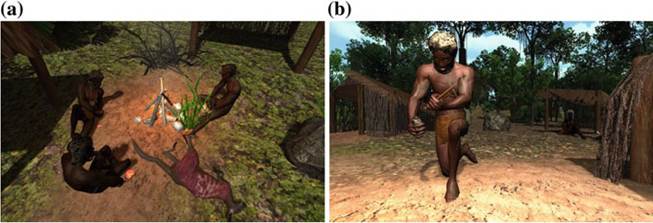
Fig. 14.20 Simulated activities. a Feasting. b Tool making
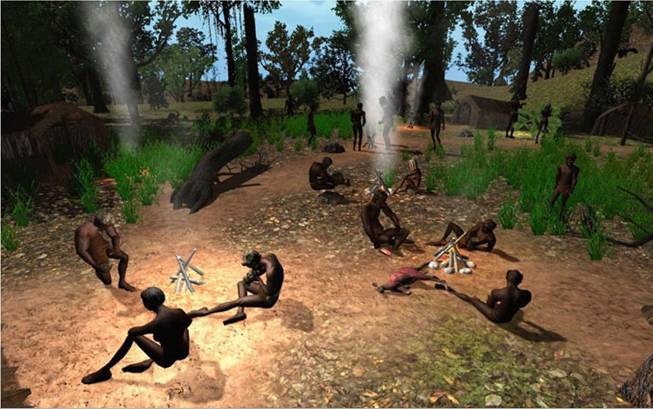
Fig. 14.21 Everyday life in the Darug clan
14.5.6 Step 6: Generating the Population
In the last step of our methodology, we generate the population of agents. Using our approach, the appearance, physiological and personality profile are unique with each generated agent.
For each created agent, a Playmaker script assigns a role and initialises the connection with the Electronic Institution. Agents start the random walk to discover their environment. After an arbitrary period, physiology triggers a feeding request. To feed, agents dynamically create plans based on their role, personality and surrounding objects. For example, the only way for spear-makers to feed is to exchange their produced spears for food with fishermen or hunters. In order to create a spear, they have to use knives, which serve them to work the spear-wood. Another role, Painters, first search for ochre, water and bark and then exchange their pieces with hunters and fishermen. Figure 14.21 shows a scene from the aboriginal simulation showing tool maker and painter at work, as well as men feasting on a kangaroo.
14.6
More on the topic Case Study: Darug Clan, Australia:
- The Mount Rennie Rape Case of 1886: Politics, Mercy and Justice in Late Nineteenth Century Australia
- Case study
- Case study contributors
- The First Farmers: A Case Study
- A Case Study of Solomon islands
- A Case Study of the Idu Mishmi
- “Killer Algae!”: A Case Study
- Enslaver Parasites: A Case Study
- A Sea in Trouble: A Case Study
- Nemo Grows Up: A Case Study
- Toolmaking Crows: A Case Study
- Frozen Frogs: A Case Study
- A Fragile Crust: A Case Study
- Case Study: Uruk 3000 B.C
- Snowshoe Hare Cycles: A Case Study
- Human Population Growth: A Case Study
- Infanticide in Lion Packs: A Case Study
- Toxins in Remote Places: A Case Study
- Can Birds and Bombs Coexist? A Case Study
- Wolves in the Yellowstone Landscape: A Case Study