Evaluation
In this section we analyse our results and estimate the effort (in hours) needed to setup and execute the simulations for both case studies. Then, we describe two experiments, that evaluate the diversity of generated agent behaviour.
14.6.1 Uruk Simulated in Second Life
We estimate that the total time spent on completing the case study from Sect. 14.4 was close to 7 days. The process was relatively fast as we have already had a model of the city and we focused only on generating the population. Step 1, definition of base population took us three days, where most of this time was spent on modelling clothing and attachments for avatars. Second Life provides parametric avatars with possibility to change more than 200 visual features. Therefore designing the body of the avatars took us only a couple hours per avatar. Steps 2 and 3, in our case took only one hour to complete, as the physiological modifiers and personality were defined only focusing on having wide range of values (rather than trying to achieve some predetermined global personality skew in the resulting population). Step 4, definition of institution took 1 day, during which we designed all scenes and a performative structure and tested agent interactions. Also, we studied how to set-up the personality facets of personality-based actions. Step 5 took a lot of effort and time, in total 4 days. During this time we recorded and tuned all the animations, designed all interactive objects (e.g. pot-making ring) and scripted their behaviour. Step 6 is fully automatic, generation of 100 agents took only a few seconds, visualisation of each avatar in Second Life takes about 30 s per avatar.
14.6.2 Everyday Life of the Darug People Simulated in Unity 3D
We estimate that the total time spent on completing the case study from Sect. 14.5 was close to 31 days. In contrast to the Uruk simulation, the Darug design has not been provided to use, so we needed to spend significantly more time on the initial design.
The increase in time is due to the fact, that we needed to re-create manually the 3D design of the terrain and houses in the reconstructed area (7 days) as well as all 3D objects (5 days) and avatar clothing (6 days). Three days were spent on recording animations. Converted animations had to be adjusted and programmed to be used with Unity (i.e. Mecanim). The conversion and animation adjustments took us 2 days. Then, we have annotated the environment with meta-data used by agents during reasoning about possible plans to accomplish their goals. In this case annotation is done directly in Unity 3D, via custom MonoBehaviour objects. With the help of the aboriginal elders we have then designed a simple institution, personality setups for the base population, their daily plans and related cultural information for the institutional roles. As a result it took us only 1 day, to adjust steps 2-6 to Unity 3D.14.6.3 General Methodology
Using our methodology, in combination with modern game engines and 3D virtual worlds, we significantly cut down the time to populate historical 3D simulations. The drawback of our approach is that we rely on parametric avatars with ability to modify the avatar appearance and clothing using declarative (visual) parameters. But, this is not a major issue, since we already possess the technology for Unity 3D and Second Life, and other game engines offer similar functionality, although in the form of paid plugins.
Having parametric avatars and employing our genetic approach we can generate unique, ethnic avatars in a very little time. Using motion capture, we can easily animate these avatars and believable results depend only on exact historical data and acting skills. Furthermore, using the Electronic Institution technology, we can declaratively specify the social structures and interaction protocols, used by agents to automatically reason about their possible actions. Electronic institution can be tweaked during the simulation runtime, decreasing the debugging efforts in comparison to traditional approach, where simulation has to be restarted after every change.
14.6.4 Generating Children of Parents with Diverse Personalities
To test the validity of generating agents with various behaviour, we performed two experiments. In the first experiment, we set-up diverse personalities of parents, where one parent had very low confidence, while the other was very aggressive (see Fig. 14.22a). When hungry, one parent chooses to beg, the other one to steal. Then, we have generated their 100 children, with father-mother ratio set to 30% (agents will have 70 % of their genes closer to their mother). Figure 14.22b depicts the highly varying personality profiles of their children. We let generated agents decide what to
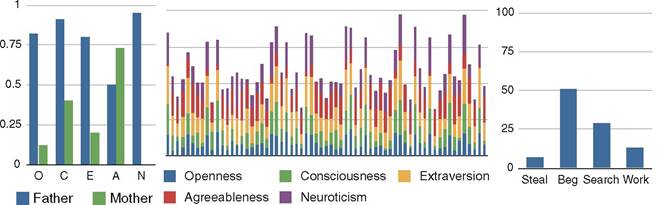
Fig. 14.22 Experiment 1: Children of parents with opposite personalities (no mutation). a Parents. b Children personalities. c Actions
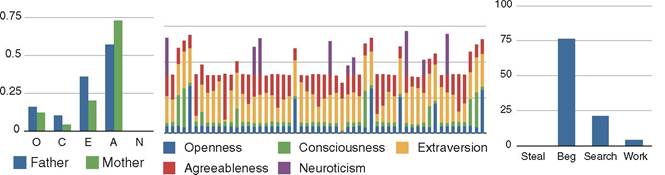
Fig. 14.23 Experiment 2: Children of parents with similar personalities (mutation 25 %). a Parents. b Children personalities. c Actions
do when hungry and observed emerging behaviour of searching for food and working in 40 % of generated children (see Fig. 14.22c). Only a few children decided to steal as the father-mother ratio was in favour of the mother.
14.6.5 Generating Children of Parents with Similar Personalities
In the second experiment we set-up father and mother with similar personalities (see Fig. 14.23a) and during generation applied a high level of mutation (25 %). We observed the children personalities and actions, depicted in Fig. 14.23b. Generated children had very similar personalities, with occasional exceptions, due to mutations. In this experiment father choses to search for food, while mother choses again to beg. Having the same father-mother ratio (30 %), most of children decide to beg, just like their mother (see Fig. 14.23c). Several mutated children decided to work.
The above experiments showed that having a base population with diverse personalities leads to generating children with diverse behaviour. Having parents with similar personalities results in their children having similar personalities and predominantly showing the same behaviour, unless they undergo mutation.
14.7
More on the topic Evaluation:
- Evaluation of a child presenting in the health care involves four key components, often referred with acronym HELP, i.e. History, Examination, Logical deduction and Plan of investigation. Present chapter outlines broad guidelines regarding history-taking, the first step in evaluation process.
- Functional Evaluation
- Particularities of Field Paratuberculosis Vaccination Evaluation
- LABORATORY EVALUATION OF GIT DISEASE
- Psychosocial Evaluation
- Nerve Biopsy Evaluation
- EVALUATION OF GENETIC DISORDERS
- CLINICAL EVALUATION IN NEUROLOGICAL DISEASE
- CLINICAL EVALUATION OF RESPIRATORY DISEASE
- CLINICAL EVALUATION OF GIT DISEASE
- Maintenance and Evaluation of the Marketing Plan
- Maintenance and Evaluation of the Marketing Plan
- Evaluation of the Patient With Renal Disease
- Evaluation
- Evaluation