Particularities of Field Paratuberculosis Vaccination Evaluation
Paratuberculosis is an infection that has been unchecked for at least a century throughout most of the world and therefore is widespread nowadays. Since it is also chronic and sub- clinical in the majority of cases, defining protection criteria for vaccine evaluation is not an easy task.
Therefore, as mentioned above, vaccine evaluation can be either summarized (Table 22.3) or focused on different variables according to the specific objective. In order to reduce direct paratuberculosis losses, studies canTable 22.3. Average protection conferred by paratuberculosis vaccines (Bastida and Juste, 2011).
| Reports | Animals | Protection | ||
| Cattle | Killed | 26 | 81,808 | 82.4 |
| Live | 17 | 247,093 | 95.7 | |
| All | 43 | 328,901 | 92.4 | |
| Sheep | Killed | 24 | 38,827 | 89.9 |
| Live | 22 | 13,629 | 55.0 | |
| All | 46 | 52,456 | 80.9 | |
| Goats | Killed | 15 | 1847 | 76.2 |
| Live | 5 | 15,539 | 63.7 | |
| All | 20 | 17,386 | 65.0 | |
| Overall | 109 | 398,743 | 89.7 |
evaluate productive losses, specific and overall mortality, clinical incidence or pathological lesions.
For transmission prevention, microbiological variables such as tissue bacterial load or faecal shedding are the most appropriate. Even more important for paratuberculosis vaccine evaluation are two issues: (i) interference with widespread official tuberculosis eradication programmes, which is the main reason for its limited use in cattle as mentioned before; and (ii) the risk of self-inoculation by operators that could cause local inflammation due to oil adjuvants.22.5.1 Microbiological variables
Excretion of MAP in faeces is an objective parameter of vaccine effect. In this sense there are two related goals: (i) reduction of the number of shedding individual animals, and (ii) reduction of the amount of bacteria that accumulates in their tissues and can be spread in the environment. To detect MAP, isolation in pure culture has been the gold standard, although it is being increasingly replaced by the faster, cheaper and even more sensitive specific DNA amplification by polymerase chain reaction. It has been seen that, although a reduction in the number of shedders does not immediately occur, a decrease in the amount of bacteria in faeces is quickly and consistently observed (Argente, 1992; Reddacliff etal., 2006; Juste etal., 2009; Sweeney et al., 2009; Bannantine et al., 2014; Hines et al., 2014; Dhand et al., 2016). This bacterial load can also be determined in postmortem studies through the processing of tissue samples using microbiological techniques. This load is closely related to the type of lesion observed (Alonso-Hearnetal., 2012; Hines etal., 2014).
22.5.2 Pathological variables
Paratuberculosis vaccine effect is containment of the evolution of the lesion at resistance focal forms with low bacterial load. Therefore the analysis of the lesion type of the vaccinated animals in comparison with the others is another way to evaluate its effect (Juste et al., 1994; Juste and Perez, 2011).
22.5.3 Clinical and productive indices
Reduction of clinical cases and of negative effects on milk or meat production are the target variables for industrial use of a paratuberculosis vaccine. However, for the reasons above mentioned, this might be difficult to determine and therefore several indicators have been used.
In some studies changes in body condition scores or in the number of animals with diarrhoea have been assessed (Hagan, 1935; Doyle, 1959; Kalis et al., 2001; Stringer et al., 2013). In dairy cattle, field studies have compared milk production before and after establishing a paratuberculosis control programme through vaccination. Although factors other than vaccination could affect the time evolution of the infection in a herd, some studies conclude that there are increases in milk production (Juste et al., 2009), as well as an improvement in the general state of health of the farm. As a consequence of this, some authors value the productive lifespan of vaccinated animals compared with unvaccinated animals (Alonso-Hearn et al., 2012; Perez de Val et al., 2012).22.5.4 Vaccination versus testing and culling
Although vaccine protection is not 100%, a reasonable estimate based on the literature reviewed
above can provide an estimated protective efficacy of 89%. Using a simulation model (Juste and Casal, 1993) on a herd of 1000 individuals with a 10% infection and 25% replacement rate, this protection will drive infection to disappearance in 7 years. The simulation allows us to estimate that protection rate is not so critical above 60% and that infection will not disappear faster with a 100% protection rate, nor much slower with any protection above 60%. This must be contrasted with the alternative strategy of testing and culling that, with the highest sensitivity of any diagnostic test being about 50%, can only eliminate infection in 19 years. Only with a sensitivity of 100% is it possible to reduce this time to eradication to a period shorter than with vaccination. The difference is that at a cost of €10 per test per animal per year and €15 per vaccination per animal once in its lifetime, the accumulated cost-benefit ratio at 20 years is 2.72 and 9.3, respectively (Fig. 22.1). Vaccination thus appears to be a sustainable approach to paratuberculosis control that can be much easier to accept both by farmers (Doyle, 1964) and the general population since it preserves life instead of destroying it through culling.
The model also indicates that any protection above 50% will eliminate infection faster than testing and culling with a test with a sensitivity below 50%. These results even seem to be improved in real field conditions as has been recently shown in a long-term vaccine field trial where vaccination eliminated shedding after 6 years while testing and culling took 8 years (Garrido et al., 2018).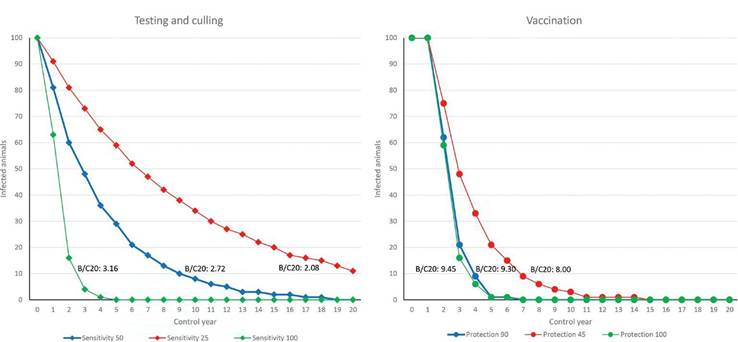
Fig. 22.1. Comparison of number of infected animals evolution according to test and vaccine performance (Juste and Casal, 1993). Notice that changes in sensitivity strongly affect time to eradication, while changes in protection have small effect.
22.5.3 Interference with bovine tuberculosis diagnosis
One of the reasons why vaccination against paratuberculosis in cattle has been strongly limited is the interference with the immune techniques used in bovine tuberculosis eradication programmes, which have the highest priority because of the zoonotic nature of tuberculosis. However the problem can be easily fixed using either better interpretation algorithms or more specific antigens (Stabel et al., 2011; Perez de Val et al., 2012; Garrido et al., 2013; Hines et al., 2014; Roy et al., 2017; Serrano et al., 2017).
22.5.4 Non-specific effects (NSE)
There is controversy regarding the NSE of vaccines, and in particular of BCG in humans (Wenner Moye, 2019). There are observations on field results that indicate that early administration of vaccines reduces overall child mortality (Timmermann et al., 2015; Aaby et al., 2017; Jenum et al., 2018; Welaga et al., 2018; Wenner Moye, 2019). This effect appears to be related to the so-called trained innate immunity (Kleinnijenhuis et al., 2015; Gyssens and Netea, 2019), which could respond to primitive mechanisms such as an increase in macrophage lytic capacity (Juste et al., 2016b; Pooley et al., 2018). That seems to be confirmed in field conditions as there is about 36% of overall mortality reduction in vaccinated herds vs testing and culling that corresponds to animals younger than 2 years (Juste et al., 2016a); that is, before the accepted paratuberculosis clinical onset age.
22.6
More on the topic Particularities of Field Paratuberculosis Vaccination Evaluation:
- General Considerations and Paratuberculosis Vaccination History
- Paratuberculosis Vaccines and Vaccination
- Vaccination
- Evaluation of a child presenting in the health care involves four key components, often referred with acronym HELP, i.e. History, Examination, Logical deduction and Plan of investigation. Present chapter outlines broad guidelines regarding history-taking, the first step in evaluation process.
- Field studies of competition
- Approaches and the state of the field
- Paratuberculosis in Camelids and Other Ruminants
- Introduction: Prevalence of Paratuberculosis in Cattle
- Field’s Theory
- THE GALACTIC FIELD OF TAMASAND ITS TWENTY-THREE EVOLUTES