Learning Objectives
11.2.1 Define density-independent factors and describe how they affect population size and growth rate.
11.2.2 Define density-dependent factors and describe how they affect population size and growth rate.
Although populations can show exponential growth under favorable conditions, conditions in nature are rarely favorable for long. For example, Damman and Cain (1998) calculated the geometric growth rate (λ) in each of 5 years for a population of A. canadense located in a young forest. As mentioned above, the maximum growth rate was λ = 1.01. During the other 4 years, however, values for λ ranged from 0.77 to 0.96 (see Figure 11.6). Thus, far from threatening to overrun the planet with its offspring, we would expect this population to decline in the long run, unless conditions changed for the better λ.
What factors change population sizes and growth rates over time? One set of factors are referred to as density-independent factors, meaning that their effects on population size (N) or population growth rate (λ or r) are independent of the number of individuals in the population (FIGURE 11.7A). The other set of factors are known as density-dependent factors because their effects on population size or population growth rate are dependent on the number of individuals in the population (FIGURE 11.7B). Let's discuss densityindependent factors first.
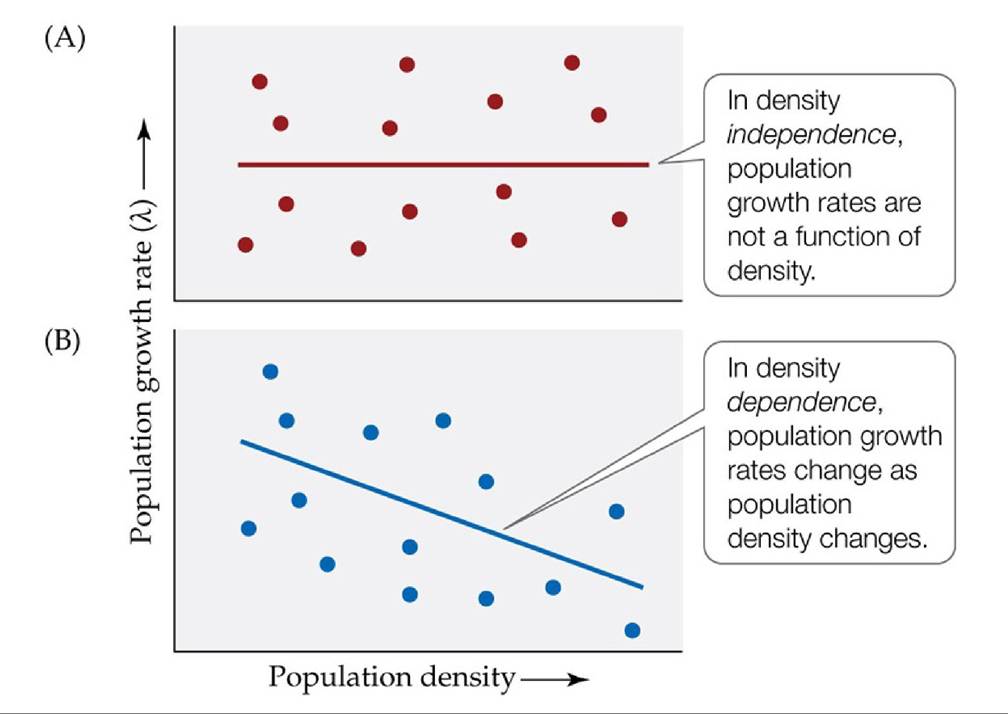
FIGURE 11.7 Comparing Density Independence and Density Dependence Each point represents one population. (A) Density independence. (B) Density dependence. In this example, population growth rates decrease as population density increases. View larger image