Fluctuations in population size can increase the risk of extinction
Imagine a population that is increasing over time. If the population size fluctuates very little over time, then in most years the population will continue to increase in size. Under these circumstances, the population will face little or no risk of extinction.
However, random variation in environmental conditions could cause the population size to change considerably from year to year. What are the implications of such fluctuations?To show what happens when population size fluctuates, computer simulations were performed for three populations that were allowed to fluctuate at random. Examining the results in FIGURE 10.11, we see that two of the populations recovered from low numbers, but one went extinct. These results support what common sense tells us: fluctuations increase the risk of extinction. In part, this occurs because, for a given average population size, a population that fluctuates in size grows slower than one that does not vary and thus either takes longer to recover or may not recover at all. The take-home message is that when variable environmental conditions increase the extent to which a population's growth rate fluctuates over time, the risk of extinction also increases. This effect, however, is dependent on the size of the population: small populations are at particular risk.
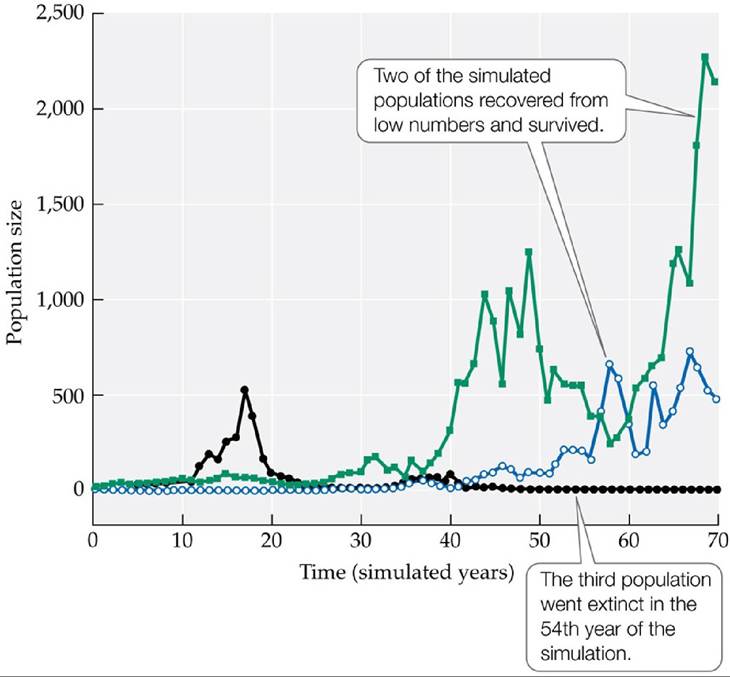
FIGURE 10.11 Fluctuations Can Drive Small Populations Extinct Simulatedgrowthof three populations in which the population growth rate varied at random from year to year. This variation over time was intended to simulate random variation in environmental conditions. Each simulated population began with 10 individuals but ended with variable population sizes, including one population that went extinct. View larger image