Life histories can be classified independent of size and time
Unlike the classification schemes discussed above, an approach described by Charnov (1993) organizes life histories in a manner that removes the influence of size and time. As we saw in our discussion of the r-K continuum, size and time play a critical role in traditional classifications of life histories.
For example, r-selected species are characterized as smaller and more short-lived than K-selected species. But if we could control for the effects of body size and life span, then we could ask whether closely related organisms experience similar selection pressures independent of those factors.To illustrate this approach, we'll begin with the observation that the age of sexual maturity is positively correlated with life span in many species (Charnov and Berrigan 1990). Such a correlation is not surprising. Species with short life spans must mature in short periods, but the same is not true of species with long life spans, and as a result a positive correlation can arise automatically. One way to remove this effect of life span is to divide the average age of maturity of a species by its average life span. This division yields a dimensionless ratio—that is, a ratio in which the units in the numerator (e.g., age of maturity in years) are identical to and hence cancel the units in the denominator (e.g., life span, also in years).
By removing the effects of variables such as size or (in our case) time, a dimensionless ratio allows ecologists to compare the life histories of very different organisms. Charnov and Berrigan compiled data for a wide range of bird, mammal, lizard, and fish species. To remove the effects of life span, they focused their analyses on the age of maturity: life span dimensionless ratio, which they denoted c (FIGURE 7.23). Their analysis revealed that c differed between ectothermic (fishes, lizards, and snakes) and endothermic (mammals and birds) organisms.
For example, if we compare organisms with a given life span, the values of c indicate that it takes fishes three to six times longer to mature than mammals and birds, while it takes lizards and snakes two to four times longer. Such results can highlight major differences in the life histories of different groups of organisms, thus helping to make sense of life history variation.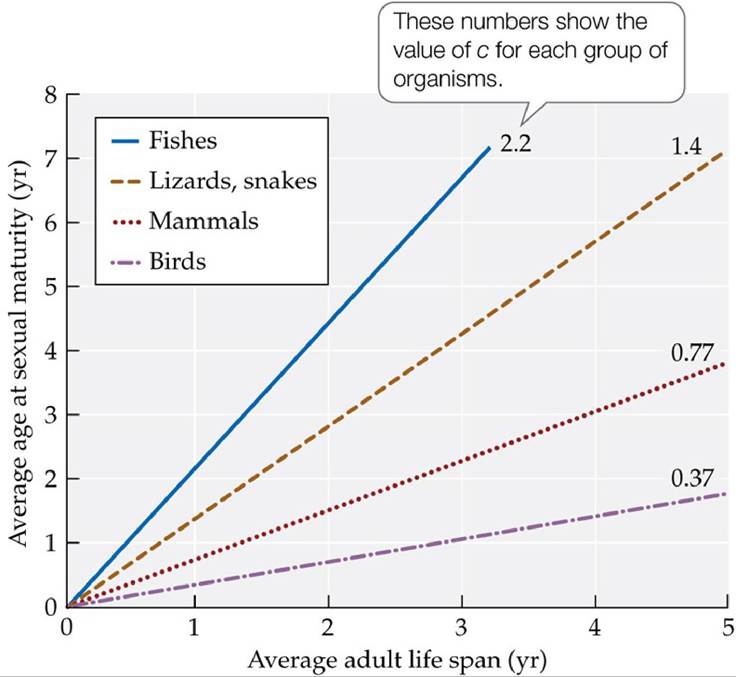
FIGURE 7.23 ADimensionlessLifeHistoryAnalysis Theaverageageatwhichfemales reach sexual maturity is plotted against the average female life span for different groups of organisms. The slope of each line yields the dimensionless ratio c: the average age of maturity
divided by the average life span.
In groups of organisms for which c > 1, do most individuals live long enough to reproduce? Explain.
(After E. L. Charnov and D. Berrigan. 1990. Evol Ecol 4: 273-275.) View larger image
While this dimensionless approach has some advantages over classification schemes that incorporate time and size, it also has potential disadvantages. Indeed, an emphasis on constant or “invariant” dimensionless life history parameters has been questioned by Nee et al. (2005), who argue that life history parameters can appear to be invariant simply as an artifact of the mathematical methods used to estimate them. Overall, there are many ways to organize the vast diversity of life history strategies. The classification scheme that is most useful in any given case will depend on the organisms and questions of interest. For example, the r-K continuum has a long history of use in relating life history characteristics to population growth characteristics, whereas Grime's scheme may be most appropriate for life history comparisons between groups of plants. Alternatively, dimensionless analyses may be most helpful when comparing life histories across broad ranges of taxonomy or size.
A Case Study Revisited
Nemo Grows Up
Why does a male clownfish that has lost his mate become a female rather than simply finding a new partner? As we have seen, large individuals often produce more offspring than do smaller individuals.
In clownfish, the number of eggs an individual can produce is proportional to its body size. Thus, larger individuals can produce more eggs and presumably have a better chance of having some of their offspring survive. Smaller individuals are more easily able to make sperm cells, which are smaller and take fewer resources to produce. For these reasons, in clownfish and in many other animals, females are larger than males.Changes in sex during the course of the life cycle, called Sequentialhermaphroditism, are found in 18 fish families and in many invertebrate groups (FIGURE 7.24). Researchers have hypothesized that these sex changes should be timed to take advantage of the maximum reproductive potentials of the different sexes at different sizes, and in some cases they appear to do so. This hypothesis helps to explain sex changes in clownfish and the timing of those changes relative to size, but it leaves unanswered the question of how a hierarchy of clownfish is maintained within each anemone.
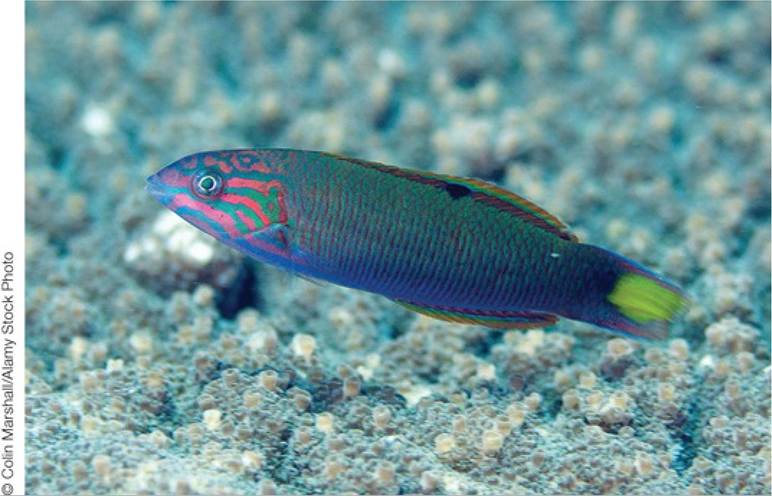
FIGURE 7.24 SequentialHermaphroditism The moon wrasse (Thalassomalunare) exhibits sequential hermaphroditism. Wrasses live among coral reefs in tropical and temperate seas. In some species, a change in sex, from female to male, may be accompanied by a change in color. View larger image
As a graduate student at Cornell University, Peter Buston set out to answer this question. He conducted experiments on a clownfish species, Amphiprion percula, that lives on reefs in Papua New Guinea. He found that each clownfish maintains the strict size hierarchy by remaining smaller than the fish ahead of it in line and bigger than the one behind it (FIGURE 7.25). If a fish grows to be too close in size to one of its anemone-mates, a fight results, which usually ends in the smaller fish being killed or expelled from the anemone. Buston suggested that the clownfish regulate their own growth to prevent such conflicts.
208" class="lazyload" data-src="/files/uch_group80/uch_pgroup312/uch_uch7303/image/image207.jpg">
FIGURE 7.25 Clownfish Size Hierarchies Clownfish within an anemone regulate their growth to maintain a hierarchy in which each fish belongs to a distinct size class. Anemones may be home to between one and six fish, and the size of each fish is
determined by that fish's rank and the size of the group in which it lives. (After P. M. Buston. 2003a. Nature 424: 145-146.) View larger image
Buston also manipulated clownfish groups by removing the breeding males from anemones and measuring the growth of the remaining individuals. He found that the largest nonbreeder grew only enough to take the place of the breeding male; it avoided growing too big and threatening the female's dominance. Similarly, the next largest nonbreeder grew only enough to take the place of the fish that had become the breeding male, and so on. Thus, clownfish avoid conflict within their social groups by exerting remarkable control over their growth rates and reproductive status.
Connections in Nature
Territoriality, Competition, and Life History
The physiology of clownfish growth regulation is not understood, but a more pressing ecological and evolutionary question is why the size hierarchy is maintained. What makes small clownfish bide their time as nonbreeders under the dominance of a single breeding female and male? The answer may lie in the clownfish's dependence on the protection of anemones for survival.
Clownfish are brightly colored, and they are poor swimmers. Outside the anemone's stinging tentacles, they are easy prey for larger fishes on the reef. Thus, expulsion from the anemone is often a death sentence. So the stakes are very high in conflicts between fish within an anemone: the loser will probably die without reproducing. This situation exerts strong selection pressure on the fish to avoid conflicts by regulating their growth. In evolutionary terms, growth regulation mechanisms have evolved because individuals that avoid growing to a size that leads to conflict with other fish have higher survival and reproductive rates (we described this process of adaptive evolution in Concept 6.2).
Buston (2003b, 2004) demonstrated that remaining in an anemone as a nonbreeder is more advantageous than trying to leave the anemone and find a new one. Anemones are a limited resource for the clownfish, and those that bide their time once they find an anemone experience the highest lifetime fitness.The scarcity of anemones also results in competition among clownfish at a key stage in their life history. As we have seen, hatchling clownfish disperse from their anemone and spend their early life stages in the open ocean. When they return to the reef, their survival depends on their choice of an anemone. The number of fish in an anemone is generally correlated with the anemone's size. However, Buston found that at any given time some anemones are undersaturated, meaning that they have room for more fish. If a juvenile fish is lucky enough to enter such an anemone, it is allowed to stay, and it enters the line of succession toward becoming a breeder. If the juvenile enters a saturated anemone, however, it is expelled, and it often dies before it can find another anemone. Similar settlement lotteries play out in many organisms that live in crowded habitats and compete for space. For example, in environments such as tropical rainforests, where many long-lived tree species compete for limited space and sunlight, the success of any one seed or seedling can depend on chance events, such as the death of a nearby large tree that creates a gap in the canopy (Denslow 1987). As we'll see in Concept 19.3, such settlement lotteries can play an important role in maintaining the diversity of
species found in highly competitive environments.
More on the topic Life histories can be classified independent of size and time:
- Life histories can be classified independent of size and time
- Individuals within species differ in their life histories
- Life tables can be based on age, size, or life cycle stage
- Maritime, Imperial and Postcolonial Histories
- Backdrop as foreground: environment and histories of imperialism
- Density-independent factors can determine population size
- Places: Histories of Colonisation
- Mode of reproduction is a basic life history trait
- THE ROLE OF INDIVIDUALS
- FIVE COMPONENTS OF LEGAL COMPETENCIES