Mode of reproduction is a basic life history trait
At the most basic level, evolutionary success is determined by successful reproduction. Despite this universal reality, organisms have evolved vastly different mechanisms for reproducing—from simple asexual splitting to complex mating rituals and intricate pollination systems.
Asexual Reproduction
The first organisms to evolve on Earth reproduced asexually by binary fission (parental cell divides to produce two cells). The sexual reproductive processes of meiosis, recombination, and fertilization arose later. Today, all prokaryotes and many protists reproduce asexually. While sexual reproduction is the norm in multicellular organisms, many can also reproduce asexually. For example, after they are initiated by a (sexually produced) founding polyp, coral colonies grow by asexual reproduction (FIGURE 7.7). Each individual polyp in a colony is produced when a multicellular bud splits off from a parent polyp to form a new polyp; as a result, each polyp is a genetically identical copy, or clone, of the founding polyp. Once the colony has grown to a certain size and conditions are right, the polyps reproduce sexually, producing offspring that develop into polyps that start their own new colonies of clones.
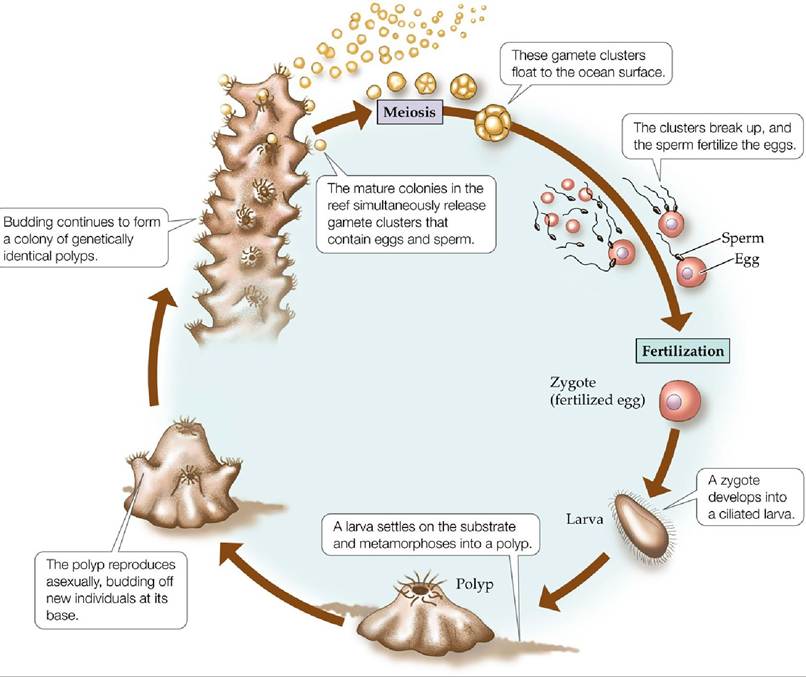
FIGURE 7.7 Life Cycle of a Coral Reef-forming coral colonies grow by asexual reproduction before producing eggs and sperm. The sexually produced offspring establish new colonies.
Would the larva shown in the diagram be genetically identical to the polyp to its left? Would two different larvae be genetically identical to each other? Explain.
View larger image
Sexual Reproduction and Anisogamy
Most plants and animals reproduce sexually, as do many fungi and protists. Some protists, such as the green alga Chlamydomonas reinhardtii (FIGURE 7.8A), have two different mating types, analogous to males and females except that their gametes are the same size.
The production of equal-sized gametes is called isogamy. In most multicellular organisms, however, the two types of gametes are different sizes, a condition called anisogamy. Typically, the eggs are much larger than the sperm and contain more cellular and nutritional provisions for the developing embryo. The sperm are small and may be motile (FIGURE 7.8B). As we'll see in Concept 8.3, differences between the sexes in gamete size can influence other reproductive characteristics, such as differences between the sexes in their mating behavior.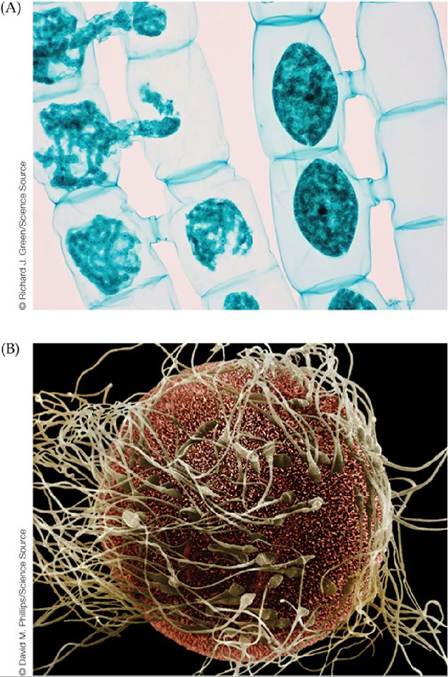
FIGURE 7.8 IsogamyandAnisogamy (A) An isogamous species: two gametes of the single-celled alga Spirogyra fusing. (B) An anisogamous species: fertilization of a human egg, showing the difference in size between egg and sperm. View larger image
Although sexual reproduction is widespread, it has some disadvantages. Because meiosis produces haploid gametes that contain half the genetic content of the parent, a sexually reproducing organism can transmit only half of its genetic material to each offspring, whereas asexual reproduction allows transmission of the entire genome. Another disadvantage of sex is that recombination and the independent distribution of chromosomes into gametes (during meiosis) can disrupt favorable gene combinations, potentially reducing offspring fitness. Finally, the growth rate of sexually reproducing populations is only half that of asexually reproducing ones, all else being equal (FIGURE 7.9).
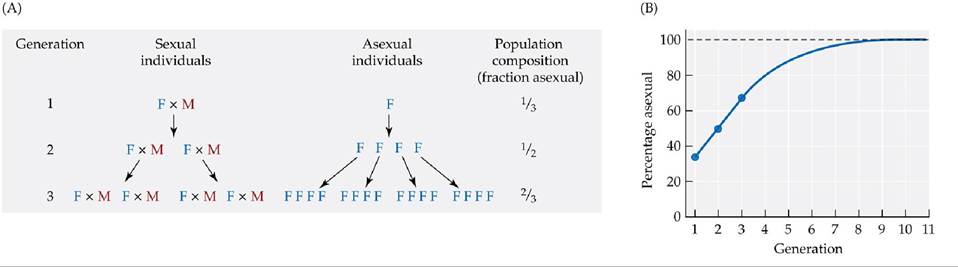
FIGURE 7.9 The Cost of Sex One cost of sex is referred to as the “cost of males.” Imagine a population in which there are both sexual and asexual individuals. Assume that each sexual or asexual female can produce four offspring per generation, but half of the offspring produced by the sexual females are male and must pair with females to produce offspring.
Under these conditions, the asexual individuals (A) will increase in number more rapidly and (B) in less than 10 generations will constitute nearly 100% of the population.In generation 2 there are four sexual and four asexual individuals. How many sexual and asexual individuals are there in generation 3? How many of each will there be in generation 4? Explain your results in terms of the cost of males.
View larger image
Given such disadvantages, why is sex so common? Sex has some clear benefits, including recombination, which promotes genetic variation and hence may increase the capacity of populations to evolve in response to environmental challenges such as drought or disease. In a test of this idea, Morran et al. (2011) examined the benefits of sex in the nematode worm Caenorhabditis elegans. Populations of C. elegans consist of males and hermaphrodites. The hermaphrodites can reproduce by self-fertilization (selfing) or by mating with males (outcrossing). In wild-type populations, outcrossing rates typically range from 1% to 30%. However, C. elegans can be manipulated genetically to form strains that always self-fertilize (“obligate selfers”) or never self-fertilize (“obligate outcrossers”). The offspring of obligate selfers are very similar genetically to their parents, whereas the offspring of obligate outcrossers are more variable genetically; thus, these strains are well suited for testing the idea that sex is beneficial because it promotes increased levels of genetic variation.
Morran et al. exposed some C. elegans populations to a lethal bacterial pathogen, Serratia marcescens. In wild-type populations exposed to this pathogen, the rate of outcrossing increased, rising from an initial 20% to more than 80% over the course of 30 generations (FIGURE 7.10A). Moreover, C. elegans populations containing only obligate selfers were always driven to extinction by the pathogen, whereas wild-type and obligate-outcrossing populations always persisted (FIGURE 7.10B).
Overall, these results support the hypothesis that the genetic variation generated by sexual reproduction is beneficial in a challenging environment. McDonald et al. (2016) obtained similar results in yeast, and showed that sex provided benefits by increasing the fixation of advantageous mutations while decreasing the fixation of deleterious mutations.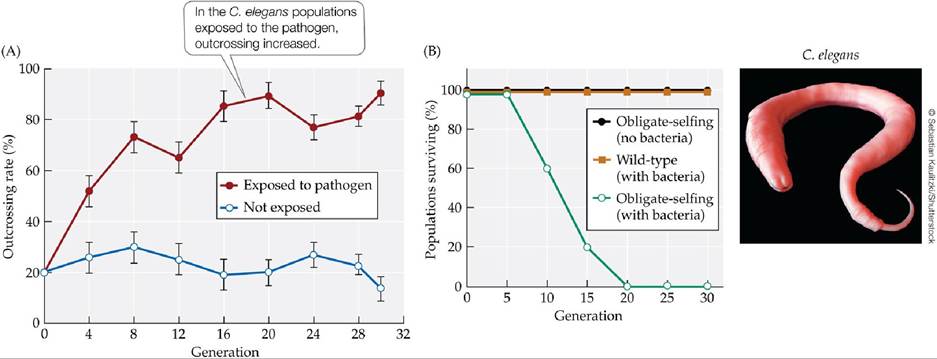
FIGURE 7.10 Benefits of Sex in a Challenging Environment (A)Outcrossingrateswere measured over time in wild-type populations of the nematode worm Caenorhabditis elegans. Some C. elegans populations were exposed to the bacterial pathogen Serratia marcescens, while others were not. Error bars show ± one standard error of the mean. (B) Percentage of replicate wild-type and obligate-selfing C. elegans populations surviving under different treatments.
In (A), which curve shows results for the control populations? Explain your choice and interpret the results shown by the two curves.
(After L. T. Morran et al. 2011. Science 333: 216-218.) View larger image