Life cycles are often complex
The small, early stages of many animal life cycles look and behave completely differently from adult stages. They frequently eat different foods and prefer different habitats. For example, coral reef fishes such as the damselfish Chromis Qtripectoralis start life as hatchlings only a few millimeters long.
The hatchlings live and grow in the open ocean, feeding on planktonic algae. When they have grown to about a centimeter in length, they return to the reef and begin to eat larger food items. This life cycle may have evolved in response to high levels of predation on young fish that stay on the reef; young fish that spend more time growing in the open ocean may have better chances of survival. Complex life cycles can also lower competition between individuals of the same species, since species at different ages use of different resources.As corals (see Figure 7.7) and coral reef fishes both demonstrate, life cycles can involve stages that have different body forms or live in different habitats. A complex life cycle is one in which there are at least two distinct stages that differ in their habitat, physiology, or morphology. In many cases, the transitions between stages in complex life cycles are abrupt. For example, many organisms undergo metamorphosis, an abrupt transition in form from the larval to the juvenile stage that is sometimes accompanied by a change in habitat (exemplified by the frogs in Figure 7.3). As we will see in Concept 7.4, complex life cycles and metamorphosis often result when offspring and parents are subjected to very different selection pressures.
Because most vertebrates have simple life cycles that lack an abrupt transition between habitats or forms, we humans tend to think of metamorphosis as an exotic and strange process. However, complex life cycles and metamorphosis can be found even among vertebrates, including some fishes and most amphibians.
Most marine invertebrates produce microscopic larvae that swim in the open ocean before settling to the bottom at metamorphosis. Many insects also undergo metamorphosis—from caterpillars to moths, grubs to beetles, maggots to flies, and aquatic larvae to dragonflies and mayflies. In fact, Werner (1988) calculated that of the 33 phyla of animals recognized at that time, 25 contained at least some subgroups that have complex life cycles. He also noted that about 80% of all animal species undergo metamorphosis at some time in their life cycle (FIGURE 7.11).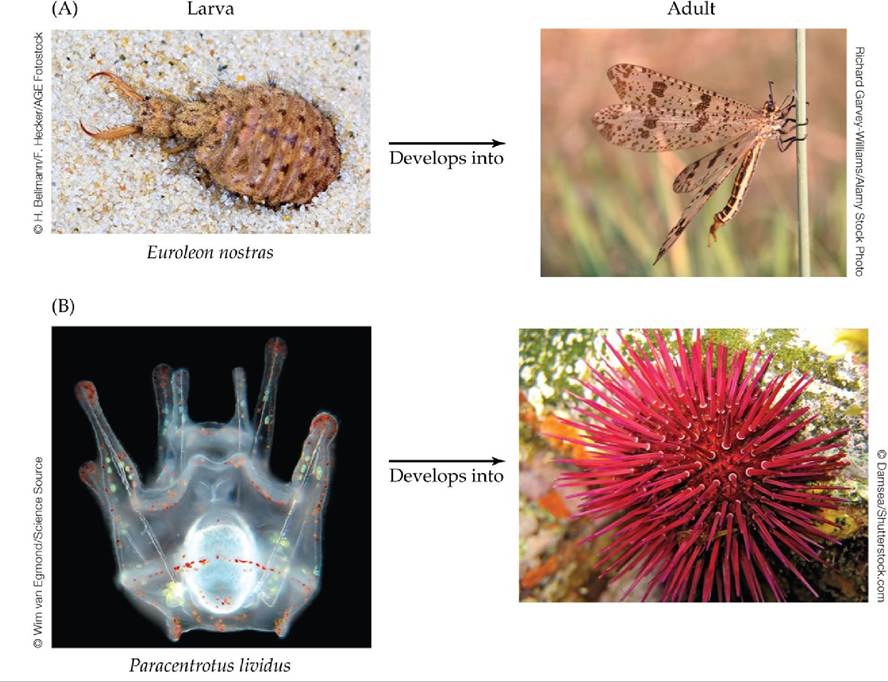
FIGURE 7.11 The Pervasiveness of Complex Life Cycles Mostgroupsofanimalsinclude members that undergo metamorphosis. (A) Familiar examples are insects such as the antlion, which develops from a larva that lives in soil. (B) Most marine invertebrates have free-swimming larval stages, including echinoderms such as sea urchins. View larger image
Complex life cycles occur in many types of algae and plants, reaching some of their most elaborate forms in these groups. Some algae and all plants have complex life cycles in which a multicellular diploid sporophyte alternates with a multicellular haploid gametophyte. The sporophyte produces haploid spores that disperse and grow into gametophytes, and the gametophyte produces haploid gametes that combine in fertilization to form zygotes that grow into sporophytes. This type of life cycle, called alternation of generations, has been elaborated on in different plant and algal groups. In mosses and a few other plant groups, the gametophyte is larger, but in most plants and some algae, the sporophyte is the dominant stage of the life cycle.
Over the course of evolution, complex life cycles have been lost in some species that are members of groups in which such cycles are considered the ancestral condition. The resulting simple life cycles are sometimes referred to as direct development because development from fertilized egg to juvenile occurs within the egg prior to hatching and no free-living larval stage occurs. For example, most species in one group of salamanders, the plethodontids, lack the gilled aquatic larval stage that is typical of salamanders. Instead, they lay their eggs on land, where they hatch directly into small terrestrial juveniles.
As we've seen, organisms vary greatly in key aspects of their life history strategies, such as when they reproduce, how many offspring they produce, and how much care is allotted to each offspring. How can we organize these diverse patterns into a coherent scheme?
More on the topic Life cycles are often complex:
- Complex cycles may result from stagespecific selection pressures
- Simulating Economic, Social and Cultural Change in Prehistory. Why Humans Have Made Life so Complex and Difficult
- Why Humans Have Made Life Even More Complex and Difficult. The Making of the State and the Origins of Class Struggle
- Some species exhibit population cycles
- Life tables can be based on age, size, or life cycle stage
- Parasites can influence host population cycles
- Geochemical cycles in the Biosphere
- THE RITUAL CYCLES
- Various Cycles of Environment
- Predator-prey cycles can be modeled mathematically
- Predator-prey cycles can persist in the field
- Historical Cycles of the Twentieth Century and the Issue of Violence
- Birth is a water-shed event in human life, necessitating various physiological changes to adapt from intrauterine to extrauterine life.