Some species exhibit population cycles
The fourth pattern of population growth is population cycles, in which alternating periods of high and low abundance occur after constant (or nearly constant) intervals of time. Such regular cycles have been observed in populations of small rodents such as lemmings and voles, whose abundances typically reach a peak every 3 to 5 years (FIGURE 10.10).
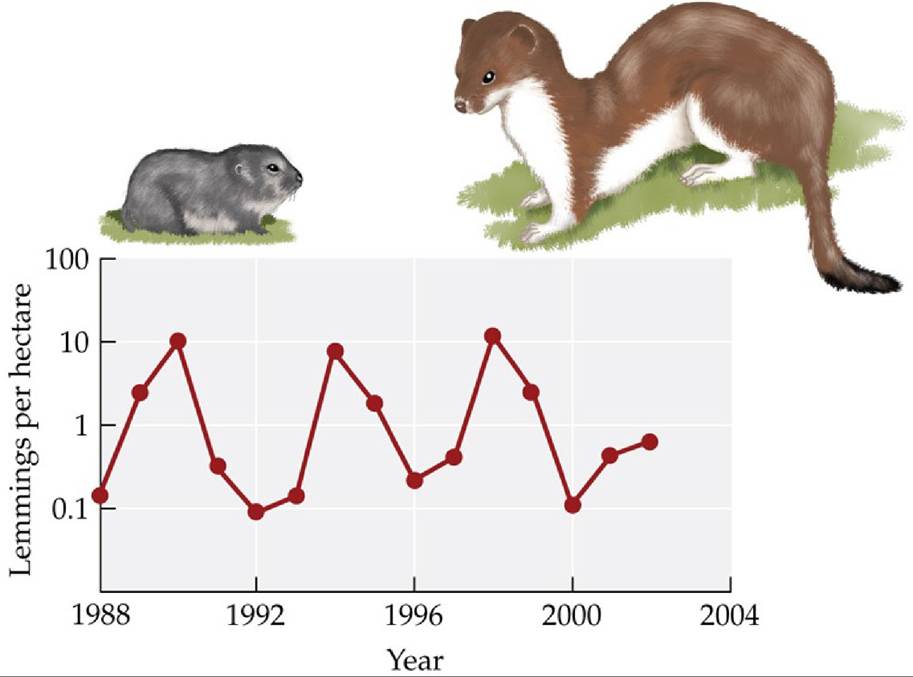
FIGURE 10.10 A Population Cycle In northern Greenland, collared lemming (Dicrostonyx groenlandicus, left) abundance tends to rise and fall every 4 years. In this location, the population cycle appears to be driven by predators, the most important of which is the stoat (Mustela
erminea, right). In other regions, lemming population cycles may be driven by food supply. Based on data from 1988 through 2000, how many lemmings per hectare would you have expected there to be in 2002? Explain your reasoning. (After O. Gilg et al. 2003. Science 302: 5646.) View larger image
Population cycles are among the most intriguing patterns observed in nature. After all, what factors can cause numbers to fluctuate greatly over time, yet maintain a high degree of regularity? Possible answers to this question include both internal factors, such as hormonal or behavioral changes in response to crowding, and external factors, such as weather, food supplies, or predators. Gilg et al. (2003) used a combination of field observations and mathematical models to argue that the 4-year cycle of collared lemming (Dicrostonyx groenlandicus) abundance in Greenland is driven by predators, one of which, the stoat, specializes on eating lemmings (see Figure 10.10). Other investigators have suggested that cycles of the Norwegian lemming (Lemmus lemmus) are caused by interactions between lemmings and their food plants. Similarly, a number of studies (e.g., Korpimaki and Norrdahl 1998) have implicated predators as the driving force behind cycles of field voles in Scandinavia, but Graham and Lambin (2002), in a large-scale field experiment, showed that predator removal had no effect on field vole cycles in England.
One mechanism that may be important to population cycles is delayed density dependence. Delayed density dependence occurs when the number of individuals born in a given time period is influenced by the population densities or other conditions that were present several time periods ago. Consider a population of predators that reproduce more slowly than their prey. If there are few predators initially, the prey population may increase rapidly in size. As a result, the predator population may also increase, reaching a point at which there are many adult predators that survive well and produce a large number of offspring. However, if the resulting large population of predators eats so many prey that the prey population decreases sharply in size, there may be few prey available for the next generation of predators. In such a case, a mismatch in predator and prey numbers (high predator numbers, low prey numbers) occurs because there is a time lag in the response of predator numbers to prey numbers. When such a mismatch takes place, the predators may survive or reproduce poorly and their numbers may drop. If prey numbers then increase (because there are now fewer predators), predator numbers may first rebound, then fall again because of the built-in time lag. Thus, in principle at least, it seems reasonable that a delay in the response of predators to prey density could cause predator numbers to fluctuate over time. You can explore how delayed density dependence can affect the population cycling in sheep blowfly (Lucilia cuprina) in ANALYZING DATA 10.1.
Z
ANALYZING DATA 10.1
Does delayed density dependence produce cycles in blowfly populations?
In the 1950s, A. J. Nicholson (1957)* performed a series of pioneering laboratory experiments on delayed density dependence in the sheep blowfly Lucilia cuprina, an important agricultural pest of sheep. Before they can lay eggs, the females of this species need a protein meal. Once they have fed, the females attack living sheep by laying their eggs near the tail or near open wounds.
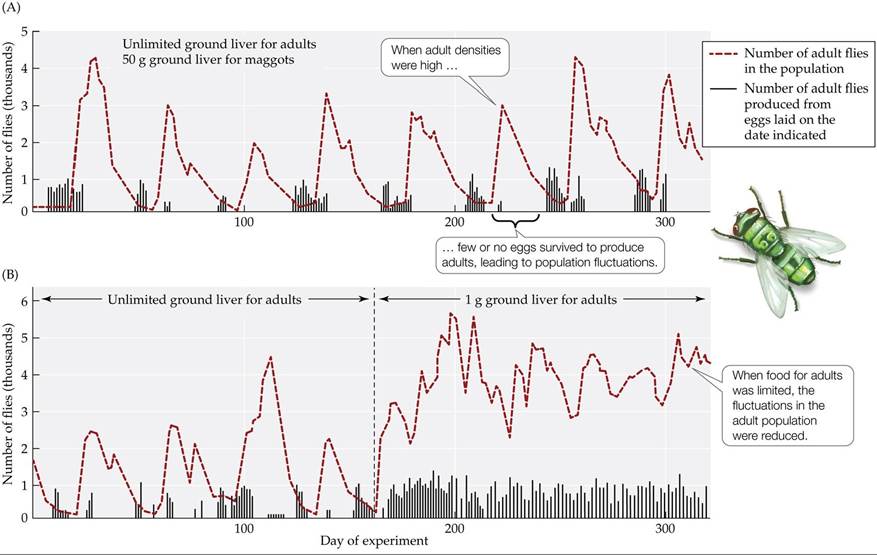
Small white maggots hatch from those eggs and feed on dung attached to the skin or on exposed flesh. Eventually the maggots metamorphosize into adult flies. The sheep blowfly's full life cycle can be completed in as little as 7 days.In the first of the two experiments, Nicholson tested for delayed density dependence by providing adult blowflies with unlimited food
(ground liver) but restricting maggots to 50 g of food per day. Because adults had abundant food, each female was able to lay many eggs but when those eggs hatched, the lack of food caused many of the maggots to die before they reached adulthood (FIGURE A). In a second experiment, Nicholson recreated the same experimental conditions as the first experiment until roughly halfway through the experiment (indicated by the dotted vertical line), when the food supply for adults was also limited (FIGURE B).
1. Based on the data, which of the four population growth patterns discussed under Concept 10.1 best characterizes the results shown in Figure A?
2. How does the pattern of population size change when food is limited for blowfly adults halfway through the second experiment (Figure B)?
3. Using data from the experiment, explain how delayed density dependence can cause populations to cycle.
4. Describe what you would expect to happen to the adult population of blowflies over time if both the adults and maggots were allowed to have unlimited food.
*Nicholson, A. J. 1957. The self-adjustment of populations to change. Cold Spring Harbor Symposia on Quantitative Biology 22: 153-173.
Climate Change Connection
Collapsing Population Cycles and Climate Change
Recent evidence suggests that population cycles may stop entirely if key environmental conditions change. For example, population cycles of lemmings (including the cycle shown in Figure 10.10), voles, and several insect herbivores have decreased in amplitude or ceased entirely in some high-latitude and high-elevation locations (Gilg et al.
2009; Johnson et al. 2010; Cornulier et al. 2013).What factors can cause the collapse of a population cycle? Some evidence points to climate change as a possible cause. Lemmings, for example, thrive when warmth from the ground melts a thin layer of the snow cover, leaving a small gap between the ground and the snow. In some regions, warmer winter temperatures have caused the snow to melt and refreeze, preventing the formation of these gaps. As discussed in Gilg et al. (2009), a shortage of gaps has made it more difficult for lemmings to feed and has made lemmings easier for their predators to catch. By holding lemming abundance in check (due to increased predation), these changes may have prevented lemming populations from increasing greatly in abundance every 3 to 4 years, thus halting the population cycles previously observed for this species (see Figure 10.10).
Climate warming also may have contributed to the collapse of vole population cycles throughout Europe and across different species (Cornulier et al. 2013). This hypothesis is reasonable since temperatures have increased and climate warming could affect populations of different species across Europe. However, vole cycles in some areas of Finland have continued despite regional warming, indicating that the effect of climate change may depend on the species or on the particular mechanisms that drive the cycles (Brommer et al. 2010). Moreover, the collapse of a population cycle can be caused by factors other than climate change. For example, Allstadt et al. (2013) concluded that the recent collapse of cycles in Canadian populations of the gypsy moth (Lymantria dispar) resulted from attack by a specialist pathogen rather than climate change.