Plant life histories can be classified based on habitat characteristics
In the late 1970s, Philip Grime (1977) developed a classification system specifically for plant life histories. The success of a plant species in a given habitat, he argued, is limited by two factors: stress and disturbance.
Grime defined stress broadly as any external abiotic factor that limits vegetative growth (see Concept 4.1). Under this definition, examples of stress include extreme temperatures, shading, low nutrient levels, and water shortages. He defined disturbance broadly as any process that destroys plant biomass (see Concept 17.1). Under Grime's definition, disturbance can result from biotic sources such as outbreaks of herbivorous insects or abiotic sources such as fire.If we consider that in a given habitat, stress and disturbance may each be either high or low, then there are four possible habitat types: high stress-high disturbance, low stress-high disturbance, low stress-low disturbance, and high stress-low disturbance. If we further consider that most habitats with high stress and high disturbance will not be suitable for plants, then there are three main habitat types to which plants may adapt. Grime developed a model for understanding the three plant life history patterns that correspond to these three habitat types: competitive (low stress-low disturbance), ruderal (low stress-high disturbance), and stress-tolerant (high stress-low disturbance) (FIGURE 7.22).
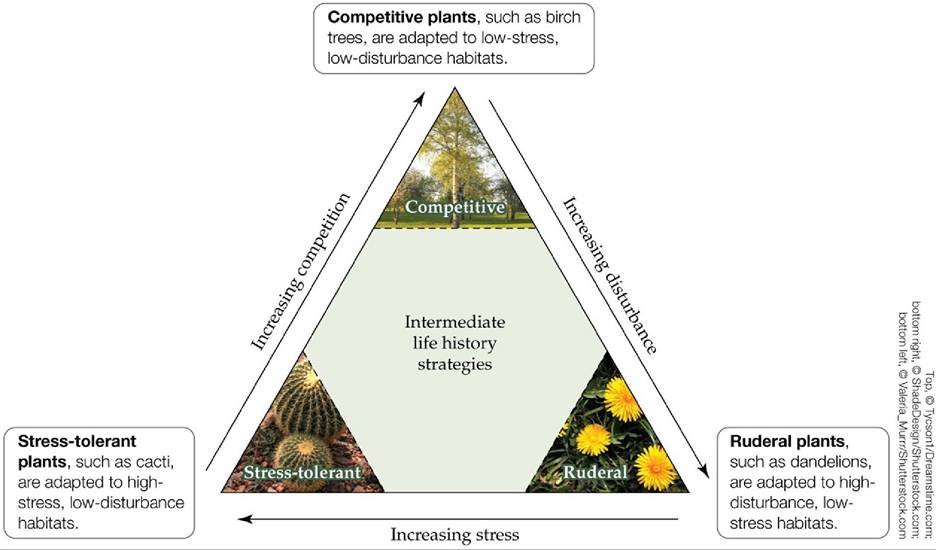
FIGURE 7.22 Grime's CSR Model Grime categorized plant life histories within a triangle whose axes indicate the degree of competition, disturbance, and stress in the habitat type to which plants are adapted. Intermediate life history strategies are shown in the center of the triangle. (After J. P. Grime. 1977. Am Nat 111: 1169-1194.) View larger image
Grime defined competition between plants in a very specific manner as “the tendency of neighboring plants to utilize the same quantum of light, ion of a mineral nutrient, molecule of water, or volume of space.” Under conditions of low stress and low disturbance, competitive plants that are superior in their ability to acquire light, minerals, water, and space should have a selective advantage.
Grime classified plants that are adapted to habitats with high levels of disturbance and low levels of stress as ruderals.
The ruderal strategy generally includes short life spans, rapid growth rates, heavy investment in seed production, and seeds that can survive in the ground for long periods until conditions are right for rapid germination and growth. Ruderal species are often called “weedy” species and are adapted for brief periods of intense exploitation of favorable habitats after disturbance has removed competitors.Finally, under conditions in which stress is high and disturbance is low, stress- tolerant plants are favored. Although stressful conditions may vary widely across habitats, Grime identified several features of stress-tolerant plants, including but not limited to slow growth rates, evergreen foliage, slow rates of water and nutrient use, high investment into defense from herbivores, and an ability to respond effectively to temporarily favorable conditions. Habitats favoring stress- tolerant plants might include places where water or nutrients are scarce or temperature conditions are extreme.
Grime's conceptual model posits that natural selection has resulted in three distinct yet very broad categories of life history strategies in plants. Although Grime focused on describing these three extreme strategies, he also recognized that intermediate strategies are commonly found. Indeed, various combinations of the three extreme strategies yield many possible intermediate strategies, such as competitive ruderals and stress-tolerant competitors, among others. However, the model also explicitly recognizes that there are trade-offs to the life history traits, and thus individual species can't be well adapted to all three of the evolutionary forces in the model.
More on the topic Plant life histories can be classified based on habitat characteristics:
- Life histories can be classified independent of size and time
- CONCEPT 24.2 Habitat loss and fragmentation decrease habitat area, isolate populations, and alter conditions at habitat edges.
- CONCEPT 7.4 Life history patterns can be classified along several continua.
- Individuals within species differ in their life histories
- Life tables can be based on age, size, or life cycle stage
- Evolution can influence plant-herbivore interactions
- Reciprocal plant-herbivore interactions
- A metapopulation can go extinct even when suitable habitat remains
- We argued in Chapter 0 that credit constraints are an important part of life, especially in the developing world. In this chapter we argue, based on Aghion-Angeletos-Banerjee-Manova (AABM), that the presence of credit constraints can help us understand why volatility is so costly for growth.
- Habitat suitability determines distribution and abundance
- Embryology, Plant Biology, and Divine Generation in the Fourth Gospel[347] [348]
- Places: Histories of Colonisation
- Two histories of torture
- Maritime, Imperial and Postcolonial Histories
- Habitat loss and degradation are the most important threats to diversity
- Histories
- Backdrop as foreground: environment and histories of imperialism
- Habitat Loss and Fragmentation