A metapopulation can go extinct even when suitable habitat remains
Human actions (such as land development) often convert large tracts of habitat into sets of spatially isolated habitat fragments (see Figure 9.7). Such habitat fragmentation can cause a species to have a metapopulation structure where it did not have one before.
If land development continues and the habitat becomes still more fragmented, the metapopulation's colonization rate (c) may decrease because patches become more isolated and hence harder to reach by dispersal. Further habitat fragmentation also causes the patches that remain to become smaller; as a result, the extinction rate (e) may increase because smaller patches have smaller populations, which, as we have just seen, have a higher risk of extinction. Both of these trends (an increase in e and a decrease in c) cause the ratio e/c to increase. Thus, if too much habitat is removed, the ratio e/c may shift suddenly from less than 1 to greater than 1, thereby dooming all populations— and the metapopulation—to eventual extinction, even though some habitat remains.The idea that all populations in a metapopulation might go extinct while suitable habitat remains was developed further in studies on the northern spotted owl (FIGURE 9.16). The northern spotted owl (Strix occidentalis caurina) is found in the Pacific Northwest region of North America. It lives in old-growth forest, where nesting pairs establish large territories that range in size from 12 to 30 km2 (territories are larger in poor-quality habitat). Lande (1988) modified Levins's model to include a description of how owls might search for vacant “patches,” which were interpreted as sites suitable for individual territories. Lande estimated that the entire metapopulation would collapse if the area covered by old-growth forest were reduced by logging to less than 20% of the total area of a large region. This result had a powerful impact: it illustrated how a species might go extinct if its habitat dropped below a critical threshold (in this case, 20% suitable habitat), and it contributed to the 1990 listing of the northern spotted owl as a threatened species in the United States. The importance of conserving old-growth forest has been highlighted by the effects of a recent invader, the barred owl (Strix varia): the arrival of barred owls can cause spotted owls to become locally extinct within forest patches, but such extinctions are less likely in old-growth forests that cover a large area (Dugger et al. 2011).
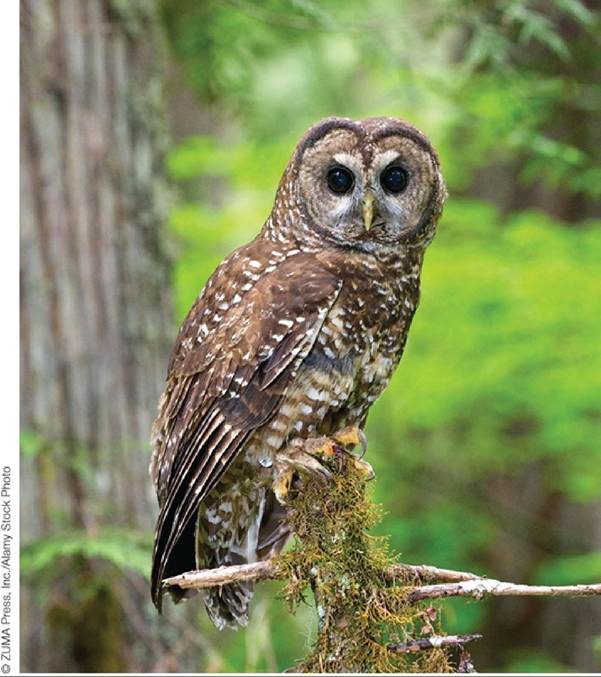
FIGURE 9.16 The Northern Spotted Owl The northern spotted owl (Strix Occidentalis Caurina) thrives in old-growth forests of the Pacific Northwest; such forests include those that have never been cut, or have not been cut for 200 years or more. View larger image
More on the topic A metapopulation can go extinct even when suitable habitat remains:
- CONCEPT 24.2 Habitat loss and fragmentation decrease habitat area, isolate populations, and alter conditions at habitat edges.
- A history of metapopulation competition models
- Habitat suitability determines distribution and abundance
- In mental life nothing which had once been formed can perish - that everything is somehow preserved and that in suitable circumstances... it can once more be brought to light... on condition that the organ of the mind has remained intact and that its tissues have not been damaged by trauma or inflammation.
- Relics and Remains
- Plant life histories can be classified based on habitat characteristics
- CHAPTER VII. PRE-SCYTHIC REMAINS IN SOUTH RUSSIA.
- Habitat loss and degradation are the most important threats to diversity
- Habitat Loss and Fragmentation
- Where should we put our focus in preventing species loss—on the species or the habitat?