Metapopulations are characterized by repeated extinctions and colonizations
As ecologists have long recognized, populations of some species are prone to extinction for two reasons: (1) the patchiness of their habitat makes dispersal between populations difficult, and (2) environmental conditions can change in a rapid and unpredictable manner.
Metaphorically, we can think of such populations as a set of “blinking lights” that wink on and off, seemingly at random, as patches of suitable habitat are colonized and the populations in those patches then go extinct. Although the individual populations may be prone to extinction, the collection of populations—the metapopulation—persists because it includes populations that are going extinct and new populations established by colonization.Building on this idea of random extinctions and colonizations, Richard Levins (1969, 1970) represented metapopulation dynamics in terms of the extinction and colonization of habitat patches:
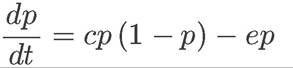
(9.4)
where p represents the proportion of habitat patches that are occupied at time t, while c and e are the patch colonization and patch extinction rates, respectively.
In deriving Equation 9.4, Levins made a few assumptions, including the following: (1) there is a very large (infinite) number of identical habitat patches, (2) all patches have an equal chance of receiving colonists (hence the spatial arrangement of the patches does not matter), and (3) all patches have an equal chance of extinction.
As we'll discuss below, some of the assumptions of Levins's model are not realistic. Still, Equation 9.4 leads to a simple but fundamental insight: for a metapopulation to persist for a long time, the ratio e/c must be less than 1. This means that some patches will be occupied if the colonization rate is greater than the extinction rate. On the other hand, if the extinction rate is greater than the colonization rate (and hence, e/c > 1), the metapopulation will collapse and all populations in it will become extinct. Levins's groundbreaking approach focused attention on a number of key issues, such as how to estimate factors that influence patch colonization and extinction, the importance of the spatial arrangement of suitable patches, the extent to which the landscape between habitat patches affects dispersal, and the vexing problem of how to determine whether empty patches are suitable habitat or not. Levins's rule for persistence also has applied importance, as we will see shortly.