Biological and geochemical fluxes both determine the global sulfur cycle
Sulfur (S) is a constituent of some amino acids, but it is rarely, if ever, in short supply for organismal growth. Sulfur plays important roles in atmospheric chemistry. As with the C, N, and P cycles, anthropogenic changes to the global S cycle have important negative environmental consequences, primarily through the generation of acid precipitation.
The major global pools of S are in rocks, sediments, and the ocean, which contains a large pool of dissolved sulfate (SO42-) (FIGURE 25.10). Fluxes of S among these global pools can occur in gaseous, dissolved, or solid forms. Weathering of S-containing minerals, mainly sedimentary pyrite, releases soluble forms of S that may enter the atmosphere or oceans. There is a net movement of S from the terrestrial pool to the oceanic pool, associated with transport in rivers and in atmospheric dust. Volcanic eruptions emit substantial amounts of sulfur dioxide (SO2) into the atmosphere. Because they are episodic events, however, the amount of S emitted to the atmosphere by volcanic eruptions, on a time scale of centuries, is approximately the same as the amount blown into the atmosphere as dust from bare soils. Oceans release S to the atmosphere as small particles of windborne ocean spray and as gaseous emissions associated with microbial activity. Bacteria and archaea in anaerobic soils also emit S-containing gases such as hydrogen sulfide (H2S). Most gaseous S compounds in the atmosphere undergo oxidation to SO42- and H2SO4 (sulfuric acid), which are removed relatively quickly by precipitation.
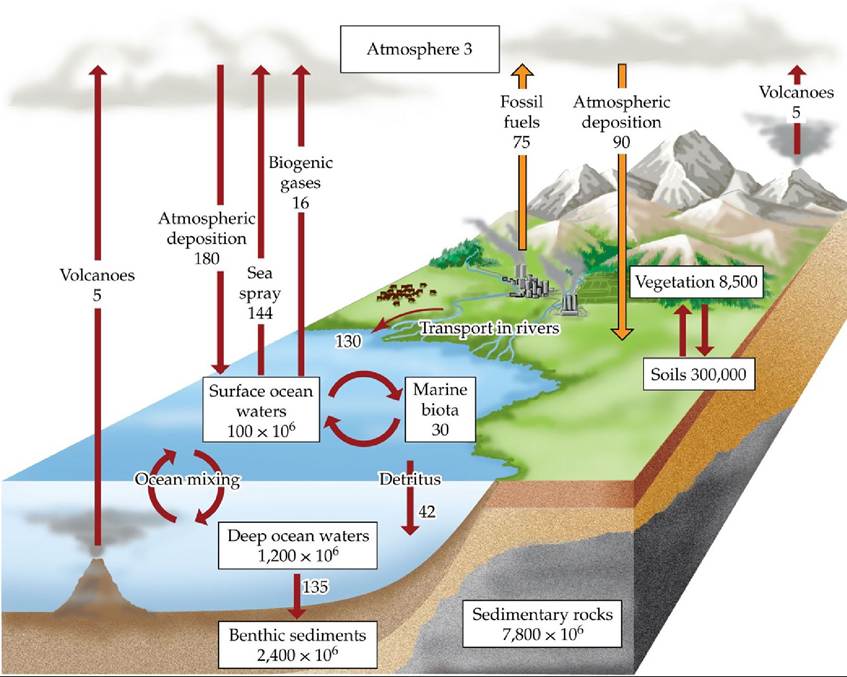
FIGURE 25.10 TheGlobaisuIfurCycIe Boxes represent major pools of S, measured in teragrams (Tg). Arrows represent major fluxes of S, measured in teragrams per year; anthropogenic fluxes are shown in orange.
(After W. H. Schlesinger and E.S. Bernhardt, 2013. Biogeochemistry: AnAnalysis of Global Change, 1st and 3rd eds. Academic Press: Cambridge, MA; F. S. Chapin et al. 2002. Principles of Terrestrial Ecosystem Ecology. Springer-Verlag: New York. Data from various sources cited within.) View larger imageAnthropogenic emissions of S to the atmosphere, which include gaseous and particulate forms (e.g., dust, aerosols), have quadrupled since the Industrial Revolution. Most of these emissions are associated with the burning of S- containing coal and oil and the smelting of metal-containing ores. What goes up must come down in the form of atmospheric deposition, usually within the same region from which it was emitted, but not always. Long-distance transport of fine dust occurs episodically in association with droughts and major wind events, as described in this chapter's Case Study. Increases in erosion associated with clearing of vegetation and overgrazing have contributed to anthropogenic input of S into the atmosphere as dust. Transport of S in rivers has doubled over the past 200 years (Schlesinger and Bernhardt 2020).
Human activities have resulted in changes in all four of the global biogeochemical cycles we have just described, and as we have noted, some of those changes have had important environmental effects. Let's turn our attention to those effects next.