The global phosphorus cycle is dominated by geochemical fluxes
Phosphorus (P) limits primary production in some terrestrial ecosystems— particularly those with old, well-weathered soils, such as tropical lowland forests —and in many freshwater and some marine ecosystems.
Biologically available phosphorus is derived from the weathering of certain minerals, and decomposition. Phosphorus is added to crops as a fertilizer globally. Phosphorus availability can also control the rate of biological N2 fixation because that process has a high metabolic demand for P. Consequently, the C, N, and P cycles are linked to one another through photosynthesis and NPP, decomposition, and N2 fixation.Unlike C and N, P has essentially no atmospheric pool, with the exception of dust (FIGURE 25.9). Gaseous forms of P are extremely rare. The largest pools of P are in terrestrial soils and marine sediments. The largest fluxes of P occur in internal ecosystem cycles, which form a tight recycling loop between biological uptake by plants and microorganisms and release by decomposition. Typically, very little of the P cycling through terrestrial and aquatic ecosystems is lost. In terrestrial ecosystems, most P loss is associated with the process of occlusion (described in Concept 22.3). Movement of P from terrestrial to aquatic ecosystems occurs primarily through erosion and movement of particulate organic matter—mainly from plants—into streams. Much of the P transported from terrestrial to marine ecosystems (about 90%) is lost when it is deposited in deep ocean sediments. Ultimately, P in sediments in both marine and terrestrial ecosystems is cycled again in association with tectonic uplift and weathering of rocks, which occurs on a scale of hundreds of millions of years.
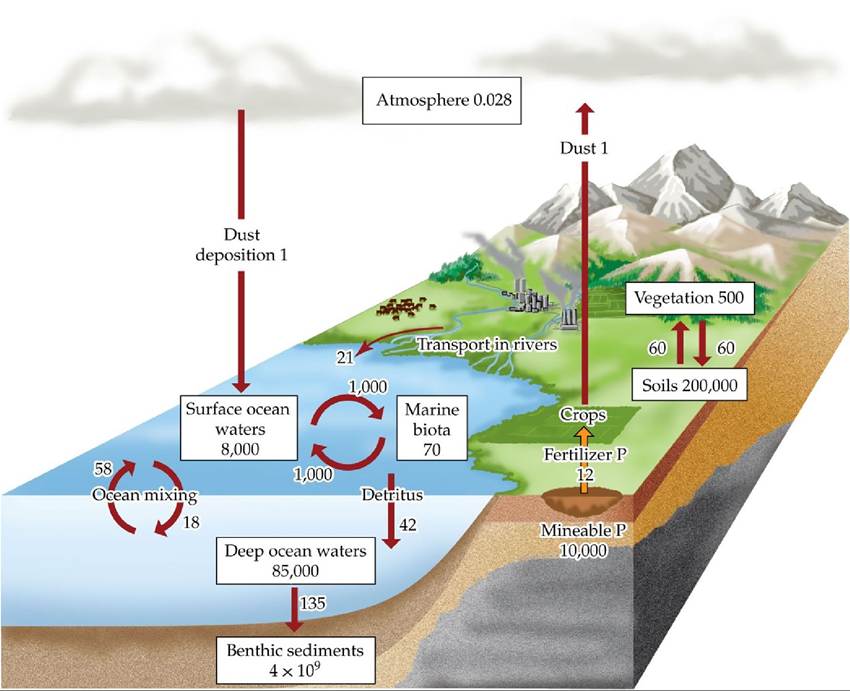
FIGURE 25.9 The Global Phosphorus Cycle Boxes represent major pools of P, measured in teragrams (Tg); arrows represent major fluxes of P, measured in teragrams per year.
The major anthropogenic flux (P fertilization of crops) is shown in orange. (After W. H. Schlesinger and E.S. Bernhardt, 2013. Biogeochemistry: AnAnalysis of Global Change, 1st and 3rd eds. Academic Press: Cambridge, MA; F. S. Chapin et al. 2002. Principles of Terrestrial Ecosystem Ecology. Springer-Verlag: New York. Data from various sources cited within.) View larger imageAnthropogenic effects on the global P cycle are associated with use of agricultural fertilizers, discharges of sewage and industrial wastes, and increases in terrestrial surface erosion. Phosphorus fertilizers are usually derived from the mining of uplifted ancient marine sediments. Phosphorus from soils and marine sediments is a nonrenewable resource, subject to depletion. Mining releases four times more P annually than is liberated through natural weathering of rock. Globally, P is applied as fertilizer in an amount equivalent to approximately 20% of the P that cycles naturally through terrestrial ecosystems (Schlesinger and Bernhardt 2020). While occlusion of P in the soil minimizes the flux of anthropogenic P from terrestrial to aquatic ecosystems, that flux still has great potential for negative environmental effects. One such effect is eutrophication in lakes, as described in Concept 22.4.