Biological fluxes dominate the global nitrogen cycle
Nitrogen (N) plays a key role in biological processes as a constituent of proteins and enzymes, and it is one of the resources that most commonly limits primary production, as we saw in Concept 20.2.
Thus, cycles of N and C are tightly coupled through the processes of photosynthesis and decomposition.The largest pool of N (>90%) is atmospheric dinitrogen gas (N2) (FIGURE
25.7). This form of N is very stable chemically and cannot be used by most organisms, with the important exception of nitrogen-fixing bacteria, which are able to convert it to more chemically usable forms, as described in Concept 22.1. These fixed chemical compounds are referred to as reactive N because, unlike
N2, they can participate in chemical reactions in the atmosphere, soils, and water. Terrestrial N2 fixation by bacteria provides approximately 128 teragrams (1 Tg = 1012 g) of reactive N per year (Cleveland et al. 1999; Galloway et al. 2004) and supplies 12% of the annual biological demand (Schlesinger and Bernhardt 2020). The remaining 88% is met by uptake of N from the soil in forms released by decomposition. Oceanic N2 fixation contributes another 120 Tg to the biosphere annually. Geologic pools associated with sediments containing organic matter represent a much smaller fraction of global N than of global C, but some N-rich sedimentary sources may be important in some sites (Morford et al. 2016).
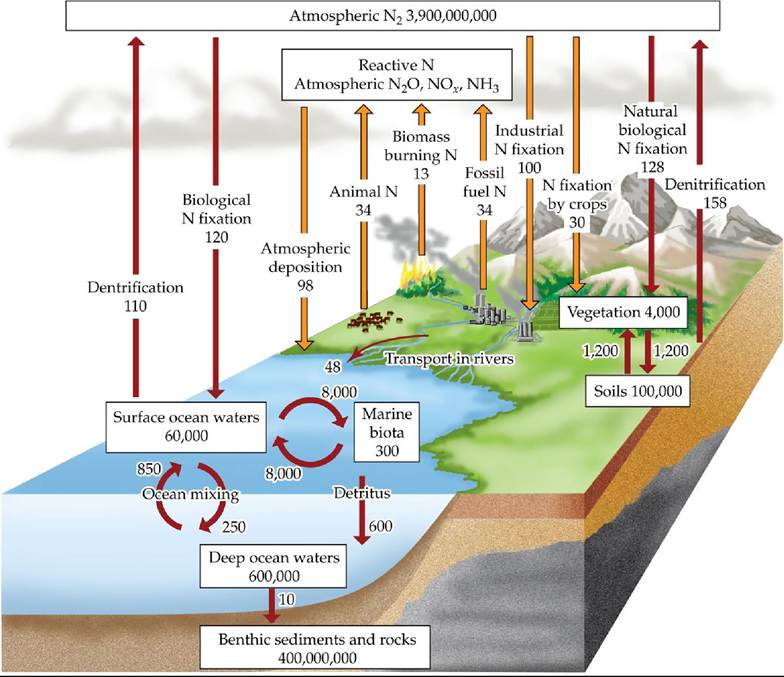
FIGURE 25.7 TheGlobalNitrogenCycle Boxes represent major pools of N, measured in teragrams (1 Tg = 1012 g). Arrows represent major fluxes of N, measured in teragrams per year; anthropogenic fluxes are shown in orange. The percentage of the total atmospheric N pool made
up of reactive N is minuscule (it is also difficult to quantify because it is very dynamic).
Given its small size, why is the reactive pool of N of such great interest?
(After W. H. Schlesinger and E.S. Bernhardt. 2013. Biogeochemistry: AnAnalysis of Global Change, 1st and 3rd eds. Academic Press: Cambridge, MA; F. S. Chapin et al. 2002. Principles of Terrestrial Ecosystem Ecology. Springer-Verlag: New York. Data from various sources including C. Cleveland et al. 1999. Global Biogeochem Cycles 13: 623-645; J. N. Galloway et al. 2004. Biogeochemistry 70: 153-226.) View larger image
Although the pools of N at land and ocean surfaces are relatively small, they are very active biologically, and they are held tightly by internal ecosystem cycling processes. Fluxes from these pools are small relative to the rates of internal cycling, usually less than 10% (Chapin et al. 2002). The natural flux of N between terrestrial and oceanic pools that occurs via rivers is tiny, but it plays an important biological role by enhancing primary production in estuaries and salt marshes. Denitrification, a microbial process that occurs in anoxic soils and in the ocean (described in Concept 22.2), results in movement of N (as N2 and as N2O, a greenhouse gas, also known as laughing gas) from terrestrial and marine ecosystems into the atmosphere. Oceanic and terrestrial ecosystems also lose N through burial of organic matter in sediments and through burning of biomass.
Human activities have altered the global N cycle tremendously—even more than they have altered the global C cycle. Anthropogenic fluxes are now the dominant components of the N cycle (Galloway et al. 2004; Canfield et al. 2010) (FIGURE 25.8). The rate of fixation of atmospheric N2 by humans now exceeds the rate of natural terrestrial biological fixation. Emissions of N associated with industrial and agricultural activities are causing widespread environmental changes, including acid precipitation, as we'll see in Concept 25.3. Three major processes account for these anthropogenic effects.
The first is the manufacture of agricultural fertilizers by the Haber-Bosch process, described in Concept 22.1. Approximately 80% of the N in human tissues is derived from fixation of N2 by this process. Second, growing N-fixing crops such as soybeans, alfalfa, and peas has increased biological N2 fixation. Flooding of agricultural fields for other crops, such as rice, has increased N2 fixation by cyanobacteria. Finally, anthropogenic emissions of certain gaseous forms of N have greatly increased the concentrations of these compounds in the atmosphere. Unlike N2, these compounds, which include oxygenated N compounds (NO, NO2, HNO3, and NO3-, collectively referred to as NOx, and N2O), ammonia (NH3), and peroxyacetyl nitrate (PAN), can undergo chemical reactions in the atmosphere and are potentially available for biological uptake. Fossil fuel combustion is the primary source of these nitrogenous gas emissions. Other contributors include biomass burning associated with deforestation, denitrification and volatilization (conversion to gaseous form) of fertilizers, and emissions from livestock feedlots and human sewage treatment plants. All of these reactive forms of N are returned to terrestrial and marine ecosystems through the process of atmospheric deposition (described in Concept 22.1).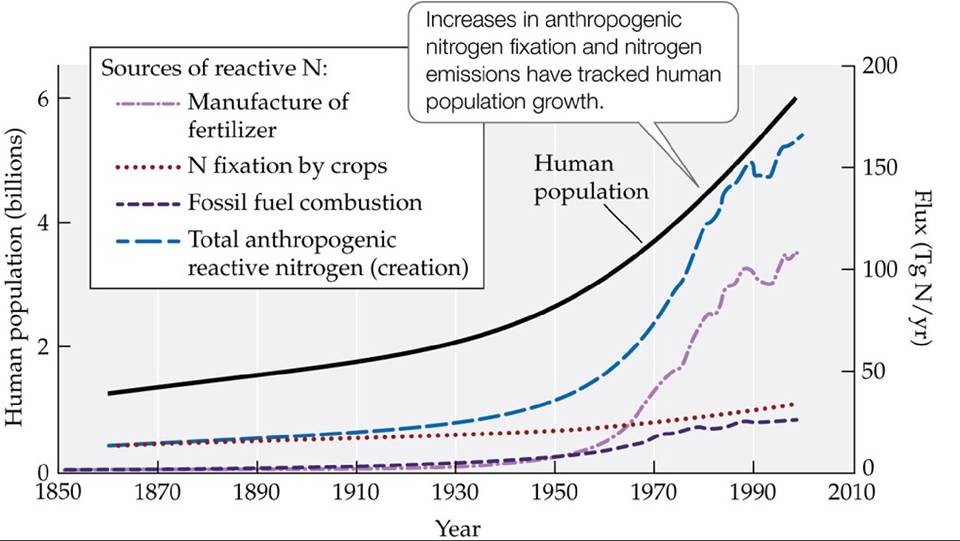
FIGURE 25.8 Changes in Anthropogenic Fluxes in the Global Nitrogen Cycle Increases
in fertilizer production through the Haber-Bosch process, the growing of nitrogen-fixing crops, and combustion of fossil fuels have all contributed to the tremendous increase in biologically available (reactive) N. (After J. N. Galloway et al. 2004. Biogeochemistry 70: 153-226.) View larger image
More on the topic Biological fluxes dominate the global nitrogen cycle:
- Biological and geochemical fluxes both determine the global sulfur cycle
- The global phosphorus cycle is dominated by geochemical fluxes
- CONCEPT 25.1 Elements move among geologic, atmospheric, oceanic, and biological pools at a global scale.
- While a repetitive gait cycle arises from the alternating base of support found in all bipeds, the existence of this cycle provides great opportunity for clinical and biomechanical analysis of a child with gait dysfunction.
- The Dominate and the Fall of the West (ad 284-476)
- Nitrogen deposition: Too much of a good thing can be bad
- THE DOMINATE
- Acid and Nitrogen Deposition
- Sources of!important; text-transform:uppercase'>Law from the Republic to the Dominate
- Global Fiscal Policies Implemented Within the Scope of Fight Against COVID-19, a Global Public Bad
- CONCEPT 18.2 Global patterns of species diversity and composition are influenced by geographic area and isolation, evolutionary history, and global climate.
- CONCEPT 25.3 Anthropogenic emissions of sulfur and nitrogen cause acid deposition, alter soil chemistry, and affect the health of ecosystems.
- Nutrients in lakes cycle efficiently in the water column
- Nutrients cycle at different rates according to element identity and ecosystem type
- In the previous section, we saw how nutrients undergo biological, chemical, and physical transformations as they are taken up by organisms and released through decomposition, ultimately returning to their original forms (or similar ones).