Nitrogen deposition: Too much of a good thing can be bad
As we have seen, anthropogenic emissions of reactive N into the atmosphere from fossil fuel burning and agricultural activities have greatly altered global N cycles. Reactive N can fall back to Earth (via dry and wet deposition) after being transported away from the emission source in the atmosphere.
Globally, anthropogenic emissions and deposition of reactive N compounds are more than three times greater now than they were in 1860 (Galloway et al. 2004, 2008) (FIGURE 25.20). Emissions and deposition of reactive N are expected to double between 2000 and 2050 as industrial development increases to keep pace with the human population. Greater deposition of N will increase the supply of N for biological activity, but this abundance will come with an environmental cost.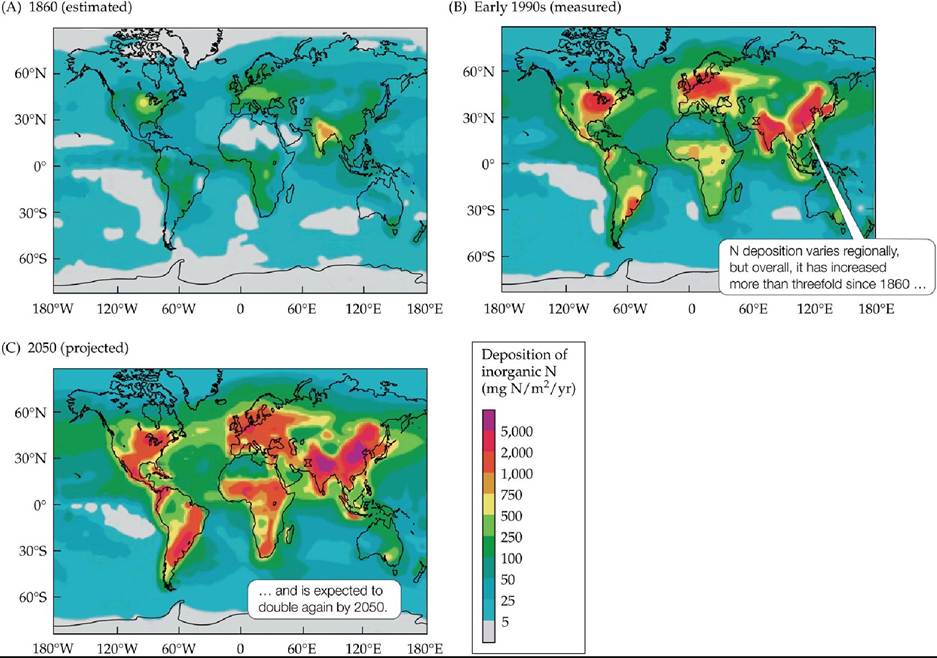
FIGURE 25.20 Historical and Projected Changes in Nitrogen Deposition (A)Estimated rates of deposition of inorganic N compounds (NH4+ and NOβ-) in 1860. (B) Measured rates for the early 1990s. (C) Projected rates for 2050. (From J. N. Galloway et al. 2004. Biogeochemistry 70: 153-226.) View larger image
The role of N as a determinant of rates of primary production was described in Concept 20.2. Nitrogen plays an important role in photosynthesis, which forms the base of the food webs that provide energy to all other organisms. Considerable benefit to humanity has accrued from the manufacture of N fertilizers and their widespread application to crops since the early twentieth century. We might expect, therefore, that an increased supply of N would facilitate plant growth and greater overall production in a N-limited ecosystem. Primary production has indeed increased in some ecosystems as a result of increased N deposition (e.g., forests in Scandinavia; Binkley and Hogberg 1997).
Nitrogen deposition may be partly responsible for the greater uptake of atmospheric CO2 by terrestrial ecosystems observed in the Northern Hemisphere (Thomas et al. 2010).Although primary production is increasing in some ecosystems because of N deposition, there is also strong evidence that N deposition is associated with environmental degradation, loss of biodiversity, decreases in primary production, and acidification of soils and surface waters. While N limits primary production in many terrestrial ecosystems, the capacity of vegetation, soils, and soil microbes to take up greater N inputs can be exceeded. This condition, known as nitrogen saturation, has a number of effects on ecosystems (Aber et al. 1998) (FIGURE 25.21). Greater concentrations of inorganic N compounds (NH4+ and NO3-) in the soil lead to enhanced rates of microbial processes (nitrification and denitrification) that release N2O, a potent greenhouse gas. Nitrate (NO3-) is easily leached from soils and can move into groundwater, eventually entering aquatic ecosystems. When NO3- moves through the soil, it carries cations, including K+, Ca2+, and Mg2+, in solution to maintain a charge balance. As in the case of acid precipitation, losses of these cations can lead to nutrient deficiencies and eventually to acidification of soils. Very high concentrations of NO3- in surface waters and ground water near agricultural areas has been linked to “blue baby” syndrome, a dangerous condition in which an infant's ability to take up oxygen is compromised.
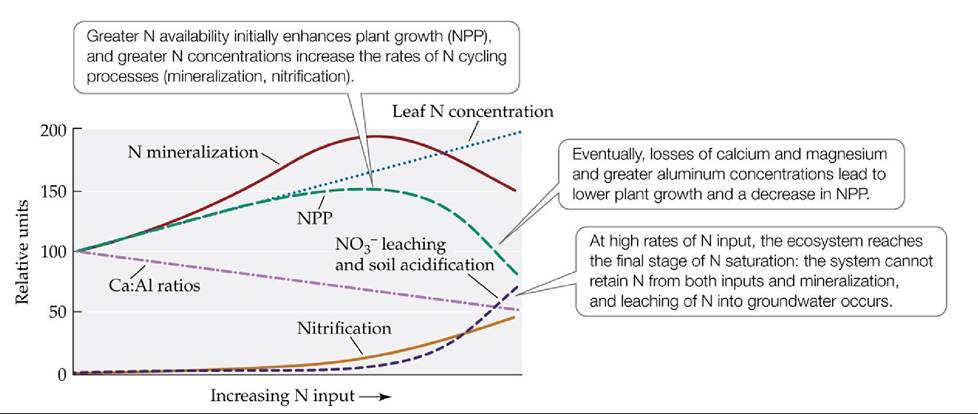
FIGURE 25.21 Effects of Nitrogen Saturation Aber and colleagues devised a conceptual model of the response of forest ecosystems to increasing inputs of inorganic N resulting in nitrogen saturation. (After J.
Aber et al. 1998. BioScience 48: 921-934.) View larger imageMost aquatic ecosystems are limited by P, so the biological uptake of anthropogenic NO3- that enters them from terrestrial ecosystems may be relatively small (although there is greater biological processing of N than expected; see Figure 22.15). Riverine transport of N to nearshore marine ecosystems has increased as inputs of N fertilizer have increased (Howarth et al. 1996). Primary production in estuarine and marsh communities is often limited by N, and thus the influx of N from terrestrial sources into these ecosystems has resulted in eutrophication (described in Concept 22.4). Eutrophication results in heavy algal growth, which can create hypoxic conditions in the bottom waters of nearshore ecosystems. The resulting high inputs of organic matter lead to high rates of decomposition by microorganisms, which consume most of the available oxygen. The resulting hypoxic conditions are lethal for most marine life, including fish. Hypoxic conditions may occur over large areas, creating “dead zones.” Dead zones of up to 18,000 km2 form annually in the Gulf of Mexico, and over 400 dead zones form in locations around the world, including the Baltic Sea, the Black Sea, and the Chesapeake Bay.
In nutrient-poor ecosystems, many plants have adaptations that lower their nutrient requirements, which also lower their capacity to take up additional inputs of N. As a result, N inputs may cause faster-growing species to outcompete the species adapted to low-nutrient conditions. Acidification and increases in soluble aluminum may lead to declines in intolerant species. Eventually, this increased competition and toxicity can lead to lower diversity and alteration of community composition. In the Netherlands, species-rich heath communities adapted to low-nutrient conditions have been replaced by speciespoor grassland communities as a result of very high rates of N deposition (Berendse et al.
1993). In Great Britain, Carly Stevens and colleagues surveyed grassland communities across the country with a range of N deposition rates (FIGURE 25.22A). At 68 sites, they measured the mean plant species richness in multiple study plots, along with several environmental variables, to try to explain the variation in plant diversity among the sites. The environmental variables included nine soil chemical factors, nine physical environmental variables, grazing intensity, and the presence or absence of grazing enclosures (Stevens et al. 2004). Of the 20 possible factors that may have influenced differences in species richness among the study sites, the amount of N deposition explained the greatest amount of variation (55%): higher inputs of N were associated with lower species richness (FIGURE 25.22B). The results of this study are supported by a similar large-scale study in the United States that found at least 25% of the sites surveyed had reduced species richness in association with greater N deposition (Simkin et al. 2016). In general, rare species appear to be most at risk for loss from plant communities (Suding et al. 2005). High rates of N deposition also facilitate the successful spread of some invasive plant species at the expense of native species (Dukes and Mooney 1999).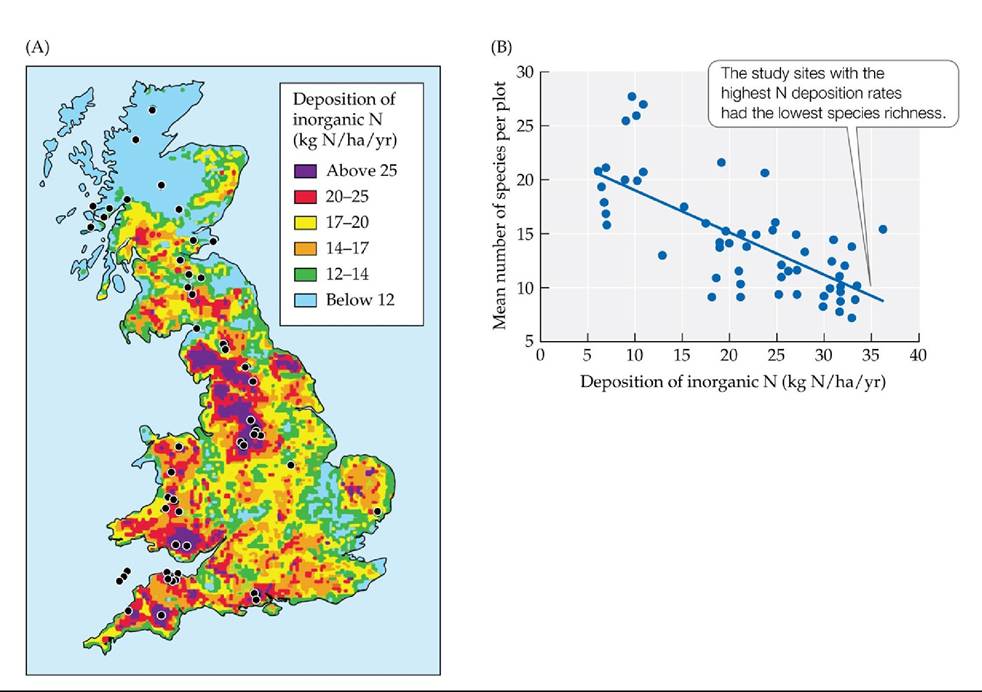
FIGURE 25.22 NitrogenDepositionLowersSpeciesDiversity (A)InorganicNdeposition in Great Britain. Dots on the map indicate the study sites where plant species richness in grassland ecosystems was measured. (B) Correlation between rates of inorganic N deposition and plant species richness. (After C. J. Stevens et al. 2004. Science 303: 1876-1879.) View larger image
The ecological effects of S and N result when atmospheric deposition returns anthropogenic emissions to Earth's surface. In the next section, we'll describe some anthropogenic compounds that exert negative effects while remaining in the atmosphere.