Acid precipitation causes nutrient imbalances and aluminum toxicity
The detrimental effects of acidic air pollution on nearby vegetation, buildings, and human health have been known for several centuries, although their mechanisms were not well understood.
In England during the mid-nineteenth century, industrial processes that released acidic compounds into the atmosphere, primarily hydrochloric acid, were implicated as a major source of harmful pollution (Jacobson 2002). Legislation was enacted in 1863 to reduce these acidic emissions. Despite such legislation, acid precipitation continued to be a problem throughout the nineteenth and twentieth centuries in large industrialized urban centers. During the 1960s, awareness of the widespread effects of acid precipitation, including its effects on nearby “pristine” ecosystems and agriculture, increased. In particular, damage to forests and mortality among aquatic organisms in northern Europe, parts of Asia, and northeastern North America prompted greater attention to acid precipitation.Sulfuric acid (H2SO4) and nitric acid (HNO3) are the main acidic compounds found in the atmosphere. As we saw in Concept 25.1, sulfuric acid forms in the atmosphere from the oxidation of gaseous S compounds. Likewise, nitric acid originates from the oxidation of other NOx compounds. Sulfuric and nitric acids can dissolve in water vapor and fall to the ground with precipitation (wet deposition). Naturally occurring precipitation has a slightly acidic pH of 5.0 to 5.6 due to the natural dissolution of CO2 and formation of carbonic acid. Acid precipitation has a pH range from 5.0 to 2.0. Acidic compounds may also be deposited on Earth's surface when they form aerosols too large to be suspended or when they attach to the surfaces of dust particles (dry deposition).
Research has focused on determining the causes of the environmental degradation associated with acid precipitation, including increased mortality of plants and amphibians and decreased diversity.
Initially, the acidity was considered the main culprit. In most cases, however, rainfall and surface waters did not have a low enough pH to cause the observed biological responses. An exception is found in regions at high latitudes or high elevations that develop a seasonal snowpack. During winter, acidic compounds accumulate in the snow. When temperatures increase in spring, water percolates through the snowpack, leaching out all the accumulated soluble compounds. The first meltwater of spring is therefore more acidic than the precipitation that fell during winter. This acid pulse has the potential to be toxic to sensitive organisms in soils and streams, including microorganisms, invertebrates, amphibians, and fish.The vulnerability of organisms in soils, streams, and lakes to inputs of acid precipitation is determined by the ability of their chemical environment to counteract the acidity, known as its acid neutralizing capacity. The acid neutralizing capacity of soils and water is usually associated with their concentrations of base cations, including Ca2+, Mg2+, and K+. Soils derived from parent material with high concentrations of these cations, such as limestone, are better able to neutralize acid precipitation than those derived from more acidic parent material, such as granite.
The detrimental effects of acid precipitation on plants and aquatic organisms are associated with biogeochemical reactions in the soil that decrease nutrient supplies and increase concentrations of toxic metals. As H+ percolates through the soil, it replaces Ca2+, Mg2+, and K+ at cation exchange sites on the surfaces of clay particles (see the description of cation exchange in Concept 22.1). These cations are released into the soil solution and can then leach out of the rooting zone of plants. The loss of these base cations leads to a decrease in soil pH, or soil acidification. Deficiencies in Ca and Mg, sometimes in combination with other stresses, were associated with large-scale mortality of trees in European forests during the 1970s and 1980s (FIGURE 25.18).
In advanced stages of soil acidification, the metal cations aluminum (Al3+) and manganese (Mn3+) are released into the soil from cation exchange sites. Aluminum and manganese are toxic to plant roots, soil invertebrates, and aquatic organisms, including fish. The combination of increasing acidity in precipitation and increasing aluminum concentrations in terrestrial runoff has been linked to fish die-offs in lakes and streams in northern Europe and eastern North America.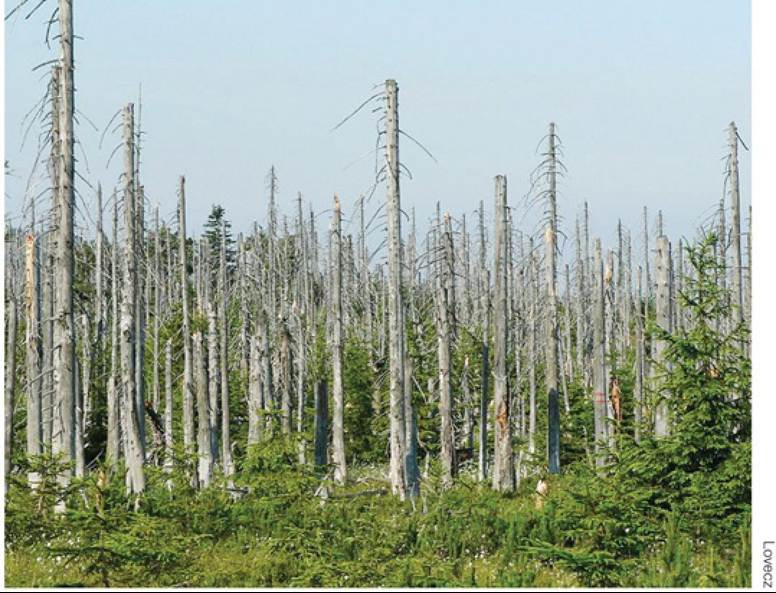
FIGURE 25.18 Air Pollution Has Damaged European Forests Thehightreemortality seen in this spruce forest in the Jizera Mountains, Czech Republic, is associated with acid precipitation and the resulting nutrient imbalance, particularly losses of base cations. Extensive forest decline occurred in Germany and northern Czechoslovakia (now part of the Czech Republic) in the 1970s and 1980s. View larger image
The realization that acid precipitation was negatively affecting the biota of forest and lake ecosystems prompted enhanced monitoring of atmospheric deposition and, eventually, laws to limit acidic emissions. Restrictions on emissions of S in North America and Europe have resulted in significant reductions in the acidity of precipitation (FIGURE 25.19). Forests are recovering from the effects of acid precipitation in central Europe, thanks to legislation limiting S emissions as well as decreased industrial activity in the former Soviet Union. Stream chemistry measurements also reflect the reduced acidity of precipitation and the recovery of aquatic ecosystems. Acid precipitation remains a problem, however, in some countries that have experienced rapid industrial development, such as China and India, though steps are being taken to reduce the emissions of acidic compounds.
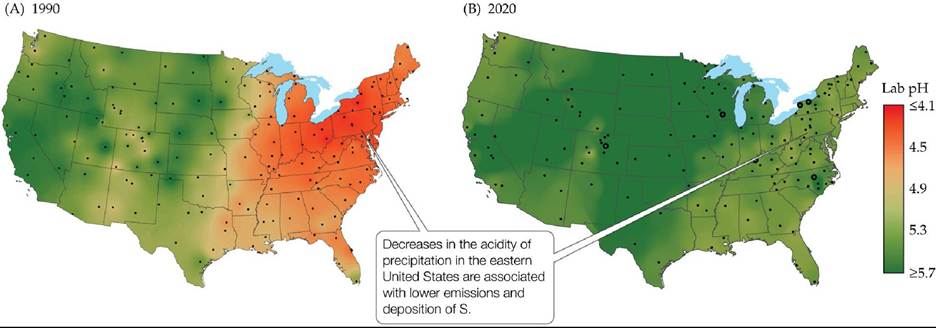
FIGURE 25.19 DecreasesinAcidPrecipitation The pH of precipitation in different parts of the United States as measured in (A) 1990 and (B) 2020, estimated based on measurements made at sampling points indicated by the dots. (From National Atmospheric Deposition Program/National Trends Network.) View larger image
More on the topic Acid precipitation causes nutrient imbalances and aluminum toxicity:
- Chloroform Toxicity
- Patterns of atmospheric pressure and topography influence precipitation
- Empirical Evidence and Power Imbalances
- TWO China’s Reserve Buildup and Global Imbalances
- A chain saw cut through a thin layer of aluminum alloy with much whining but little difficulty—the monument’s neck was hollow.
- Mountains influence wind patterns and gradients in temperature and precipitation
- Organisms have specific nutrient requirements
- DISORDERS OF AMINO ACID METABOLISM
- EVALUATION OF ACID-BASE STATUS
- Valproic Acid
- ACID-BASE DISORDERS
- Terrestrial biomes reflect global patterns of precipitation and temperature
- SPECIFIC ACID-BASE DISORDERS
- NPP in aquatic ecosystems is controlled by nutrient availability
- Nutrient Transformations
- Each day we experience the weather around us: the current temperature, humidity, precipitation, wind, and cloud cover.
- 22 Nutrient Supply and Cycling
- Nutrient Requirements and Sources
- Nutrient Cycles and Losses