Patterns of atmospheric pressure and topography influence precipitation
The locations of the Hadley, Ferrell, and polar circulation cells suggest that precipitation should be highest in the tropical latitudes between 23.5°N and S and in a band at about 60°N and S and should be lowest in zones around 30°N and S (see Figure 2.9).
The African continent displays the pattern closest to this idealized precipitation distribution. However, there are substantial deviations from the expected latitudinal precipitation pattern in other areas, particularly in the Americas (FIGURE 2.16). These deviations are associated with the semipermanent high-pressure and low-pressure cells discussed earlier (see Figure 2.11) as well as with large mountain chains.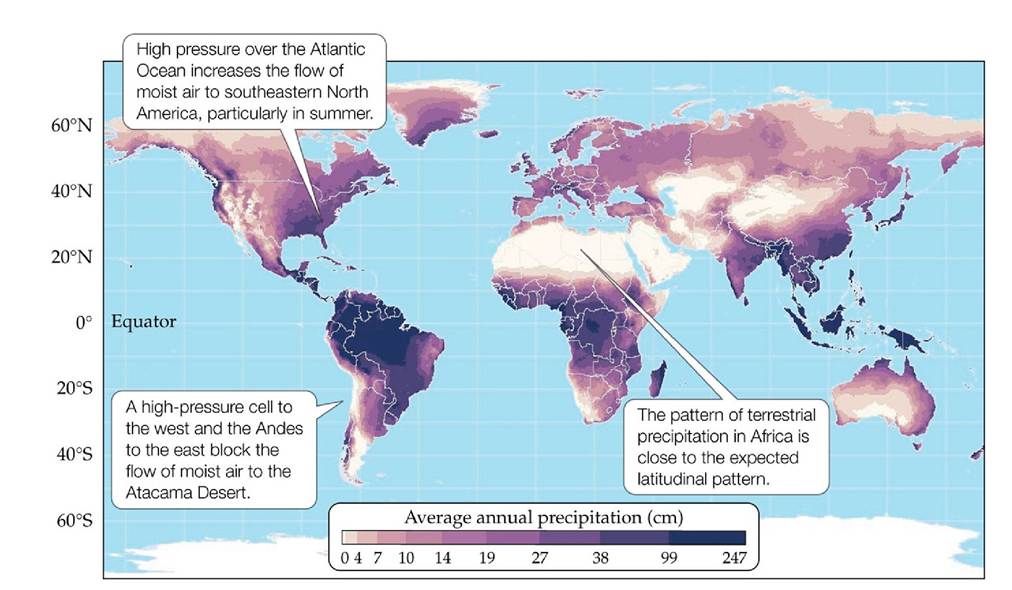
FIGURE 2.16 AverageAnnualTerrestrialPrecipitation Thelatitudinalpatternof precipitation deviates from what would be expected based on atmospheric circulation patterns alone (see Figure 2.9). (Courtesy of the Center for Sustainability and the Global Environment [SAGE] through their Atlas of the Biosphere, (⅛⅝ https://nelson.wisc.edu/sage/data-and-models/maps.php. Data from CRU 0.5 Degree Dataset [M. G. New et al. 2000. J Climate 13: 2217-2238].) View larger image
Pressure cells influence the movement of moist air from oceans to continents, as well as cloud formation. For example, high pressure over the South Pacific Ocean decreases precipitation along the central west coast of South America. One of the driest deserts in the world, the Atacama, located along the Pacific coast of Chile, is associated with the presence of this high-pressure cell and with the blockage of air masses moving from the east by the Andes. In contrast, high pressure over the Atlantic Ocean increases the flow of moist air to southeastern North America, particularly in summer, increasing precipitation and supporting the occurrence of forests there.
Mountains also influence precipitation patterns by forcing air moving across them to rise, which enhances local precipitation. The effects of mountains, as well as those of oceans and vegetation, on regional climate patterns are addressed in the next section.
More on the topic Patterns of atmospheric pressure and topography influence precipitation:
- Each day we experience the weather around us: the current temperature, humidity, precipitation, wind, and cloud cover.
- Reviewers
- Biological communities in mountains occur in elevational bands