Landscape patterns affect ecological processes
Landscape structure plays an important role in ecological dynamics. For example, it can affect whether and how animals move and can therefore influence rates of pollination, dispersal, or consumption.
Mickael Henry and his associates studied the movements of the fruit-eating bat Rhinophylla pumilio in a tropical forest in French Guiana that had been fragmented by the construction of a reservoir. Using landscape metrics that quantified the degree of patch (the degree to which landscapes allow movement between patches) at their sampling sites, they found that more isolated forest fragments were less likely to be visited by bats, even if they contained abundant food resources (Henry et al. 2007). Thus, the landscape structure affected bat foraging behavior. Furthermore, because frugivorous bats disperse plant seeds, it is also likely that the landscape structure affected the dispersal of the plants that the bats fed on.Landscape structure also influences biogeochemical cycling. Ecosystem ecologists have identified biogeochemical “hot spots” where chemical reaction rates are higher than in the surrounding landscape. Many such hot spots are found at the interfaces between terrestrial and aquatic ecosystems (McClain et al. 2003), but other factors may also play a part. For example, Kathleen Weathers and her colleagues found that inputs of sulfur, calcium, and nitrogen from atmospheric deposition were higher at forest edges than in forest interiors, primarily as a result of greater interception of airborne particles by the denser and more complex vegetation typically found at a forest edge. The fragmented forests that typically surround urban areas are therefore more likely to be influenced by inputs of atmospheric pollutants and nutrients than intact forests. This finding has implications for soil microbial dynamics, plant growth and diversity, and animal communities in the edges of these fragments (Weathers et al.
2001). We will discuss other such “edge effects” in Concept 24.2.Habitat patches typically vary in both quality and resource availability. This variation can affect the diversity and population densities of the species inhabiting each patch, the time animals spend foraging in a patch (see Concept 8.2), and the movement of organisms between patches (see Concept 9.3). Patch boundaries, connections between patches, and the matrix between patches can also affect population dynamics, both within and among patches. For example, Schtickzelle and Baguette studied the movement patterns of the bog fritillary butterfly (Proclossiana eunomia) across fragmented landscapes in Belgium (FIGURE 24.7). Where patches of suitable butterfly habitat were aggregated, female butterflies crossed readily from patch to patch. However, where the habitat was more fragmented and there was a wider distance of matrix to cross, the butterflies were less likely to leave a patch (Schtickzelle and Baguette 2003).
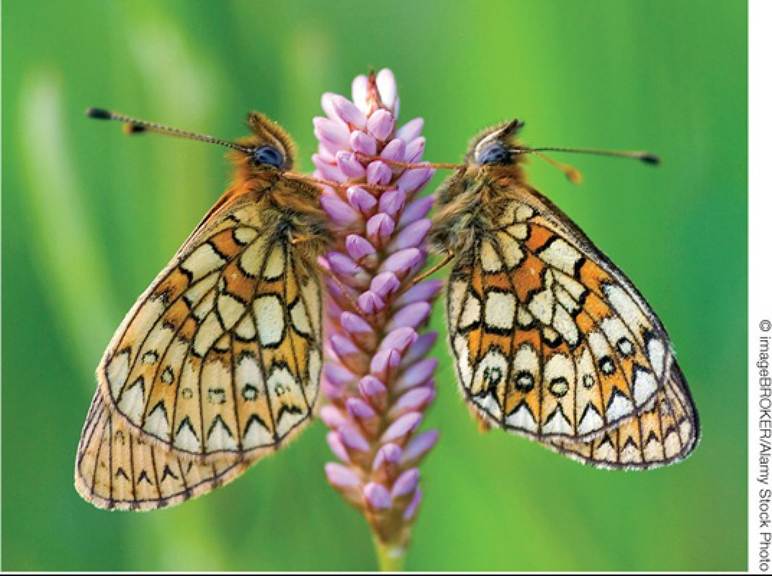
FIGURE 24.7 TheBogFritillaryButterfly Thetravelpatternsofthesebutterflies (Proclossiana eunomia) are influenced by features of the surrounding landscape. Butterflies will hesitate to leave the patches they inhabit if there is not another suitable habitat patch nearby, but they will traverse a matrix of unsuitable habitat when the next patch is close. View larger image
While ecological processes are influenced by landscape patterns, landscape patterns are in turn influenced by ecological processes. Large grazing mammals, for example, often shape the landscapes they inhabit. The effects of moose (Alces alces) on Isle Royale in Lake Superior have been studied through the use of exclosures since the 1940s. These studies have shown that high rates of browsing by moose decrease plant growth, not just directly through the removal of biomass, but also indirectly by decreasing nitrogen supply via lower mineralization and litter decomposition rates (Concept 22.2). Moose browsing also shifts the tree species composition toward spruce, which in turn influences rates of biogeochemical processes (Pastor et al. 1988). The moose are thus both responding to and shaping the landscape. At a broader scale, landscape patterns interact with larger-scale disturbances, as we will see next.