A landscape is a heterogeneous area composed of a dynamic mosaic of interacting ecosystems
A landscape is an area in which at least one element is spatially heterogeneous (varies from one place to another) (FIGURE 24.3). Landscapes can be heterogeneous either in what they are composed of—for example, twelve different vegetative cover types versus only three—or in the way their elements are arranged—such as many small patches arranged regularly over the landscape versus a few large patches.
Ecologists often refer to this composite (or pattern) of heterogeneous elements that make up a landscape as a mosaic.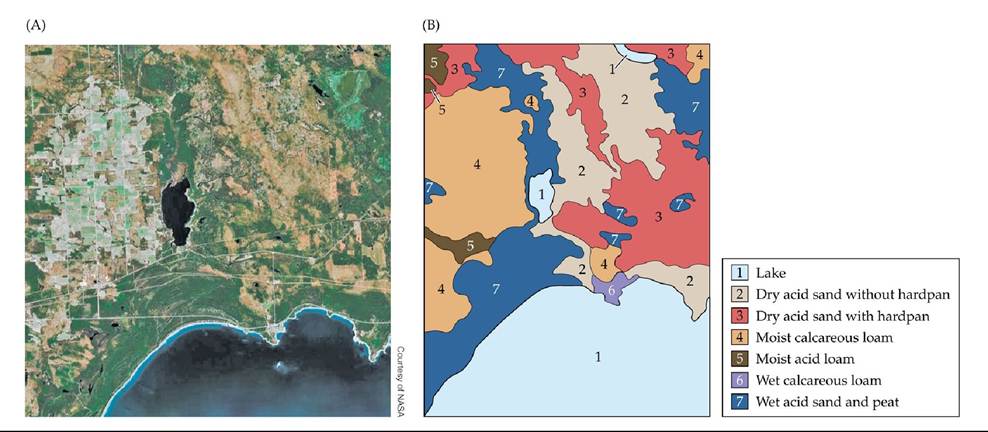
FIGURE 24.3 LandscapeHeterogeneity Landscapescanbeheterogeneousinmany different kinds of elements, which may be arranged in ways independent of one another. (A) An aerial photograph of Michigan’s Upper Peninsula. (B) A map of six different soil types in the same area.
In part (B), which landscape element covers the least area?
(After H. R. Delcourt. 2002. In Learning Landscape Ecology, S. E. Gergel and M. G. Turner [Eds.], pp. 6282. Springer: New York.) View larger image
Landscapes often include multiple ecosystems. The different ecosystems that make up a landscape are dynamic and continually interacting with one another. These interactions may occur through the flow of water, energy, nutrients, or pollutants between ecosystems.
There is also biotic exchange between habitat patches in the mosaic as individuals or their gametes (e.g., pollen) move between them (Forman 1995). For such movement to occur, patches of the same habitat type must be connected to one another, or the surrounding habitat (the matrix) must be of a type through which dispersal is possible (FIGURE 24.4). In Australia, for example, rats regularly leave patches of forest habitat to forage in adjacent macadamia nut plantations (a part of the surrounding matrix).
As a result, nut losses to rats along plantation edges adjacent to forests are greater than along edges adjacent to grasslands or agricultural fields (White et al. 1997).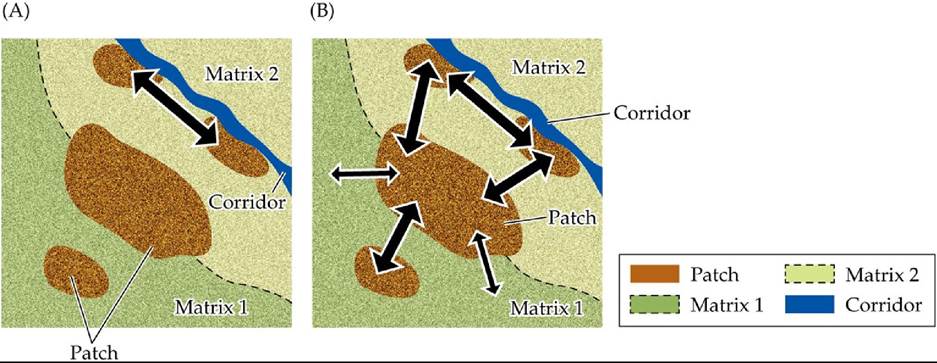
FIGURE 24.4 Movements across the Landscape Movements between adjacent landscape elements may occur frequently (thicker arrows) or rarely (thinner arrows). (A) Exchange between patches of the same type occurs frequently if a corridor that allows movement connects the patches. (B) Exchange between patches of the same type occurs frequently, but exchange with the matrix occurs only rarely.
Do organisms move more freely across the matrix in (A) or in (B)? Explain. (After A. M. Hersperger. 2006. Landscape Urban Plann 77: 227-239.) View larger image
Next, let's focus in more detail on two aspects of landscape heterogeneity: how it is described, and the scale at which it is studied.
Describing Landscape Heterogeneity
The heterogeneity that we see in landscapes can be described in terms of composition and structure. Landscape composition refers to the kinds of elements or patches in a landscape, as well as to how much of each kind is present. These elements are defined by the investigator and are influenced by the source of data used and goals of the analysis. In an example from Yellowstone National Park, researchers working on the history of landscape dynamics designated five different age classes of lodgepole pine forest using ground-based fieldwork, aerial photographs, and GIS (Tinker et al. 2003). The composition of the landscape in FIGURE 24.5 can thus be quantified by counting the kinds of
elements in the mapped area (five in this case), by calculating the proportion of the mapped area covered by each kind of element, or by measuring the diversity and dominance of the different landscape elements much as one does for species, using a measure such as the Shannon index (described in Concept 16.2).
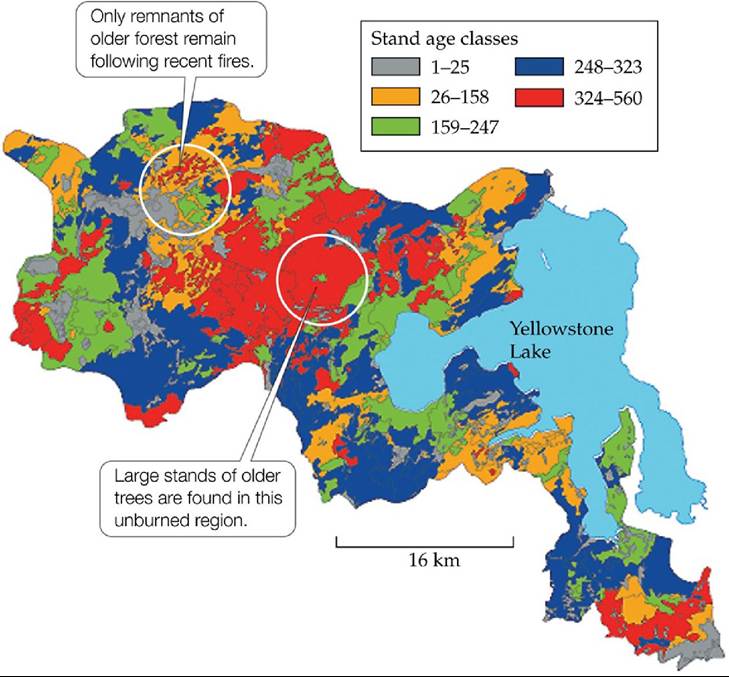
FIGURE 24.5 Landscape Composition and Structure This map of lodgepole pine (Pinus contorta var. Iatifolia) forest in Yellowstone National Park shows five different age classes of forest. Structural complexity varies across the landscape, as seen in the varying degree of natural fragmentation. (From D. B. Tinker et al. 2003. Landscape Ecol 18: 427-439.) View larger image
Landscape structure is the physical configuration of the different elements that compose the landscape. In Figure 24.5, we can see that some parts of the landscape contain large contiguous blocks of older forest, while other parts are more fragmented and contain smaller patches of forest with a variety of different ages. Landscape ecologists quantify landscape structure primarily by addressing whether the landscape is characterized by large or small patches, how aggregated or dispersed the patches are, whether the patches are simple or complicated in their shape, and how fragmented the landscape is (With 2019). Quantitative analyses of landscape structure allow us to compare one landscape with another and to relate landscape patterns to ecological processes and to the dynamics of landscape change. For example, Tinker and colleagues (2003) were able to use the measures of landscape structure that they derived for Yellowstone to compare the natural, fire-caused fragmentation within the park with fragmentation caused by clear-cutting in adjacent national forests. Logging created greater heterogeneity relative to the landscape primarily impacted by fire, with important implications for differences in population and community processes between the two landscape management types.
The Importance of Scale
Consideration of scale is an important aspect of landscape ecology and can vary depending on the size of the area viewed. A landscape may be heterogeneous at a scale important to a tiger beetle, but homogeneous to a warbler or moose.
The scale at which we choose to study a landscape determines the results we will obtain. Part of landscape ecology, therefore, is dedicated to understanding the implications of scale.Scale, the spatial or temporal dimension of an object or process, is characterized by both grain and extent. Grain, which is the size of the smallest homogeneous unit of study (such as a pixel in a digital image), determines the resolution at which we view the landscape (FIGURE 24.6A). The selection of grain will affect the quantity of data that is used in analysis: using a large-grained approach may be appropriate when one is looking at patterns at a regional to continental scale. Extent refers to the area or time period encompassed by a study. Consider how differently we might describe the composition of a landscape depending on how we define its spatial extent. Panel 4 of FIGURE 24.6B, for example, shows little late successional whitebark pine, while panel 6 contains a considerable area of it (Turner et al. 2001). There may be natural or human-created boundaries that determine the extent of a study, or they may be defined by the researcher.
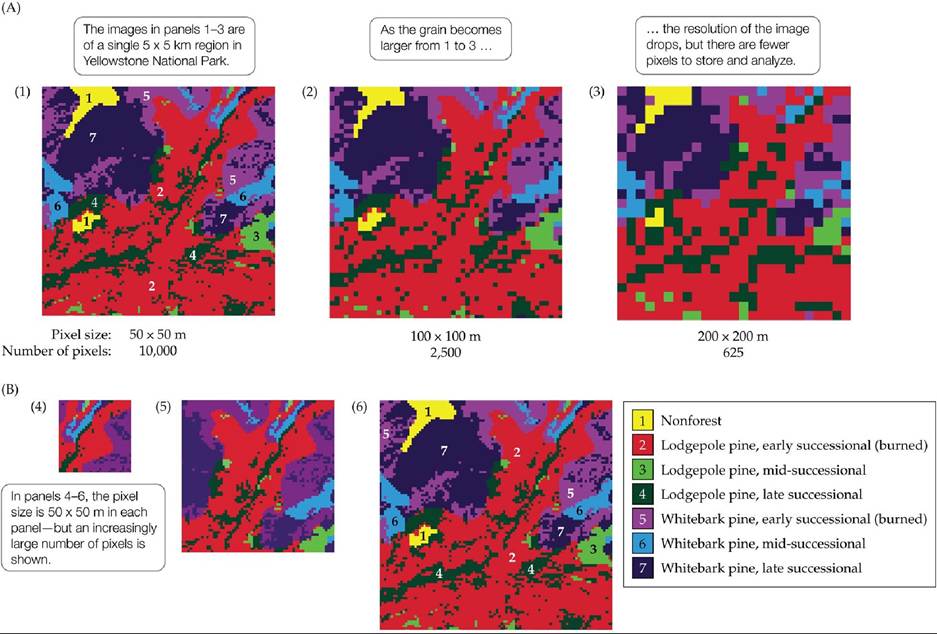
FIGURE 24.6 Effects of Grain and Extent (A) Panels 1-3 show the effect of increasing grain, measured here as pixel size. (B) Panels 4-6 show the effect of increasing extent.
The grain in panel 1 of (A) is identical to the grain in which of the panels of (B)?
(After M. G. Turner et al. 2001. Landscape Ecology in Theory and Practice: Pattern and Process. Springer: New York.) View larger image
Ecosystem and landscape studies considering questions impacted by scale must also determine how processes scale up or down. For example, a researcher studying carbon exchange at the landscape level needs to know how leaf-based measurements of CO2 exchange scale up to the whole plant, the ecosystem, and ultimately the mosaic of ecosystems that make up the landscape. This example shows the importance of connecting processes across different scales. Ecologists have developed methods to analyze how patterns and phenomena at one scale affect those occurring at either larger or smaller scales (see Levin 1992).
More on the topic A landscape is a heterogeneous area composed of a dynamic mosaic of interacting ecosystems:
- A landscape is a heterogeneous area composed of a dynamic mosaic of interacting ecosystems
- Reviewers