Disturbance both creates and is influenced by landscape heterogeneity
Landscapes are dynamic. Changes can occur gradually as a result of shifts in climates and moving continents. Change can also be sudden, such as large disturbances, which is our focus in this section.
For example, forests and prairies may burn over large areas, or floods bring sudden inputs of sediment into river ecosystems. We saw in Chapter 17 that disturbances can influence community composition. Landscape ecologists have asked, in turn, whether particular landscape patterns slow or accelerate the spread of disturbances or increase or decrease an ecosystem's vulnerability to disturbances.An opportunity to examine the influence of landscape patterns on the spread of fire occurred after the 1988 forest fires that burned nearly one-third of the 898,000 hectares (ha), or 2.2 million acres, of Yellowstone National Park. Fires this extensive are thought to have occurred in the northern Rockies at 100- to 500-year intervals over the past 10,000 years. The 1988 fires burned through forest stands of different ages and species compositions, leaving a complex mosaic of patches that were burned at different intensities (FIGURE 24.8). The type and arrangement of these patches will influence the landscape composition for centuries (Turner et al. 2003). Here, a disturbance—fire—was a primary force shaping the landscape pattern of the future. At the same time, the fire was also responding to the existing landscape structure through its influence on burn probability. This reciprocal interaction between landscape pattern and disturbance is a common one.
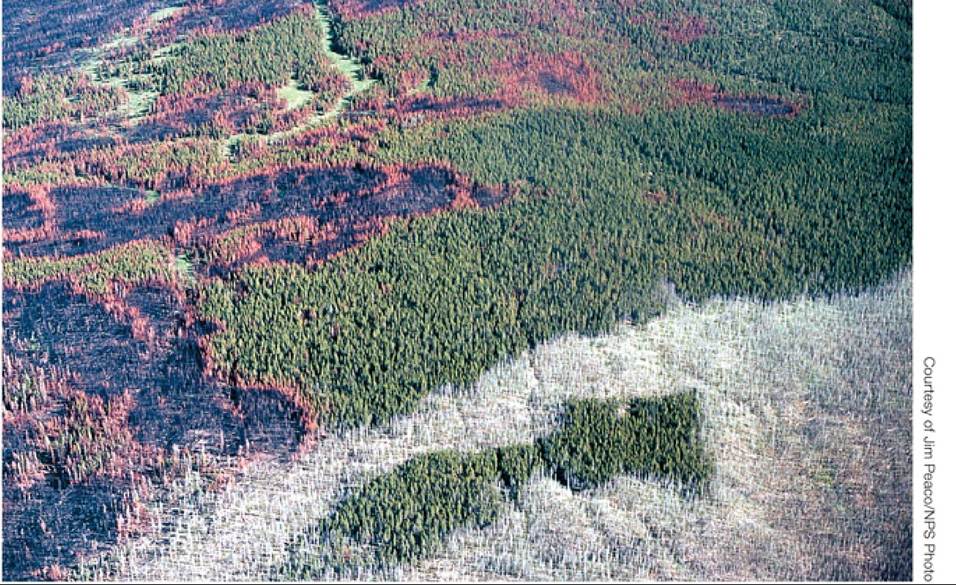
FIGURE 24.8 DjsturbancesGanShapeLandscapeRatterns Thefiresthatburned through nearly one-third of Yellowstone National Park in the summer of 1988 resulted in a complex mosaic of burned and unburned patches.
Areas that appear black in this aerial view of Madison Canyon were burned by intense crown fires, and brown patches were burned by severe ground fires, both of which killed most or all of the vegetation. View larger imageHuman actions have greatly altered the nature and extent of landscape-level disturbance. Some places have experienced greater human disturbance for a longer period of time than others. People first settled and cleared the areas with the most fertile soils, subjecting these ecosystems to the earliest human disturbance. Areas close to human settlements were converted to agriculture or had logging and hunting earlier than outlying areas. These disturbance patterns can be detected in ecological communities even centuries after people have left the land and it has reverted to forest (Butzer 1992).
Such landscape legacies can influence communities in subtle ways for centuries. In central France, Etienne Dambrine and his colleagues (2007) found that forest plant communities on the sites of recently uncovered Roman farming settlements still reflected the impacts of those disturbances 1,600 years later (FIGURE 24.9). These researchers studied plant diversity in the forest at various distances from the Roman ruins. Dambrine and colleagues found that plant species richness increased in the vicinity of the ruins. An examination of soil properties revealed that this increase was primarily a consequence of higher soil pH and phosphorus, associated with the remnants of the lime mortar used in Roman buildings and from Roman agricultural practices. How many other ecosystems on Earth might display the signatures of human activities long since abandoned in their current community structure?
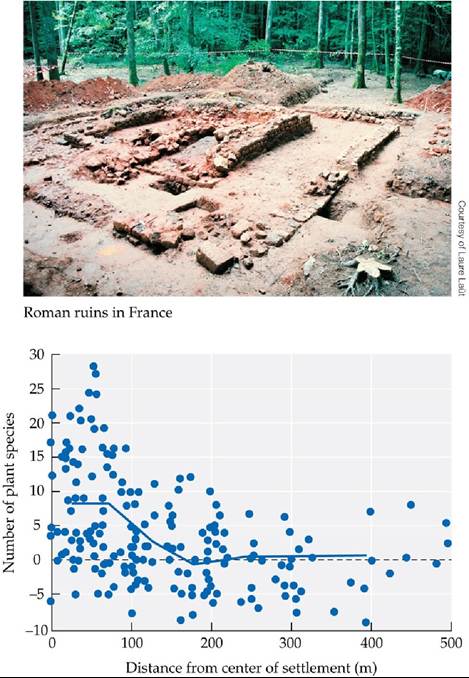
FIGURE 24.9 LandscapeLegacies In central France, the legacy of Roman farming settlements, abandoned for nearly two millennia, is still reflected by higher plant species richness in the forest that replaced them. More plant species were found closer to the center of settlement
sites, including more species that prefer a higher soil pH. The у axis represents departure from the mean calculated for plots 100-500 m from the settlement. (After E. Dambrine et al. 2007. Ecology 88: 1430-1439.) View larger image
Disturbance, whether natural or human-caused, is an important factor shaping the landscape. Some current human activities are creating disturbances with far- reaching ecological effects, as we'll see in the next section.