Natural selection shapes animal behaviors over time
As we've seen in earlier chapters of this book, an individual's fitness—that is, its ability to survive and reproduce—depends in part on its behavior. Therefore, natural selection should favor individuals whose behaviors make them efficient at activities such as foraging, obtaining mates, and avoiding predators.
To explore this idea further, recall from Concept 6.1 that natural selection is not a random process. Instead, when natural selection operates, individuals with particular traits consistently leave more offspring than do other individuals because of those traits. If the traits that confer advantage are determined in part by genes, then individuals that have those traits will pass them to their offspring. In such cases, natural selection can cause adaptive evolution, a process in which traits that confer survival or reproductive advantages tend to increase in frequency over time.
Applying these ideas to heritable behaviors, we would predict that as an outcome of natural selection, individuals should exhibit behaviors that improve their chances of surviving and reproducing. As illustrated by the practice of infanticide by male lions—a behavior that increases a male's chance of reproducing before he is displaced by a younger male—animal behaviors are often consistent with this prediction. Further support comes from studies that have documented adaptive behavioral change as it took place.
For example, Silverman and Bieman (1993) reported an adaptive behavioral change in populations of the German cockroach (Blattella germanica) (FIGURE 8.3). In the 1980s, efforts to control this cockroach often used baits that combined an insecticide with a feeding stimulant, such as glucose. Initially, these baits were highly effective, killing the vast majority of the cockroaches that encountered them. Over time, however, a novel behavioral adaptation, glucose aversion, emerged in some cockroach populations.
Cockroaches from these populations avoided feeding on glucose, causing the baits to become ineffective. This change in the feeding behavior of German cockroaches is heritable and is controlled by a single gene (Silverman and Bieman 1993). In particular, glucose aversion appears to result from mutations that affect taste receptor neurons. In individuals that exhibit glucose aversion, the presence of glucose activates taste receptor neurons that in other individuals are activated only by bitter substances (Wada-Katsumata et al. 2013).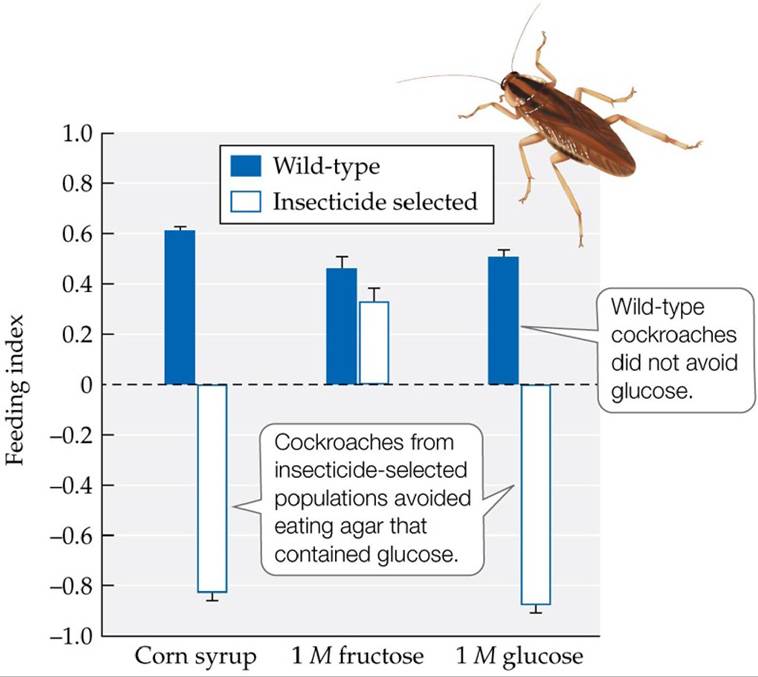
FIGURE 8.3 An Adaptive Behavioral Response Feeding behavior in two populations of the German cockroach (Blattella germanica), one of which (wild-type) had no prior exposure to insecticides, while the other had been exposed to insecticides. Cockroaches could choose to eat plain (unsweetened) agar, agar that contained one of three sources of sugar—fructose, glucose, or corn syrup (which contains both fructose and glucose)—or both. The diets the cockroaches selected were characterized by a feeding index ranging from 1.0 (indicating that 100% of their diet consisted of agar containing glucose) to -1.0 (indicating that 100% of their diet consisted of plain agar). Error bars show one standard error (SE) of the mean.
Give both a proximate and an ultimate explanation for glucose aversion in
B. germanica.
(After J. Silverman and D. N. Bieman. 1993. JlnsectPhysiol 39: 925-933.) View larger image
The increase in the frequency of glucose aversion in populations of cockroaches exposed to baits containing glucose shows how natural selection under different environmental conditions can shape behaviors over time. But for selection to have this effect—and for ultimate explanations of behavior to be convincing—a behavior must be determined at least in part by genes. Because later sections of this chapter emphasize ultimate explanations of behavior, we turn now to a closer examination of this key underlying assumption: that animal behaviors are determined by genes.