Behaviors are determined by genes and by environmental conditions
Many characteristics of an animal, including aspects of its behavior, are influenced both by genes and by environmental conditions (see Concepts 6.2 and 7.1). Later in this chapter, we'll discuss how certain features of the environment, such as the presence of predators, can alter an animal's behavior.
Here we'll focus primarily on genes, but it is essential to bear in mind that environmental conditions also affect most behaviors, even those that are strongly influenced by genes.The glucose-aversion behavior of cockroaches that we have just discussed is heritable and appears to be controlled by a single gene. However, this behavior is a relatively simple one—a cockroach either avoids glucose or it does not. But is there evidence for a genetic basis to more complex behaviors?
Weber et al. (2013) examined the genetics of one such complex behavior, burrow construction in mice. They studied two closely related species, oldfield mice (Peromyscus polionotus) and deer mice (P. maniculatus). In the wild, oldfield mice build complex burrows with a long entrance tunnel and an escape tunnel, while deer mice build much simpler burrows (FIGURE 8.4). Most other Peromyscus species construct simple burrows, or no burrows at all. The complex burrows built by oldfield mice are unique, and they may be an adaptation to avoiding predators in open habitats that provide little protective cover. Although snakes and other predators might spot oldfield mice easily in such habitats, the length of the burrow entrance tunnel and the presence of an escape tunnel might help a mouse evade a pursuing predator.
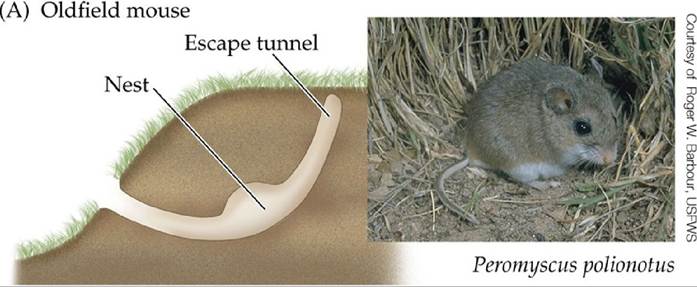
Long entry tunnel
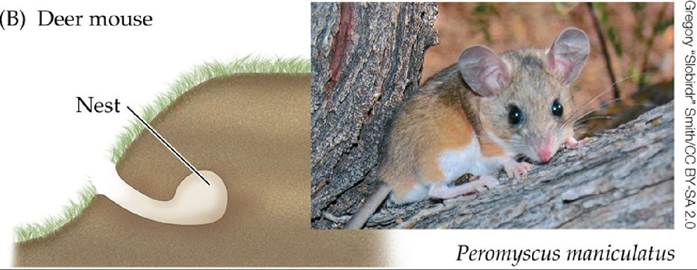
Short entry tunnel
FIGURE 8.4 Distinctive Mouse Burrows (A) The oldfield mouse (Peromyscus polionotus) constructs a complex burrow with a long entrance tunnel and an escape tunnel.
(B) The deer mouse (P. maniculatus) constructs a simpler burrow, with a short entrance tunnel and no escape tunnel. (After E. Callaway. 2013. Nature 493: 284.) View larger imageWeber et al. wanted to evaluate the contribution of genes to the unique burrowing behavior of oldfield mice. To do this, they took advantage of the fact that oldfield mice and deer mice can interbreed to form viable and fertile hybrid offspring and that both species exhibit their usual field burrowing behaviors in a laboratory enclosure. They examined the burrowing behaviors of oldfield mice, deer mice, and two different types of hybrid offspring: first-generation (F1) hybrids (offspring of matings between oldfield mice and deer mice) and later- generation backcross hybrids (offspring of matings between F1 individuals and deer mice).
The results indicated that the complex burrowing behavior of oldfield mice is affected by several different DNA regions. As expected, all of the oldfield mice and none of the deer mice built escape tunnels. In addition, 100% of the F1 hybrid mice built escape tunnels, and roughly 50% of the backcross mice built escape tunnels (FIGURE 8.5). These results and additional genetic mapping by Weber et al. indicate that a single chromosomal location, or genetic locus, controls whether the mice build escape tunnels, and that the genes for tunnelbuilding behavior are dominant. The complex burrow-building behavior of oldfield mice appears to have evolved as a combination of two simpler behaviors (construction of long entrance tunnels and construction of escape tunnels).
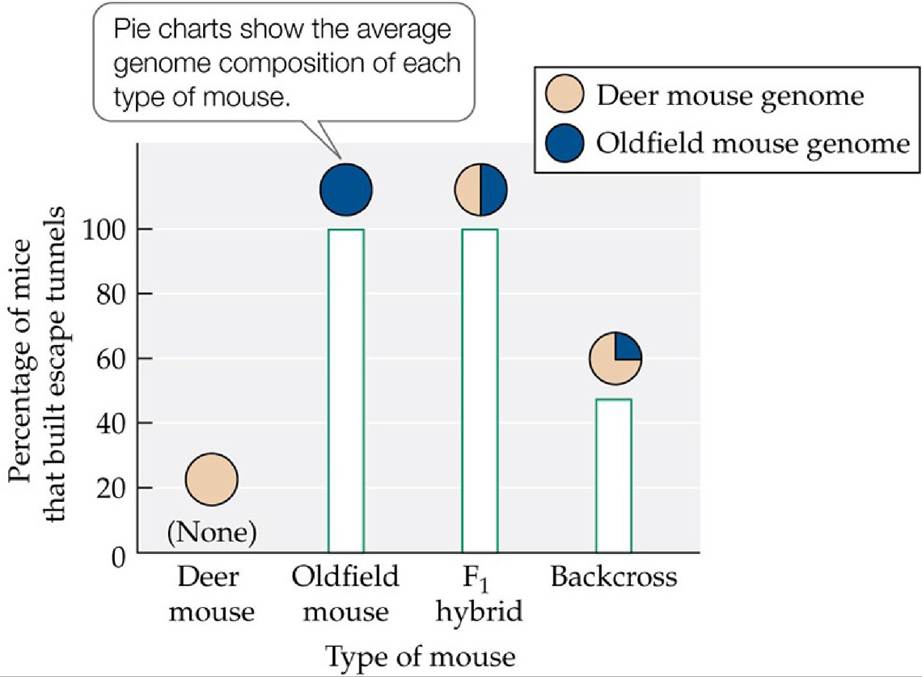
FIGURE 8.5 The Genetics of Escape Tunnel Construction Thegraphshowsthe proportions of deer mice, oldfield mice, hybrids, and backcross mice (i.e., offspring of a hybrid mouse and a deer mouse) that constructed burrows with escape tunnels.
Do the colors shown in the pie charts match what you would expect based on the types of mice used in this study? Explain.
(After J. N. Weber et al. 2013. Nature 493: 402-405.) View larger image
The study by Weber et al. is unusual in its use of both behavioral observations and genetic mapping to examine how genes affect a complex behavior of ecological importance. Although relatively few studies have identified genes that affect other such behaviors, a wide range of behaviors are known to be heritable, and typically those behaviors are influenced by multiple genes (van Oers and Sinn 2013).
Overall, it is clear that genes affect many behaviors, but it is important to keep a few caveats in mind. In particular, it is usually a mistake to assume that behaviors are under the control of one or a few genes. It is also wrong to assume that an individual that has an allele associated with a certain behavior will always perform that behavior—like an inflexible robot under the strict control of its genes. Instead, two individuals with identical alleles may behave differently. Moreover, individuals often change their behavior when in different environments, and these changes can occur quickly. For example, when the COVID-19 pandemic hit in 2020, noise created by motorized vehicles in cities impacted by business and school shutdowns decreased substantially. In response to the quieter conditions, white-crowned sparrows (Zonotrichia Ieucophrys) in the San Francisco Bay area altered their song performance and decreased the volume of their songs by 30%. Birds were able to hear songs proclaiming territorial occupation from twice as far away compared to conditions under the previous noise levels prior to the pandemic (Dewberry et al. 2020). By assuming that genes affect behaviors and that natural selection has molded behaviors over time, we can make specific predictions about how animals will behave in particular situations. Even when these predictions turn out to be wrong, an evolutionary view of behavior provides a productive approach to the study of animal behavior that can help us understand how animals interact in nature.