Adaptations are the result of natural selection
Unlike genetic drift, natural selection is not a random process. Instead, when natural selection operates, individuals with certain alleles predictably have higher survival and produce more offspring than do individuals with other alleles.
By consistently favoring individuals with some alleles over individuals with other alleles, natural selection causes adaptive evolution, a process of change in which traits that confer survival or reproductive advantages tend to increase in frequency over time. Although gene flow and genetic drift can improve the effectiveness of an adaptation (by increasing the frequency of an advantageous allele), they can also do the reverse (by increasing the frequency of a disadvantageous allele). Thus, natural selection is the only evolutionary mechanism that consistently results in adaptive evolution.An example of adaptive evolution is provided by changes in populations of the soapberry bug (Jadera haematoloma) (Carroll and Boyd 1992; Carroll et al. 1997). This insect uses its needle-like beak to feed on seeds located within the fruits of several different plant species. Soapberry bug populations in southern Florida feed on the seeds of the insect's native host, the balloon vine (Cardiospermum corindum). Balloon vines, however, are rare in central Florida. Thus, in that region, soapberry bugs do not feed on balloon vines, but instead feed on the seeds of a species introduced from eastern Asia, the goldenrain tree (Koelreuteria elegans). A few specimens of the goldenrain tree were brought to Florida in 1926, but it was not commonly planted until the 1950s. The oldest goldenrain trees in the central Florida populations studied by Carroll and colleagues were 35 years old, suggesting that the soapberry bugs there have fed on this species for 35 years or less.
Soapberry bugs feed most efficiently when the length of a bug's beak matches the depth to which it must pierce a fruit to reach the seeds.
Since goldenrain tree fruits are smaller than balloon vine fruits, the introduction of the goldenrain tree 35 years ago can be viewed as a natural experiment on the effect of selection on the insect's beak length. Carroll and Boyd predicted that as a result of natural selection, beak lengths would evolve to be shorter in soapberry bug populations that fed on goldenrain tree fruits than in populations that fed on the native host, balloon vines. Carroll and Boyd also studied soapberry bugs in Oklahoma and Louisiana, where the insect had begun to feed on several other new host plants that had been introduced within the past 100 years. However, in Oklahoma and Louisiana, the fruits of the introduced hosts were larger than those of the native hosts, leading to the prediction that in those two states, the beaks of insects that ate the introduced species would be longer than those of insects that ate the native species.In all three locations, Carroll and Boyd found that soapberry bug beak lengths evolved in the direction predicted by fruit size, decreasing in central Florida (FIGURE 6.11) and increasing in both Oklahoma and Louisiana. The changes in beak length were substantial: compared with historical values, average beak lengths dropped by 26% in central Florida and increased by 8% (on one introduced host species) and 17% (on another introduced host species) in Oklahoma and Louisiana. In addition, Carroll et al. (1997) showed that beak length is a heritable characteristic, so the observed changes in beak length must have been due at least in part to changes in the frequencies of alleles that affect beak length. Thus, we can conclude that in a relatively short time (35-100 years, or approximately 35-200 generations), natural selection in soapberry bug populations caused adaptive evolution in which a characteristic of the organism (beak length) evolved to match an aspect of its environment (fruit size) more closely.
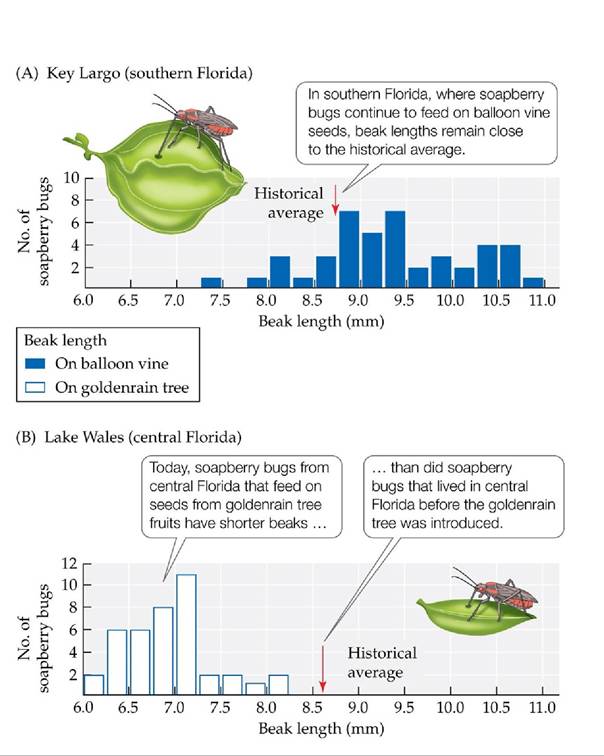
FIGURE 6.11 Adaptive Evolution in Soapberry Bugs Soapberry bug populations in southern Florida feed on the seeds of their native host, the balloon vine (A), while soapberry bug populations in central Florida feed on the seeds of an introduced plant, the goldenrain tree (B). The beak lengths of insects feeding on the goldenrain tree decreased by 26% in 35 years, providing a better match to the smaller fruits of this introduced plant. Red arrows indicate beak length historical averages (obtained from museum specimens collected before the introduction of goldenrain trees). (After S. P. Carroll and C. Boyd. 1992. Evolution 46: 1052-1069.) View larger image
More on the topic Adaptations are the result of natural selection:
- Differences between males and females can result from sexual selection
- Complex cycles may result from stagespecific selection pressures
- Natural selection shapes animal behaviors over time
- CONCEPT 6.3 Natural selection is the mechanism for adaptive evolution.
- CONCEPT 6.2 Natural selection, genetic drift, and gene flow can cause allele frequencies in a population to change over time.
- Natural selection increases the frequencies of advantageous alleles and decreases the frequencies of deleterious alleles
- Adaptations of organisms
- Adaptations are not perfect
- Primary abiotic factors and adaptations of organisms
- Topic: Organism and habitat. Primary abiotic factors and adaptations of organisms
- THYMIC SELECTION AND T CELL MATURATION
- CONCEPT 5.4 Heterotrophs have adaptations for acquiring and assimilating energy efficiently from a variety of organic sources.
- Personnel Selection
- Personnel Selection