Adaptive evolution can occur rapidly
Soapberry bugs are not unique: studies on populations of a wide range of other organisms show that natural selection can lead to rapid increases in the frequency of advantageous traits.
Examples include the evolution of increased antibiotic resistance in bacteria (in days to months); increased insecticide resistance in insects (in months to years); drabber coloration in guppies, which makes them harder for visually hunting predators to find (several years); and increased beak size in medium ground finches (several years; see Figure 6.6A). A study of anole lizards in the Turks and Caicos archipelago found that hurricanes can induce strong selection pressure for morphological traits that enhance the ability of the lizards to cling to trees (FIGURE 6.12; Donihue et al. 2018). These and many other examples of apparently rapid evolution are described by Endler (1986), Thompson (1998), and Kinnison and Hendry (2001); collectively, these studies suggest that what we think of as “rapid” evolution may in fact be the norm, not the exception.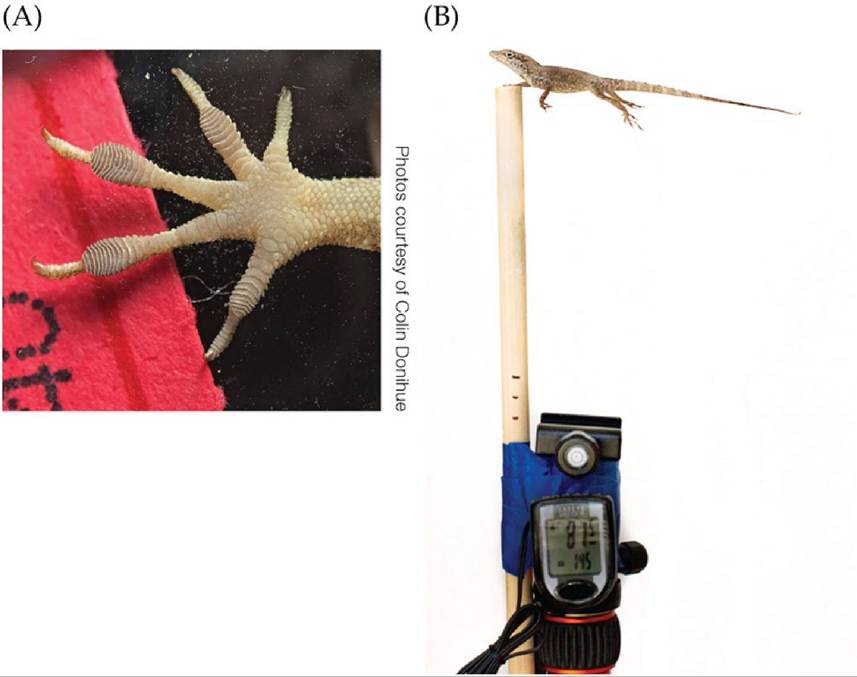
FIGURE 6.12 Rapid Adaptive Evolution in Anole Lizards Hurricanescanbeaverystrong selective force for anole lizards found on small islands in the Caribbean Sea. Following two hurricanes in a 2-week period, researchers found that, compared to the lizards analyzed prior to
the hurricane, the surviving lizards had wider footpads and shorter legs (A), which are two genetically based traits. These traits were experimentally shown to enhance the ability of the lizards to cling to dowels resembling branches under high winds (B). View larger image
Z
Climate Change Connection
Evolutionary Responses to Climate Change
Rapid, apparently adaptive evolution also has been documented in response to climate change.
Several such studies have focused on clines, patterns of change in a characteristic of an organism over a geographic region. For example, in the fruit fly Drosophila melanogaster, the alcohol dehydrogenase (Adh) gene exhibits a cline in which the Adhs allele decreases in frequency as latitude increases (FIGURE 6.13A). This pattern has been found in both the Northern and the Southern Hemisphere. Previous studies indicated that this cline results from natural selection on the Adhs allele, which codes for a form of the enzyme that is more effective in warmer temperatures at lower latitudes and hence is more common there.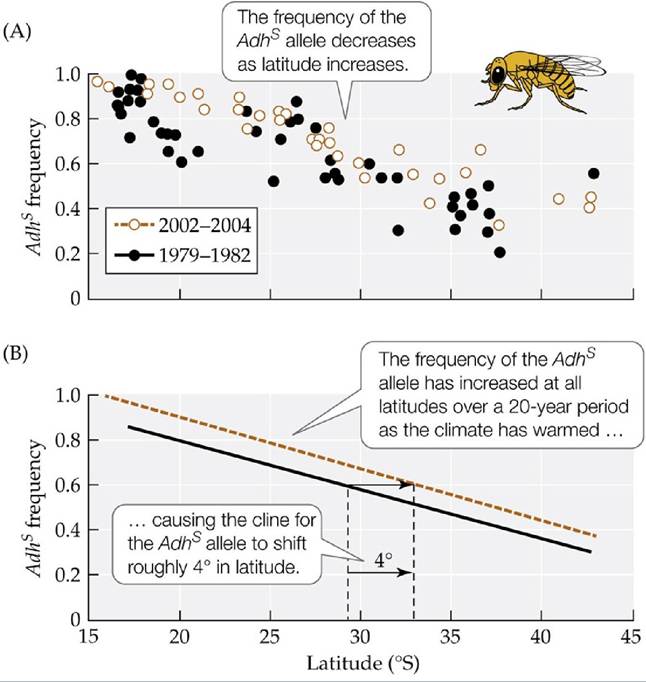
FIGURE 6.13 Rapid Adaptive Evolution on a Continental Scale TheAdhgene encodes a metabolically important enzyme, alcohol dehydrogenase, used to detoxify alcohol. Previous field and laboratory studies indicate that the Adhs allele of this gene is selected against in cooler environments, such as those found at high latitudes. (A) Frequencies of the Adhs allele in coastal Australian Drosophila melanogaster populations in 1979-1982 and in 2002-2004. (B) Regression lines calculated from the data in part A show that between 1979-1982 and 2002-2004, the cline of the Adhs allele shifted 4° toward the South Pole as the region's average temperatures increased by 0.5°C. (After P. A. Umina et al. 2005. Science 308: 691-693.) View larger image
Over a 20-year period in coastal Australia, the Adh cline shifted about 4° in latitude toward the South Pole (Umina et al. 2005), a movement of roughly 400 km (FIGURE 6.13B). During the same period, mean temperatures in the region increased by 0.5°C. Since the Adhs allele is favored at higher temperatures, the 4° shift in latitude appears to have been a rapid, adaptive increase in the frequency of this allele in response to climate change. Rapid evolutionary changes that are correlated with global warming have also been observed in worldwide populations of another fruit fly species, Drosophila subobscura (Balanya et al.
2006). Evolutionary responses to climate change over short periods have also been documented in pitcher-plant mosquitoes (Bradshaw and Holzapfel 2001), red squirrels (Reale et al. 2003), tawny owls (Karell et al. 2011), tufted knotweed (Sultan et al. 2013), and the mustard plant Brassica rapa (Franks et al. 2007).Finally, hundreds of species have altered the timing of key events in their lives in ways that may be a response to global warming, such as delaying the onset of winter dormancy or reproducing earlier in the spring (Parmesan 2006). In most of these cases, it is not yet known whether the observed changes are due to phenotypic plasticity (in which the same genotype can produce different phenotypes in different environments; see Concept 7.1), an evolutionary response (in which the genetic constitution of the population changes over time), or both. Research has begun to address this issue. For example, Jill Anderson and colleagues (2012) examined the contributions of phenotypic plasticity and evolution to changes in the flowering time of Boechera stricta, a mustard plant native to the U.S. Rocky Mountains. Data from a 38year field survey of B. stricta populations show that the date at which flowers first came into bloom was about 13 days earlier in 2011 than it was in 1973. Both adaptive evolution (flowers opened earlier in populations that experienced warming) and phenotypic plasticity contributed to the earlier flowering times observed for this species.