The natural world is filled with striking examples of organisms that are well suited for life in their environments.
This match between organisms and their environments highlights their adaptations, which are features that evolve by natural selection and improve an organism's ability to survive and reproduce in its environment (see Concept 4.1).
Examples of adaptations include remarkable features like those shown in FIGURE 6.10 but also include less visually striking characteristics—such as an enzyme in a desert plant that can function at high temperatures that would denature most enzymes, enabling the plant to thrive in its environment. There are literally millions of other examples of adaptations. How do these adaptations arise?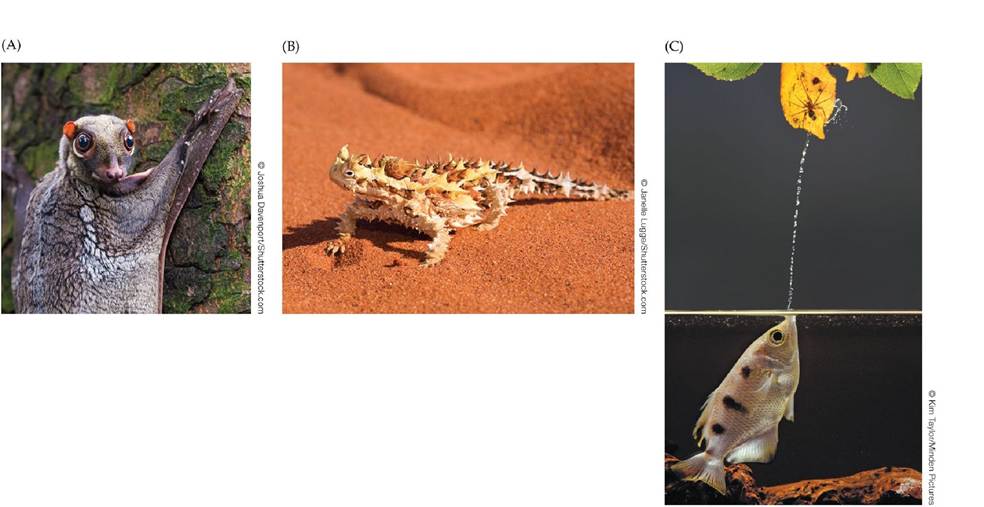
FIGURE 6.10 SomeStrikingAdaptations (A) The extensive skin extending from the neck to the limbs and to the toes and fingers of the Sundra flying lemur (Galeopterus variegatus) allows this animal to glide from tree to tree in the rainforest canopies of Southeast Asia. (B) The thorny devil (Moloch horridus) has adapted to withstand the dry scrubland and desert of central Australia. The animal's scales are ridged so that it can absorb water by simply touching it. (C) This archerfish (Toxotes chatareus) catches a spider by shooting a jet of water into the air. Field observations show that these fish will squirt repeatedly at potential prey and that they can reliably hit targets at heights of up to eight times their body length. View larger image