Natural selection increases the frequencies of advantageous alleles and decreases the frequencies of deleterious alleles
Natural selection occurs when individuals with particular heritable traits consistently leave more offspring than do individuals with other heritable traits. But some traits may give organisms an advantage only under certain environmental conditions.
Indeed, as we'll see later in this chapter, traits that are advantageous in one environment can be disadvantageous in another.Depending on what traits are favored, we can categorize natural selection into three types (FIGURE 6.6). Directional selection occurs when individuals with one extreme of a heritable phenotypic trait (e.g., large size) are favored over other individuals (small and medium-sized individuals). In stabilizing selection, individuals with an intermediate phenotype (e.g., medium-sized individuals) are favored, while in disruptive selection, individuals with a phenotype at either extreme are favored (e.g., both small and large individuals have an advantage over medium-sized individuals). However, in all three types of natural selection, the fundamental process is the same: some individuals have heritable phenotypes that give them an advantage in survival or reproduction, causing them to leave more offspring than other individuals.
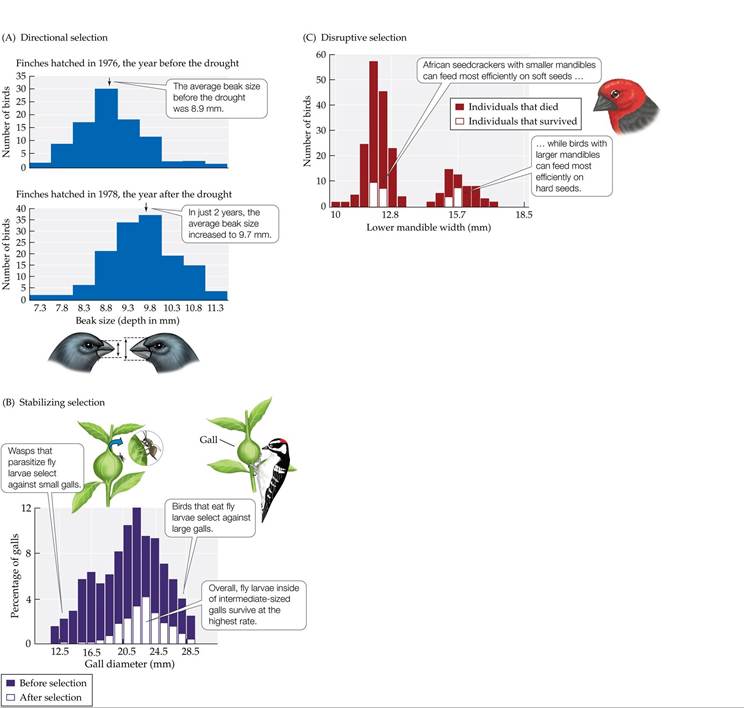
FIGURE 6.6 Three Types of Natural Selection (A) Directional selection favors individuals at one phenotypic extreme. A prolonged drought in the Galapagos archipelago resulted in directional selection on the beak size of the seed-eating medium ground finch (Geospiza fortis). As a result of the drought, most of the available seeds were large and hard to crack, so birds with large beaks, which could more easily crack those seeds, had an advantage over birds with smaller beaks. (B) Stabilizing selection favors individuals with an intermediate phenotype.
Eurosta flies parasitize goldenrod plants, causing the plant to produce a gall in which the fly larva matures as it feeds on the plant. The preferences of Eurosta,s own predators and parasites result in stabilizing selection on gall size. Field observations showed that wasps that parasitize and kill the fly larvae prefer small galls, while birds that eat the fly larvae prefer large galls. As a result, larvae in galls of intermediate size have an advantage. (C) Disruptive selection favors individuals at both extremes. African seedcrackers (Pyrenestes ostrinus) depend on two major food plants in their environment. Birds with smaller mandible sizes can feed on one plant's soft seeds most efficiently, while birds with larger mandibles can feed on the other plant's hard seeds most efficiently. Thus, individuals with mandible sizes that are either relatively small or relatively large have an advantage.In (B), do birds or wasps appear to provide stronger selection pressure on gall size? Explain.
(A after B. R. Grant and P. R. Grant. 2003. BioScience 53: 965-975; B after A. E. Weis and W. G. Abrahamson. 1986. Am Nat 127: 681-695; C after T. B. Smith. 1993. Nature 363: 618-620.) View larger image
When selection favors a particular phenotype, individuals with alleles that encode that phenotype are likely to leave more offspring than are individuals with other alleles. As a result, alleles that encode a favored phenotype can increase in frequency from one generation to the next. In some cases, the end result of this process is that most or all of the individuals in a population have an allele that encodes a trait favored by selection. A well-studied example is the Andean goose (Chloephaga melanoptera), which lives at high elevations. These birds have evolved a version of the oxygen transport protein hemoglobin that has an unusually high affinity for oxygen and hence provides an advantage at high altitudes with low oxygen partial pressure (Weber 2007; McCracken et al. 2009). The allele that encodes this version of hemoglobin occurs at a frequency of 100% in Andean goose populations. An allele such as this that occurs in a population at a frequency of 100% is said to have reached fixation.
To recap, natural selection can cause the frequency of an allele that confers an advantage to increase over time, as has occurred in populations of the Andean goose. We'll consider the consequences of such increases in the frequencies of advantageous alleles later in this chapter. But first, we'll look at two other mechanisms that can cause allele frequencies to change: genetic drift and gene flow.
More on the topic Natural selection increases the frequencies of advantageous alleles and decreases the frequencies of deleterious alleles:
- CONCEPT 6.2 Natural selection, genetic drift, and gene flow can cause allele frequencies in a population to change over time.
- Gene flow is the transfer of alleles between populations
- Species richness increases with area and decreases with distance
- Adaptations are the result of natural selection
- Natural selection shapes animal behaviors over time
- CONCEPT 6.3 Natural selection is the mechanism for adaptive evolution.
- Selection can favor a diversity of host and parasite genotypes
- THYMIC SELECTION AND T CELL MATURATION
- Loss of stratospheric ozone increases transmission of harmful radiation
- CONCEPT 10.2 The risk of extinction increases in populations that fluctuate in size and/or are small.
- Differences between males and females can result from sexual selection
- Personnel Selection