Loss of stratospheric ozone increases transmission of harmful radiation
About 2.3 billion years ago, when prokaryotes first evolved the capacity to carry out photosynthesis, oxygen began to accumulate in Earth's atmosphere, leading to a series of changes that facilitated the evolution of greater physiological and biological diversity.
The increase in atmospheric oxygen (in the form of O2) also led to the formation of a layer of ozone (O3) in the stratosphere (at an altitude 630 miles [10-50 km] above Earth's surface). This ozone layer acts as a shield protecting Earth's surface from high-energy ultraviolet-B (UVB) radiation (0.25-0.32 μm). UVB radiation is harmful to all organisms, causing damage to DNA and photosynthetic pigments in plants and bacteria, impairment of immune responses, and cancerous skin tumors in animals, including humans.Stratospheric ozone concentrations change seasonally as a result of changes in atmospheric circulation patterns, particularly in the polar zones, where they decline in spring. British scientists measuring ozone concentrations in the Antarctic were the first to record an unusually large decrease in springtime stratospheric ozone concentrations starting in 1980. Springtime minimum ozone concentrations decreased by as much as 70% between 1980 and 1995 (FIGURE 25.23). There was also a concomitant increase in the area of the Antarctic region experiencing a decrease in ozone, called the ozone hole. An ozone hole is defined as an area with an ozone concentration of less than 220 Dobson units (= 2.7 ? 1016 molecules of ozone) per square centimeter; prior to 1979, average annual ozone concentrations had never been recorded below this level. Ozone decreases have been recorded between 25°S and the South Pole. Similar reductions in ozone have been recorded in the Arctic (from 50°N to the North Pole), although the magnitude of the decrease has not been as great (thus conferring the name Arctic ozone dent, since ozone concentrations have not
dropped below 220 Dobson units).
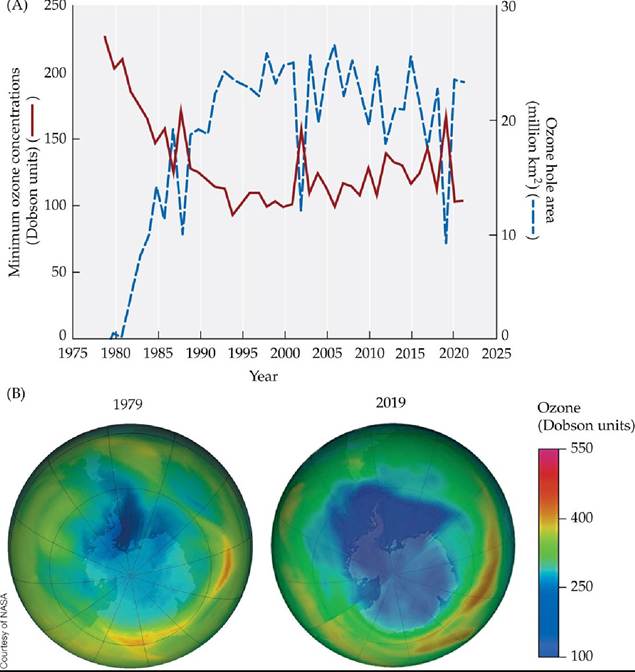
FIGURE 25.23 TheAntarcticOzoneHole (A) Since 1980, there has been a dramatic decrease in springtime ozone concentrations over the Antarctic region, with concentrations dropping below the threshold for ozone hole status (220 Dobson units) for a large proportion of the region after 1984. (B) Average ozone concentrations over Antarctica for the month of September in 1979 and 2019 demonstrate the dramatic decrease that occurred during this period. The lowest ozone concentrations are shown in dark blue. (A, data from ozonewatch.gsfc.nasa.gov.) View larger image
The decrease in stratospheric ozone was predicted in the mid-1970s by Mario Molina and Sherwood Rowland, who discovered that certain chlorinated compounds, particularly chlorofluorocarbons (CFCs), could destroy ozone molecules. CFCs were developed in the 1930s for use as refrigerants and were later found to be useful as propellants in spray cans dispensing hair spray, paint, deodorants, and many other products. By the 1970s, as much as a million metric tons of CFCs were being produced every year. Molina and Rowland (1974) found that CFCs did not degrade in the troposphere and could remain there for a very long time (50-140 years). From the troposphere, CFCs can move slowly into the stratosphere, where they react with other compounds, particularly in the polar regions during winter, to produce reactive chlorine molecules that destroy ozone. Other anthropogenic compounds with the same effect include carbon tetrachloride, used as a solvent and to fumigate grain, and methyl chloroform, used as an industrial solvent and degreaser. A single reactive chlorine atom has the potential to destroy 100,000 ozone molecules. Thus, the danger posed by chlorinated compounds to the stratospheric ozone layer was clear to Molina and Rowland.
The amount of UVB radiation at Earth's surface increases as concentrations of stratospheric ozone decrease (Madronich et al.
1998). These increases in UVB have been most notable in the Antarctic region, which has experienced an increase in UVB radiation of as much as 130% during spring. Increases have also been recorded in the Northern Hemisphere, including a 22% increase at mid-latitudes during spring.These increases in UVB radiation at Earth's surface have coincided with an increasing incidence of skin cancer in humans, which is now approximately 10 times more common than it was in the 1950s. UVB radiation had an important role in the evolution of pigmentation in humans (Jablonski 2004). The production of melanin, a protective skin pigment, was evolutionarily selected for in humans living at low latitudes, where ozone levels are naturally lowest and the highest levels of UVB radiation reach Earth's surface. As humans migrated away from equatorial Africa into colder climates with less sunlight, however, high amounts of melanin in the skin limited production of vitamin D, resulting in selection for lower melanin production in peoples of higher latitudes. As these lighter-skinned humans have subsequently migrated into environments with higher UVB radiation, to which their complexions are not adapted, they have increased their risk of skin cancers. This is also true for populations at high latitudes in the Southern Hemisphere, including Australia, New Zealand, Chile, Argentina, and South Africa, where exposure to UVB is enhanced by stratospheric ozone loss. Concern is particularly great in Australia, where nearly 30% of the population has been diagnosed with some form of skin cancer.
Substantial evidence exists to indicate that increasing UVB radiation has important ecological effects (Caldwell et al. 1998; Paul and Gwynn-Jones 2003). UVB radiation damages membranes and nucleic acids (DNA and RNA) of organisms, impacting metabolic function and increasing susceptibility to other stresses and disease. Sensitivity to UVB radiation varies among the species within a community, and as a result, changes in community composition are likely to result from increased UVB radiation.
The potential for detrimental UVB effects due to stratospheric ozone loss is greatest at high latitudes and at high elevations (>3,000 m, or 9,800 feet) because of lower atmospheric filtering of UV radiation.The realization of the rapid decreases in stratospheric ozone concentrations, and of their probable anthropogenic cause, resulted in several international conferences on ozone destruction in the 1980s. At these conferences, the Montreal Protocol, an international agreement calling for the reduction and eventual end of production and use of CFCs and other ozone-degrading chemicals, was developed. The Montreal Protocol has been signed by more than 150 countries. Atmospheric concentrations of CFCs have remained the same or, in most cases, declined since the Montreal Protocol went into effect in 1989 (FIGURE 25.24). A progressive recovery of the ozone layer is expected to occur over several decades, since the slow mixing of the troposphere, with the long- lived CFCs it still contains, and the stratosphere will result in a time lag before stratospheric ozone concentrations rise. The trends in stratospheric ozone concentrations shown in Figure 25.23 indicate ozone destruction is slowly declining in response to lower emissions of CFCs, and a full recovery of the ozone layer is not expected until 2050. An estimated 280 million cases of skin cancer and 1.6 million skin cancer deaths have been avoided as a result of the Montreal Protocol.
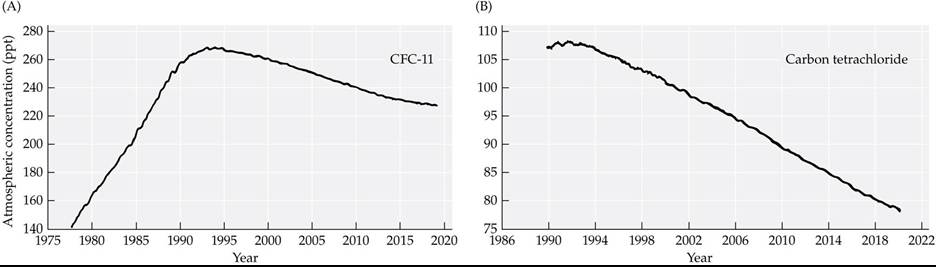
FIGURE 25.24 ProgressagainsttheOzoneKillers Measurementsofatmospheric concentrations of ozone-destroying chlorinated compounds, in parts per trillion (ppt), at five monitoring locations across the globe show that several of them have declined since the signing of the Montreal Protocol in 1989. (Data from NOAA/Earth System Research LaboratoryZGlobal Monitoring DivisionZHATS Flask Sampling Program. ⅞∙3*/ https://www.esrl.noaa.gov/gmd/hats/flask/flasks.html.) View larger image