Tropospheric ozone is harmful to organisms
Ninety percent of Earth’s ozone is found in the stratosphere. The remaining 10% occurs in the troposphere. Tropospheric (including ground-level) ozone is generated by a series of reactions involving sunlight, NOx, and volatile organic compounds such as hydrocarbons, carbon monoxide, and methane.
In some regions, natural vegetation can be an important source of volatile organic compounds, which include terpenes (which give pines their characteristic odor) and isoprene. Under natural atmospheric conditions, the amount of ozone produced in the troposphere is very small, but anthropogenic emissions of ozone precursor molecules have greatly increased its production. Air pollutants that produce ozone can travel long distances, and thus tropospheric ozone production is a widespread concern.Tropospheric ozone is environmentally damaging for two main reasons. First, ozone is a strong oxidant; that is, the oxygen in it reacts easily with other compounds. Ozone causes respiratory damage and is an eye irritant in humans and other animals. An increase in the incidence of childhood asthma has been linked to exposure to ozone. Ozone damages the membranes of plants and can decrease their photosynthetic rates and growth. Ozone also increases the susceptibility of plants to other stresses, such as low water availability. Decreases in crop yields have been associated with exposure to ozone. Characteristic symptoms of ozone pollution have been found in plants near urban areas since the 1940s and 1950s (e.g., in the San Gabriel Mountains near Los Angeles and in the northern Alps in Italy), but more recently, symptoms have been noted in national parks and wilderness areas farther from sources of pollution. For example, plants in the Sierra Nevada of California are negatively affected by ozone generated in the Central Valley and the San Francisco and Los Angeles urban areas (Bytnerowicz et al.
2003). Growth rates of trees in forests of the eastern United States are as much as 10% lower than they would be in the absence of ozone (Chappelka and Samuelson 1998).Second, ozone is a greenhouse gas that can contribute to global climate change. Ozone has a short life span in the atmosphere relative to other greenhouse gases, however, and its concentration can vary greatly from place to place. Thus, the effect of anthropogenic ozone on climate change is difficult to estimate.
Strategies to limit tropospheric ozone production have focused on lowering anthropogenic emissions of NOx and volatile organic compounds. In most developed countries, efforts to lower emissions of ozone-producing compounds have met with success. In the United States, for example, emissions of volatile organic compounds dropped by 50% between 1970 and 2004, emissions of NOx dropped by more than 30% (U.S. EPA 2005), and tropospheric ozone concentrations are decreasing near large urban areas (Cooper et al. 2014). Regulation of emissions of ozone-producing compounds has not been as strict in some developing countries, however. Ozone is a serious air pollutant in urban and agricultural regions of China and India.
A Case Study Revisited
Dust Storms of Epic Proportions
We've seen throughout this chapter that many aspects of global ecology—such as greenhouse gases and climate change, emissions and deposition of N and S, and stratospheric destruction and tropospheric production of ozone—involve transport and chemical processes in the atmosphere. The movements of dust described in this chapter's Case Study are also influenced by atmospheric processes, including rainfall patterns and wind. We've also seen that humans change the environment at a global scale through emissions of greenhouse gases and pollutants into the atmosphere. Land use change, which alters the amount and type of vegetation cover, generally influences the environment at a more local scale. However, land use change in arid zones that are subject to periodic severe droughts can have global-scale effects by enhancing the amount and spread of dust into the atmosphere.
During the early part of the twentieth century, the southwestern Great Plains of the U.S. was opened up for agricultural development. The natural vegetation of the region consisted of drought- and grazing-tolerant grasses. Bison, which had grazed the land for centuries, were replaced by cattle in the late nineteenth century. Economic demand for wheat, due to losses of agricultural lands in Europe during World War I, and the recent population expansion into the southern Great Plains encouraged the development of agriculture. Although this area was known to experience periodic droughts, farmers, encouraged by the notion that “rain follows the plow” and by recent technological developments in farming, cultivated large areas of land, plowing under the native prairie grasses and replacing them with wheat. For a while, the weather was conducive to agriculture, and the farmers prospered. However, the 1930s brought prolonged severe drought. Fields dried up, and with no protective network of roots to hold it together, the soil began to blow away. Major dust storms carried the soil across the North American continent and all the way to the Atlantic Ocean. The Dust Bowl event is still considered the worst environmental disaster the United States has ever experienced (Egan 2006).
Similar circumstances in Asia enhanced the severity of dust storms there. Deforestation, the development of agriculture in marginal zones, overgrazing, and the drainage of the Aral Sea for irrigation have all been implicated in the increased severity of dust storms following the mid-1990s (Wang et al. 2004).
While dust storms in urban areas are a rarity, large-scale dust storms regularly occur in desert regions (FIGURE 25.25). However, both the American Dust Bowl and Asian examples suggest that while dust storms are a natural phenomenon, a combination of agricultural development of marginal lands and severe drought exacerbates these events (Cook et al. 2009). At a global scale, extreme droughts and land use change contribute one-third to one- half of the inputs of dust into the atmosphere (Tegen and Fung 1995).
Desert regions, such as the Gobi and Sahara-Sahel regions, have expanded at their margins because of land use change since the 1970s, increasing the global impact of dust storms. For example, Asian dust has been detected in the European Alps, traveling two-thirds of the way around the globe in approximately a week (Grousset et al. 2003). On a geologic time scale, major periods of dust redistribution occur in association with the recession of large ice sheets during interglacial periods, as evidenced by the distribution of loess soils, some hundreds of meters thick, across North America and Europe (FIGURE 25.26).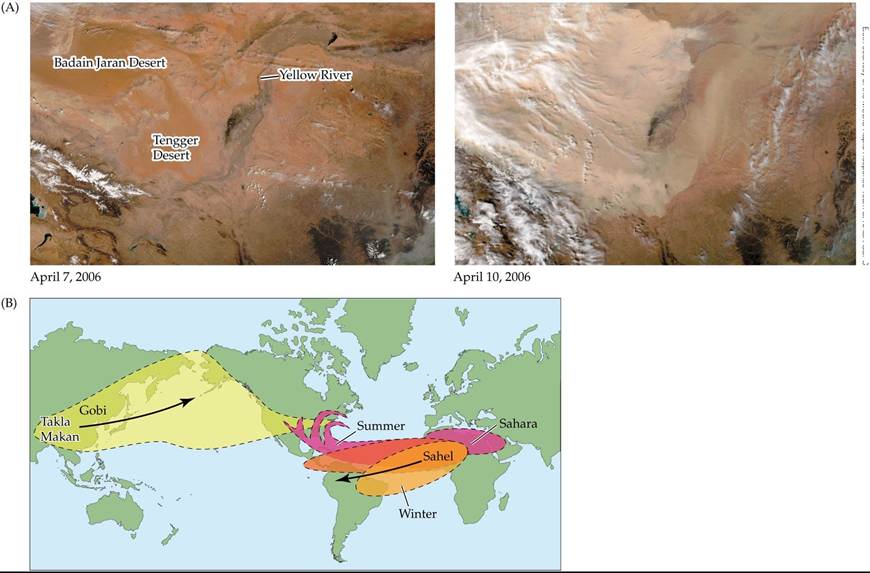
Both courtesy of the MODIS Rapid Response Team at NASA GSFC
FIGURE 25.25 Desert Origins of Global Dust Storms Deserts are sources of dust that may travel large distances and have important ecological impacts in distant regions. (A) The photo on the left is a satellite image of the Gobi desert in early April 2006. The
photo on the right shows the same region 3 days later, obscured by a massive dust storm. (B) Sources of the dust deposited in the Caribbean region include the deserts of North America and Asia. The main directions of dust flow are indicated by arrows. (B adapted from illustration by Betsy Boynton in V. H. Garrison et al. 2003. BioScience 53: 469-480.) View larger image
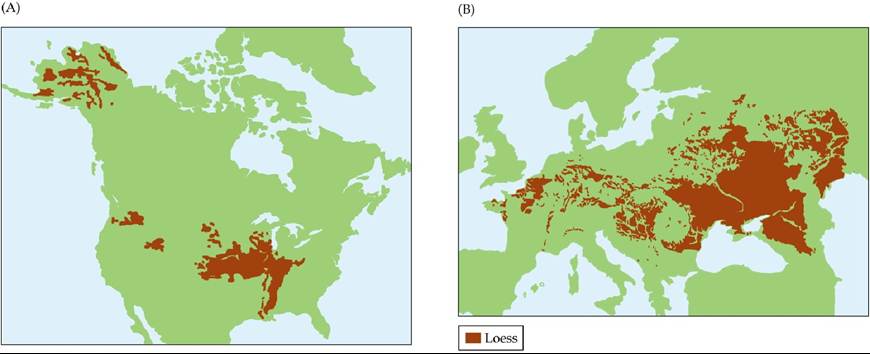
FIGURE 25.26 DistributionofLoessSoils As continental glaciers receded following the most recent glacial maximum, wind carried substantial amounts of loose soil from the exposed areas. Large areas of (A) North America and (B) Europe were covered with deep layers of this material, which developed into loess soils. (A after D. R. Muhs. 2007. In Encyclopedia of Quaternary Science, pp. 2075-2086. Elsevier: New York; B after D. Haase et al. 2007. Quat Sci Rev 26: 1301-1312.) View larger image
Connections in Nature
Dust as a Vector of Ecological Impacts
The ecological effects of dust removal and deposition are not fully understood, but one of the best-studied effects is the movement of nutrients (as described in Chapter 22) at spatial scales ranging from a few meters to continents and oceans (Field et al.
2010). Dust deposition of nutrients can have important consequences for primary production and the global carbon cycle. The supply of iron (Fe) from dust deposition is important for oceanic primary production (Mahowald et al. 2005), as we saw in Concept 20.2. Dust from the Asian storms described earlier has been associated with algal blooms in the Pacific, and inputs of cations from African dust are important to primary production in tropical forests in the Amazon (Okin et al. 2004). In contrast, the removal of surface soils by wind can lead to lower production due to losses of organic matter and fine mineral particles, which are important for nutrient supply and retention. Dust may also be important in long-distance transport of pathogens (Garrison et al. 2003) and pollutants (Jaffe et al. 2003) and may influence disease dynamics (as described in Concept 13.5).The ecological effects of dust movement can be both direct and indirect. Nutrient input and loss are examples of its direct effects. An example of an indirect effect occurs in the southwestern United States when dust transported from the Colorado Plateau falls in the Rocky Mountains and alters the timing of snowmelt. As noted in the Case Study in Chapter 22, grazing and recreational vehicle use have disturbed biological soil crusts in arid lands of the Colorado Plateau, increasing their erodibility and dust input into the atmosphere. Most of the dust is swept away in spring storms, and some ends up deposited in snow on the Rockies (FIGURE 25.27). The dust increases the amount of sunlight absorbed by the land surface, warming the snow and causing accelerated melting. Earlier snowmelt has the potential to increase the length of the growing season for plants growing in areas with deep snow cover. However, rather than stimulating earlier growth of plants in areas that melt sooner, accelerated snowmelt delays the initiation of growth and flowering of alpine plants, which wait to grow when air temperatures are suitable.
This delay results in greater synchrony of greening up of alpine plants, possibly leading to greater competition (Steltzer et al. 2009). In contrast, earlier snowmelt in lower-elevation subalpine meadows triggers some plants to initiate growth immediately, exposing them to potentially killing frosts (Inouye 2008). The surrounding subalpine forests may experience water shortages when snowmelt occurs earlier, which may lower their NPP (Hu et al. 2010). The ecological impacts of dust, both direct and indirect, remind us that ecological phenomena occur at a global scale, have widespread importance, and testify to the role of humans in intensifying their effects.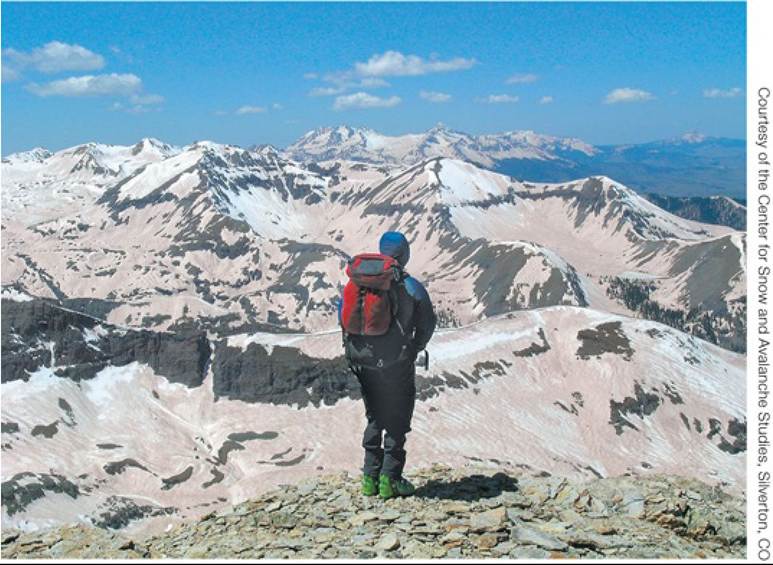
FIGURE 25.27 DustySnowintheRockies Dust from the Colorado Plateau is carried by spring storms to the Rocky Mountains, where it increases absorption of sunlight by snow and accelerates its melting. Earlier snowmelt has important implications for mountain ecosystems and regional hydrology. View larger image