Mutation generates the raw material for evolution
Individuals in populations may differ from one another in their phenotype, the observable characteristics of an organism, such as size or color (FIGURE 6.5). Many aspects of an organism's phenotype, including its physical features, metabolism, growth rate, susceptibility to disease, and behavior, are influenced by its genes.
As a result, individuals differ from one another, in part because they have different alleles of genes that influence their phenotype. These different alleles arise by mutation, a change in the DNA of a gene. Mutations result from events such as copying errors during cell division, mechanical damage when molecules and cell structures collide with DNA, exposure to certain chemicals (called mutagens), and exposure to high-energy forms of radiation such as ultraviolet light and X rays. As we'll see in Concept 7.1, the environment can also affect an organism's phenotype. For example, a plant growing in nutrientrich soil may grow larger than another individual of the same species growing in nutrient-poor soil, even if both have the same alleles of genes that influence size. In this chapter, however, we will focus on phenotypic differences that result from genetic, not environmental, factors.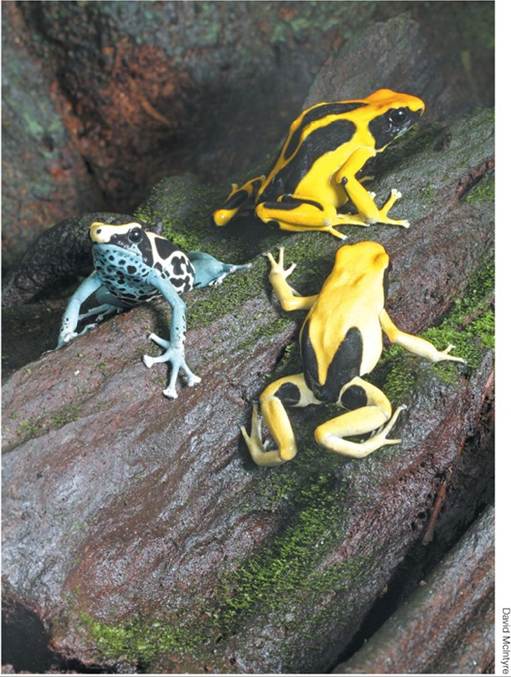
FIGURE 6.5 Individuals in Populations Differ in Their Phenotypes Poisondartfrogs (Dendrobates tinctorius) show great variation in color and pattern. Native to northern South America, these frogs live in isolated patches of forest. Their bright colors are thought to serve as a warning to predators of a poison excreted from their skin. Individual frogs likely also differ in other morphological traits as well as in biochemical, behavioral, and physiological traits. View larger image
The formation of new alleles by mutation is critical to evolution.
If a species lacked mutations, each gene would have only one allele, and all members of a population would be genetically identical. If this were the case, evolution could not occur: allele frequencies cannot possibly change over time unless the individuals in a population differ genetically. Individuals in a population can differ genetically not only because of mutation, but also because of recombination, the production of offspring that have combinations of alleles that differ from those in either of their parents. We can think of mutation as providing the raw material (new alleles) on which evolution is based, and recombination as rearranging that raw material into unique new combinations. Together, these processes provide the genetic variation among individuals that is required for evolution to occur.Despite its importance to evolution, mutation usually occurs too rarely in most cases to be the direct cause of significant allele frequency change over short periods of time. Mutations typically occur at rates of 10-4 to 10-6 new mutations per gene per generation (Hartl and Clark 2007). In other words, in each generation, we can expect one mutation to occur in every 10,000 to 1,000,000 copies of a gene. At these rates, in one generation, mutation acting alone causes virtually no change in the allele frequencies of a population. Eventually, mutation can cause appreciable allele frequency change, but typically it takes thousands of generations for it to do so. Overall, in terms of its direct effects, the background mutation rate is a weak agent of allele frequency change. But because it provides new alleles on which natural selection and other mechanisms of evolution can act, mutation is central to the evolutionary process. It should be noted, however, that some environmental factors, such as exposure to high- energy radiation (e.g., radioactivity or X rays) and some mutagenic chemicals, can greatly increase mutation rates.
The evolution of antibiotic resistance is an example where mutation rates are frequent enough to influence allele frequencies in a population. There are around 40 trillion (4 ? 1013) bacterial cells in a human body, consisting of around 500 distinct species. Given the mutation rate described above, we could expect an appreciable number of alleles to appear in a population in each generation. The majority of these mutations are deleterious—that is, they lower growth and reproduction of the bacteria. However, some alleles confer greater resistance to antibiotics applied to kill them. As a result, the efficacy of antibiotics is potentially compromised, particularly with regular application, which enhances the potential for natural selection to favor the allele conferring resistance.
More on the topic Mutation generates the raw material for evolution:
- During the 1990s, the market for mortgage origination fluctuated between $500 billion and $1.5 trillion and provided the raw material for MBSs.
- Chapter 4 Testing Brantingham's Neutral Model: The Effect of Spatial Clustering on Stone Raw Material Procurement
- Assuming 5000 Unique Raw Materials
- Assuming 20 Unique Raw Materials
- Mutation of a Sector
- The previous chapter described a world where a financial accelerator first generates a lending driven boom and then its inevitable collapse.
- THE ROLE OF MATERIAL CULTURE
- Foreign Material
- From Goods to Gods: The Material Turn and Ritual Studies
- Troika Material
- ORGANIZATION OF THE MATERIAL
- Prehistoric material and religion: a personal odyssey
- THE “DIVINE TWINS” IN TEXTS AND MATERIAL CULTURE
- EARLIEST MATERIAL EVIDENCE FOR RELIGIOUS CULTS
- The evolution of the biosphere