Assuming 5000 Unique Raw Materials
Raw Material Richness in Tool Kit Two different patterns are visible when investigating raw material richness. First, when a forager engages in random or wiggle walk, a more clustered environment leads to lower average raw material richness in the toolkit (Fig.
4.4). However, these relationships are not statistically significant. The random walk data has a non-significant moderate positive relationship with thepr values (Spearman’s rs = 0.6; p = 0.23), while the wiggle walk data has a non-significant weak positive relationship with the pr values (Spearman’s rs = 0.3; p = 0.52). Because the forager will consume a unit of raw material at every time step if material is available in the tool kit and will refill the toolkit to the maximum when encountering a source, a high encounter frequency in combination with encountering new sources evenly distributed across the map will increase the richness. This is because no single raw material has a chance to dominate the frequency make-up of the tool kit. As clustering increases, the forager will on average move longer periods without encountering a source. Due to this and the fact that the forager use a material at every step, the forager will then when encountering a source fill up the tool kit to the maximum capacity resulting in one raw material dominating the make-up of the tool kit in terms of frequency. However, as noted above, this relationship is not statistically significant.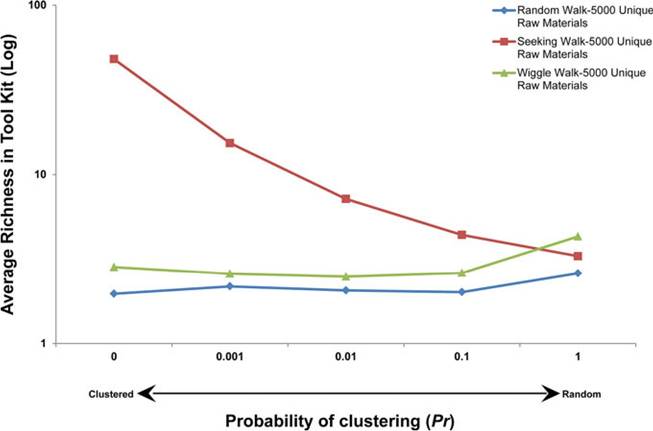
Fig. 4.4 Average richness of toolkit. Y values are shown as log values. Each curve is based on the average of 100 simulation runs
In the other pattern, the forager engages in a seeking walk and seeks the closest raw material sources when the tool kit is empty. In this case, the increased clustering of raw material sources leads to increased raw material richness (Fig.
4.4). The seeking walk data has a significant negative strong relationship with the pr values (Spearman’s rs = -1; p = 0.02). The richness increases because when the forager seeks the nearest raw material source, and this nearest raw material source is clustered with other sources, it increases the chance of encountering other sources in close proximity that in turn could lead to increased richness.Distance Materials Travel Until Discarded In terms of the distances that raw materials travel until discarded, two patterns can be observed (Fig. 4.5). In the first pattern, when a forager engages in random or wiggle walk, increased clustering leads to decreased travel distance (Fig. 4.5). However, not both of these relationships are statistically significant. The random walk data has a strong but non-significant relationship with the pr values (Spearman’s rs = 0.7; p = 0.2), while the wiggle walk data has very strong and significant relationship with the pr values (Spearman’s rs = 1; p = 0.02). Because raw material richness increases with increased random distribution of sources as shown above, the probability that any one raw material is consumed decreases. This decreased probability means that there is increased chance that any one raw material will stay in the tool kit for a longer time, which results in raw materials being carried for longer distances before being consumed.
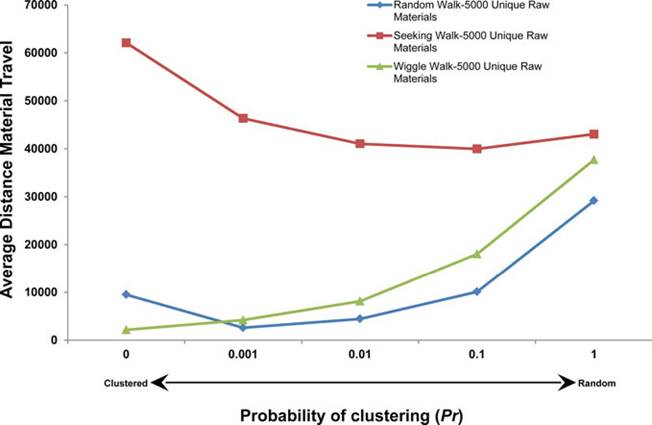
Fig. 4.5 Average distance materials are travelling from the source. Each curve is based on the average of 100 simulation runs
On the other hand, when the forager engages in a seeking walk, increased clustering leads to increased travel distance (Fig. 4.5). However, this relationship is not significant although there is a strong negative correlation (Spearman’s rs = -0.7; p = 0.2). As noted above, tool kit richness controls how long a raw material travels before being consumed.
Increased richness results in increased distances that any one raw material travels before being consumed because the probability that any one raw material is consumed at each time step is decreased.Time Steps Without Material in Tool Kit When investigating how much time the forager spends without material in the tool kit one clear pattern can be observed: clustering leads to increased time without materials in the tool kit. Across all three simulated walk behaviors, the analysis shows that when resources are more clustered than simulated in the original neural model, we can expect that foragers run out of materials for longer periods of time (Fig. 4.6). All three walk behaviors have significant and strongly negative relationships with the pr values (Table 4.1). Table 4.2 shows the estimated time steps without raw materials. If engaging in random or wiggle walk, the forager will on average spend about 55 time steps without materials when the raw materials are randomly placed as simulated in the neutral model. However, as the clustering of the raw material sources increases to mimic a realistic landscape, one can observe that time spent without materials increases 10-30 times. This is because increased clustering leads to more spaces between sources leading to an increased probability that a forager will use up all the raw materials in the tool kit before encountering a new source. Hence, the original neutral model might not be an appropriate model for landscapes with raw material sources clustered like is often typical of most environments. It is unrealistic to expect that foragers go extended periods of time without raw materials in their tool kit to create and repair tools.
Although ethnoarchaeological work and ethnographic description offer some evidence that stone procurement was a daily exercise for some groups (Hayden and Nelson 1981; MacCalman and Grobelaar 1965; Miller 1979; Sillitoe and Hardy 2003; Stout 2002) it has to be noted that this behavior cannot be considered a universal behavior, and that caches of stone to provision daily use can also be maintained at a central location where the foragers operate (Parry and Kelly 1987).
An important distinction needs to be made here. If the forager returns to such a central location where a cache is situated, then the forager could go extended periods of time without procuring materials as long as the forager returns to such a central cache and refills the tool kit. However, if random walk takes the forager away from the central location and never or very seldom returns then it is unrealistic to assume that random walk is a realistic behavior because the probability that the foragers runs out of materials is high.Not surprisingly, when the forager is engaging in seeking walk behavior, the time spent without materials is decreased drastically compared to random and wiggle walk simulations (Fig. 4.6). However, even in seeking walk simulations an
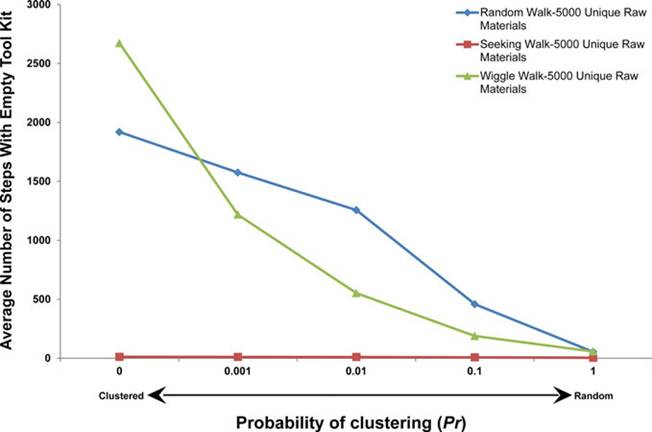
Fig. 4.6 Average number of time steps a tool kit is empty. Each curve is based on the average of 100 simulation runs
Table 4.1 Spearman’s rs test results
| Random walk | Wiggle walk | Seeking walk | |
| p value | 0.02 | 0.02 | 0.02 |
| rs coefficient | -1 | -1 | -1 |
Table 4.2 Time steps spent without material in tool kit
| Pr | Random walk | Wiggle walk | Seeking walk |
| 0 | 1919 | 2673 | 12 |
| 0.001 | 1575 | 1217 | 11 |
| 0.01 | 1257 | 552 | 10 |
| 0.1 | 458 | 189 | 8 |
| 1 | 54 | 57 | 4 |
increased clustering of the raw material sources leads to more time without any raw materials in the toolkit. This is because there is an increased probability that a forager can find itself further from a cluster or any single source because of the increased space between any sources. This means that the forager has to travel further to find the nearest material, which leads to increased time without material in the tool kit.
4.3.2
More on the topic Assuming 5000 Unique Raw Materials:
- Assuming 20 Unique Raw Materials
- A MULTITUDE OF ARCHAEOLOGICAL MATERIALS
- Mutation generates the raw material for evolution
- THE UNIQUE DIVINE NAME
- During the 1990s, the market for mortgage origination fluctuated between $500 billion and $1.5 trillion and provided the raw material for MBSs.
- Chapter 4 Testing Brantingham's Neutral Model: The Effect of Spatial Clustering on Stone Raw Material Procurement
- A. D. Nock illustrated the problematic nature of the source materials documenting the cult of Mithras by means of the following analogy (Nock 1964: 58)
- Typical and unique shape of the state.
- Medical transport of neonatal and pediatric patients provides many unique challenges.
- Medical transport of neonatal and pediatric patients provides many unique challenges.
- In dealing with archaeological materials, some fundamental differences distinguish the study of religion from other archaeological sub-disciplines, such as subsistence, trade or social structures.
- This chapter deals with some unique therapeutic modalities in management of hematological disorders.
- The Mauryan Empire (321-185 все) has a unique place in India's history.
- Progressive Islam in Europe: a critical analysis of the unique nature of Bosnia and Hercegovina’s Islamic practice Richard Burgess
- The letters and reports by Assyrian and Babylonian scholars to the Neo-Assyrian king provide a unique window to the relationship between a body of scholarly texts and the practice of actual scholarship.
- Humility and romantic love are two major positive attitudes toward other people. Humility expresses a general attitude toward all people, while romantic love is a unique attitude toward a specific person (or several people).
- ‘Maintaining moral sensitivity and awareness is crucial to the practice of law. The profession must resist inroads on the lawyer’s commitment to the truth, and take steps to correct rules that lessen this commitment. The unique role lawyers occupy in our society and their position as officers of our judicial system require that their word be trusted. More is required of a lawyer than the custom of the marketplace, than bargaining in a bazaar, or in playing poker. Lawyers must feel that theirs
- Archaeological Implications and Predictions
- Introduction
- Local Production of Small Incense Altars