The Mauryan Empire (321-185 все) has a unique place in India's history.
It is celebrated as the first empire established across large parts of South Asia and extending into modern Afghanistan. More importantly, its memory continued to be invoked in Sanskrit, Pali, and Prakrit writings of Buddhist, Jain, and Hindu affiliation, throughout the historical periods.
For example, the Rajatarangini, a chronicle written in Sanskrit by the Kashmiri poet Kalhana in 1148/1149 се attributes to Asoka, the most famous of the Mauryan emperors, the foundation of Srinagari, the old capital, identified with a site in the vicinity of the present city of Srinagar in Kashmir. Asoka figures as the patron of the ancient and famous Saiva shrine of Vijayesvara.Jain sources also know of Asoka, but he is not as central in Jain accounts as he is in Buddhist ones. Instead, Jain histories focus more on Asoka's grandfather and founder of the dynasty, Candragupta, who they say became a Jain. Historians of one of the Jain sects, the Digambaras, credit him with leading a migration south to avoid a great famine, and eventually dying in meditation at the holy shrine of Sravana Belgola in the modern South Indian state of Karnataka. Asoka's grandson and successor, Samprati, is honored as a Jain ruler who actively spread Jainism to different parts of South Asia. Medieval Jain writers, such as the twelfth-century polymath Hemacandra, described the king's good deeds in glowing terms. Samprati and his temples and icons thereby came to occupy a prominent place in the Jain history of western India closely analogous to that occupied by Asoka in the Buddhist history of India.
Buddhist texts such as the Mahavamsa, the earliest Pali chronicle of Sri Lanka, dated to the late fourth or early fifth century се, are the most consistent in emulating the notion of kingship propagated by Asoka. In the Sri Lankan chronicles, the emphasis is on the purification of the Buddhist Sangha by Asoka, as well as the dispatch of Buddhist missionaries not only to different parts of the subcontinent, but also to Suvarnabhumi—often identified with parts of Southeast Asia—and most of all to Sri Lanka.
There are references to King Devanampiyatissa (250-210 все) of Sri Lanka being re-consecrated by envoys of Asoka.1The Mauryas, and particularly Candragupta, the founder of the dynasty, are referred to prominently in early Greek accounts of the eastern empire of Alexander the
1 Geiger 1950; Olivelle, Leoshko, and Prabha 2012, 1-16.
Himanshu Prabha Ray, The Mauryan Empire In: The Oxford World History of Empire. Edited by: Peter Fibiger Bang, C.A. Bayly, Walter Scheidel, Oxford University Press (2021). © Oxford University Press. DOI: 10.1093/oso/9780197532768.003.0007.
Great. The Greek historian Arrian of Nicomedia states that the Greek ambassador Megasthenes went further than Alexander and his men, and visited Candragupta (or, to the Greeks, Sandracottus), the greatest king of the Indians. He also visited Pataliputra, but did not travel further east or south.[529] Scholars have debated the veracity of Megasthenes's reports, considering that his writings survive only in fragments. These writings acquired primacy in the search for the chronology of the Mauryas by the Asiatic Society, founded in 1784 by Sir William Jones, an English philologist and judge based in Calcutta. Based on his study of the Sanskrit Puranas, Jones tabulated a detailed history of the kings of Magadha, one of the ancient kingdoms of North India. The members of the ruling dynasty of the Nandas are said to have been killed by the clever brahmana Canakya who then established Candragupta Maurya as king.[530] On the death of the tenth Maurya king, his place was usurped by his commander-in-chief, Pusyamitra Sunga.
While Chandragupta founded the Mauryan dynasty and expanded its rule in large parts of the Ganga Valley and the northwest, it was his grandson Asoka who established supremacy over the subcontinent, as evident from his edicts that inform us of his empire. Asoka's epigraphs, inscribed on pillars and rocks, are found over an extensive area from Gandhara in the northwest (now Pakistan) to Karnataka in South India.
In Major Rock Edict II, Asoka refers to the people on the frontiers— the Greek ruler Antiochus in the northwest and the Ceras, Colas, Pandyas, etc., in the far south. Rock Edict V alludes to officers responsible for the establishment and promotion of dhamma or dharma even among the Greeks (yavanas), Kambojas, and others resident on the western borders of his dominions, while Rock Edict XIII refers to his victories over the Greek king yavanaraja Antiyoka and others bordering his dominions, such as Ptolemy, Antigonus, Magas, and Alexander.In Rock Edict XIII, which is the largest in the group, Asoka expresses remorse at the loss of life that occurred during the conquest of Kalinga, identified with the coastal areas of the modern Indian state of Odisha, which took place in the ninth year of his reign. Interestingly, Rock Edict XIII is not found at the two sites of Asoka's edicts in Odisha and is replaced by two separate edicts at both Jaugada on the north bank of the Rishikulya River, in Ganjam district, and at Dhauli on the banks of the river Daya, eight kilometers south of Bhubaneswar, the present capital of Odisha. The Dhauli and Jaugada edicts are addressed to the officials at Tosali and Samapa, respectively, indicating the names of ancient settlements near the two sites. The separate edicts exhort the officers to gain the affection and confidence of the people, whom Asoka regarded as his children, and to promote dhamma among them.
In the southeast section of Bhubaneswar, about five kilometers from the rock edict at Dhauli, several seasons of archaeological excavations have been conducted at the fortified site of Sisupalgarh, roughly one square kilometer on plan. A striking feature of the Sisupalgarh fort, quadrangular in outline, is the alignment of 13
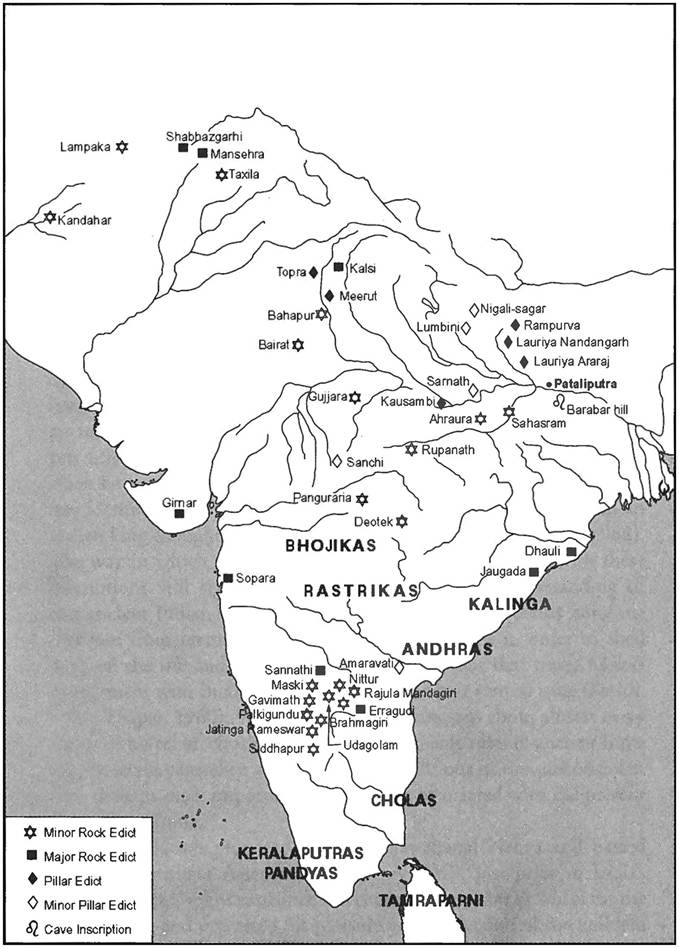
Map 7.1. The Mauryan Empire.
Source: Olivelle, Leoshko, and Ray, 2012, Reimagining Asoka: Memory and History, p.
xvii. Copyright: Oxford University Press. monolithic laterite columns that still survive and a large gateway made of dressed laterite blocks. The fort was circumscribed by the stream Gangua (or Gandhavati), which flows around Sisupalgarh. The latest results of excavations have suggested that the initial occupation of the site dates from 500 bce and continued until the seventh century ce. However, dates are not available for the different structures at the site, such as the fortifications or the Buddhist stupa that has been identified within the area.In the past, scholars have constantly tried to reconcile information contained in the edicts with those from other sources, such as the biography of Asoka in Buddhist texts, like the Asokavadana written 500 years after Mauryan rule, in the second century ce, in Sanskrit. In the Asokavadana, compiled in northwestern India, Asoka is described as an ugly prince who quelled the revolt in Taxila (in present-day Pakistan) and ascended the throne after killing his brothers. His fierce and malevolent nature was tamed by the Buddhist monk Upagupta, who is said to have converted him and inspired him to visit places associated with the life of the Buddha. Asoka then built 84,000 stupas throughout his empire. The text also includes the tragic story of his son Kunal, who was blinded by a jealous stepmother. A second text that popularized the story of Asoka was the Ceylonese chronicle, the Mahavamsa, which was discussed earlier. The text, however, presents a very different perspective on the king and does not mention Asoka's ugliness or his violent nature.
It is evident, therefore, that Asoka's reign, as recounted in the Sri Lankan chronicles, was considered to be a model for future rulers and continued to inspire later kings well into the present day. The afterlife of the Mauryan Empire entered its latest phase in the mid-twentieth century, as the 284 men and women involved in framing the Constitution of India accepted the importance of the Mauryas, and their most famous king, Asoka (268-232 bce). The Constitution of India was adopted by the Constituent Assembly on November 26, 1949, and came into effect on January 26, 1950, announcing India's birth as a Republic. In the next section, I discuss the unique features of the Mauryan Empire, features that perhaps added to its appeal for successive rulers, as well as to the longevity of its reputation.
More on the topic The Mauryan Empire (321-185 все) has a unique place in India's history.:
- CHAPTER THIRTY-ONE The Mauryan Empire of India
- Archaeology of the Mauryan Empire
- 7 The Mauryan Empire
- The period covered in this chapter, from the death of Herod the Great, King ofthejews, in 4 все to the end of the secondjewish war with Rome in 135 ce, is a period of lingering and terminal crisis in the history of Israel
- India: mission within the empire
- The Achaemenid Persian Empire was something new in history: a hyper-power without serious rival, a world empire on an unprecedented scale.
- 20 PLACE AND SPACE IN BRITISH IMPERIAL HISTORY WRITING
- The Cold War occupies a rather unusual place in the history of organised mass violence.
- General Remarks on the Religious History of India
- Bang Peter F., Bayly C.A., Scheidel Walter (eds.). The Oxford World History of Empire. Volume Two: The History of Empires. Oxford University Press,2020. — 1352 p., 2020
- The centuries following the first appearance of Islam in the subcontinent were among the most creative in the history of religion in India.
- Historians have traditionally regarded the Ottoman Empire's failed second siege of Vienna in 1683 as a turning point in the empire's long history, bringing to an end centuries of military success and expansion.
- CASE 185: Twins
- 7 Nomination of the Jews to the Curias A General Law of Constantine the Great 11 December 321
- As the colony that gave Europe its archetype of tropical cannibalism and consumed more African bodies than any other American slave system, Brazil warrants a central place in the history of early modern racial violence.