Model Description
Original Neutral Model Brantingham (2003) created a simple model of one forager with a mobile toolkit of fixed capacity that is randomly placed on the environment. At each time step, the forager moves to one of the nearest eight neighboring cells or stays in the present cell, with equal probability (=1/9).
At each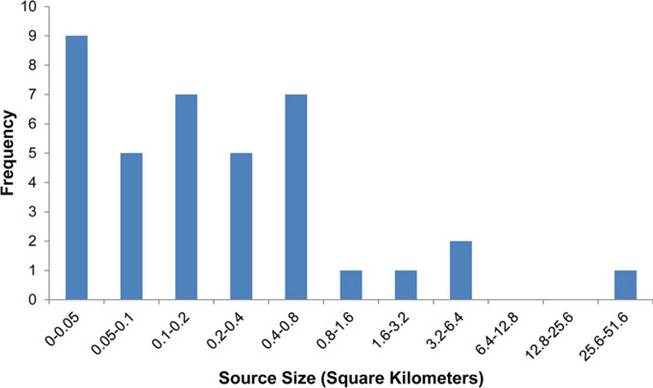
Fig. 4.1 Frequency of stone tool raw material sources by size bin in the Mossel Bay region
time step a fixed amount of raw material is consumed dependent only upon its frequency in the mobile toolkit. If a raw material source is encountered, the toolkit is re-provisioned up to its maximum capacity before moving again at random. If no raw material source is encountered, the forager moves immediately at random. Simulations are run until 200 unique raw material sources are encountered, or the edge of the simulation world is reached. The model is replicated in Netlogo by Janssen and Oestmo (2013).
New Analysis For the initial configuration and analysis in this paper, a maximum capacity of the tool kit equal to 100 was used, the environment was set to 500 X 500 cells and consisted of 5000 unique raw material sources. To include clustering of sources, the probability pr was included. When the 5000 material sources were placed on the landscape there was a probability pr determining where the new material source was placed on a randomly chosen empty cell. Five different values of pr were used (Fig. 4.2) with probability 1 — pr, a new material source was placed on a randomly chosen empty cell that had at least one neighbor (one of 8 neighboring cells) that already contained a material source (see Fig. 4.3 for landscape examples for each pr value used in this paper). Every simulation-run lasted 35,000 time steps, and each type of simulation with different walk behaviors was run 100 times.
Three different model outcomes are addressed here: raw material richness (the number of different raw material types), distance materials move before being discarded, and steps taken without raw material in the toolkit. The two first outcomes are the same as Brantingham (2003) used in his original study to evaluate his neutral model. Here they will be used to evaluate the effect of spatial clustering on the neutral model outcomes. The last model outcome, steps taken without raw
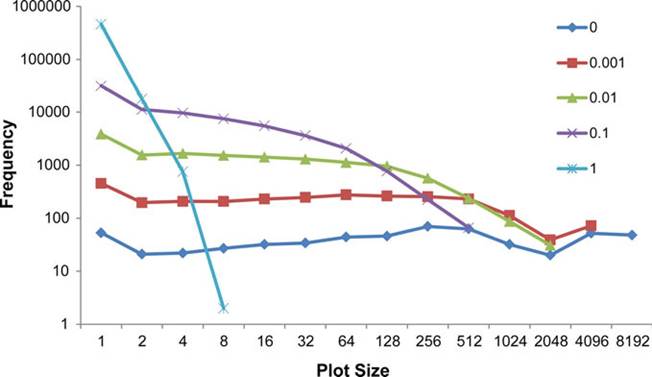
Fig. 4.2 Distribution of source sizes in generated landscapes with different pr values
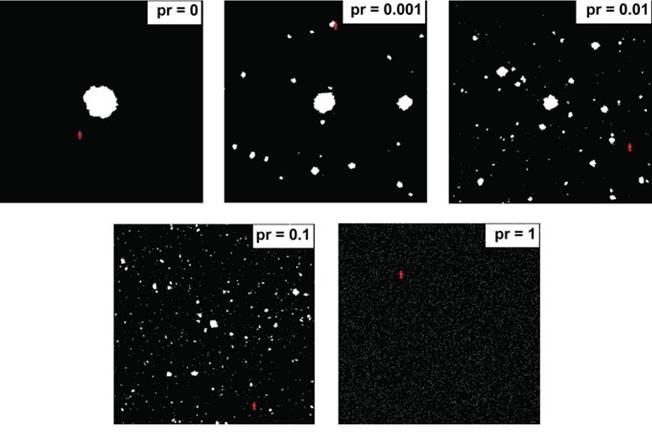
Fig. 4.3 Spatial view of distribution of material sources in generated landscapes with different pr values
material in the toolkit, is used to evaluate whether the criticism that a forager can never engage in random walk in an environment is a valid criticism.
To address the second limitation that 5000 unique raw materials on an extended landscape is unrealistic, a second model configuration is run where 20 unique raw materials are distributed among the 5000 raw material positions. This can lead to, by chance, a cluster with a majority of one unique raw material distributed next to each other.
In addition to the original random walk behavior, two other walk behaviors will be simulated for both the original configuration with 5000 unique raw materials and with the configuration with 20 unique raw materials. The first one is here called “seeking walk”. The seeking walk behavior could be seen as an analogy for returning to a stone cache at a central location. During seeking walk simulations, the forager will move towards the nearest material source if the level of the materials in the toolkit is lower than a certain number. Here the number will be 0. This means that at any moment when a foragers' toolkit is empty it will seek to acquire new material.
The second alternative walk model is termed the “wiggle walk” where it is assumed that a forager has a direction and moves forward one cell each time step. At each time step, the forager changes the direction by taking a left turn with a degree drawn from a uniform distribution between 0 and 90°, and then a right turn with a degree drawn from a uniform distribution between 0 and 90°.
4.3
More on the topic Model Description:
- Model Description
- Test Case and Model Description
- In the last chapter, we argued that there are two and only two plausible models of legal reasoning, the natural model and the rule model.
- In our view, there are only two plausible methods available to judges when they decide cases as a matter of common law, the ‘natural' model of decision-making and the ‘rule' model of decision-making.
- Description and prescription
- DATA DESCRIPTION
- Sample Position Description—Critical Care Transport Nurse
- Sample Position Description—Critical Care Transport Nurse
- Sample Position Description—Critical Care Transport Physician
- Sample Position Description—Critical Care Transport Physician
- Description and Pathophysiology of the ART-Related Abnormal Fat Distribution
- Sample Position Description—Transport Emergency Medical Technician-Basic
- Sample Position Description—Transport Emergency Medical Technician-Basic
- Sample Position Description—Critical Care Transport Respiratory Therapist
- Sample Position Description—Critical Care Transport Respiratory Therapist
- Appendix 6B Description of the Data[242]
- AN ANCIENT DESCRIPTION OF THE MILKY WAY GALAXY