Gene flow is the transfer of alleles between populations
Gene flow occurs when alleles are transferred from one population to another via the movement of individuals or gametes (e.g., plant pollen). Gene flow has two important effects.
First, by transferring alleles between populations, it tends to make populations more similar to one another genetically. This homogenizing effect of gene flow is one reason why individuals in different populations of the same species resemble one another: alleles are exchanged often enough that relatively few differences accumulate between the populations.Second, gene flow can introduce new alleles into a population. When this occurs, gene flow acts in a manner similar to mutation (although mutation remains the original source of new alleles). One example of gene flow involves consequences for human health. Before the 1960s, the mosquito Culex pipiens was not resistant to organophosphate insecticides. This mosquito transmits West Nile virus, the most common mosquito-borne disease in North America. Insecticides were often used to destroy its populations to prevent disease transmission. In the late 1960s, however, new alleles that provided resistance to organophosphate insecticides were produced by mutation in a few C. pipiens populations, probably in Africa or Asia (Raymond et al. 1998). Mosquitoes carrying these alleles were blown by storms or transported accidentally by humans to new locations, where they bred with mosquitoes from the local populations. In populations of mosquitoes exposed to insecticides, the frequency
of these introduced alleles then increased rapidly because insecticide resistance was favored by natural selection (FIGURE 6.9). The global spread of these alleles by gene flow has allowed billions of mosquitoes to survive the application of insecticides that otherwise would have killed them.
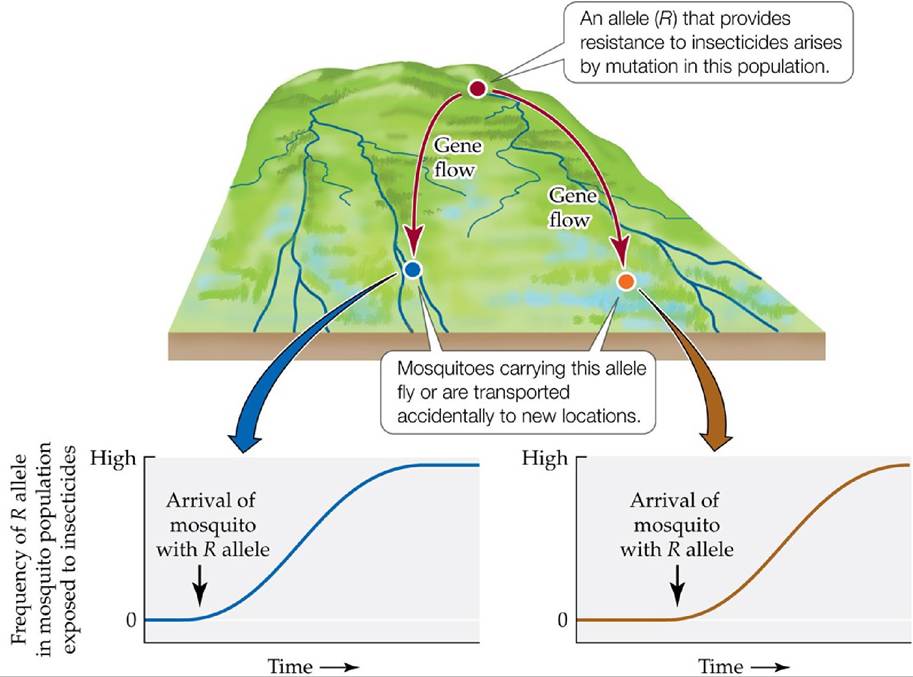
FIGURE 6.9 Gene Flow: Introducing Alleles for Insecticide Resistance Inthisidealized scenario, an allele that causes resistance to organophosphate insecticides arises by mutation in one population of mosquitoes and then spreads by gene flow to two other populations. If mosquitoes in those two other populations are exposed to the insecticide, natural selection causes the frequency of the resistance allele to increase rapidly. View larger image
Evolutionary change that results in a closer match between the traits of organisms and the conditions of their environment, such as the increase in the frequency of insecticide resistance in a mosquito population exposed to insecticides, is an example of adaptive evolution, the topic we'll consider next.