Genetic drift results from random events
Allele frequencies in populations can be influenced by random events. Imagine a population of ten plants in which three individuals have genotype AA, four have genotype Aa, and three have genotype aa.
Thus, the initial frequencies of both the A and a alleles are 50%. Assume that the A and a alleles encode two different versions of a protein that function equally well. Although neither allele is more advantageous than the other (and hence natural selection does not affect this gene), random events could alter their frequencies. For example, suppose that a moose walking through the woods happened to step on four of the wildflowers (two of genotype AA and two of genotype Aa), killing them, but not harming any of the three plants of genotype aa. As a result, the frequency of the a allele in the population would increase from 50% to 67% due to a random event.When random events affect which alleles are passed from one generation to the next, genetic drift is said to occur. Although random events occur in populations of all sizes, the effects of genetic drift on allele frequency changes is greater in small populations than in large ones. To see why, imagine that our plant population had 10,000 individuals, 3,000 of genotype AA, 4,000 of genotype Aa, and 3,000 of genotype aa. If (as before) a moose stepped on a random sample of 40% of the individuals in this larger population, there is virtually no possibility that all of the 3,000 individuals of genotype aa would be spared. Instead, it is likely that many individuals of each genotype would be killed and, hence, that the frequencies of the A and a alleles would change little, if at all.
Genetic drift has four related effects on evolution, the strength of which is larger in small populations:
1. Because it acts by chance alone, genetic drift can cause allele frequencies to fluctuate randomly over time in small populations (FIGURE 6.7).
When this occurs, eventually some alleles disappear from small populations experiencing genetic drift, while others reach fixation.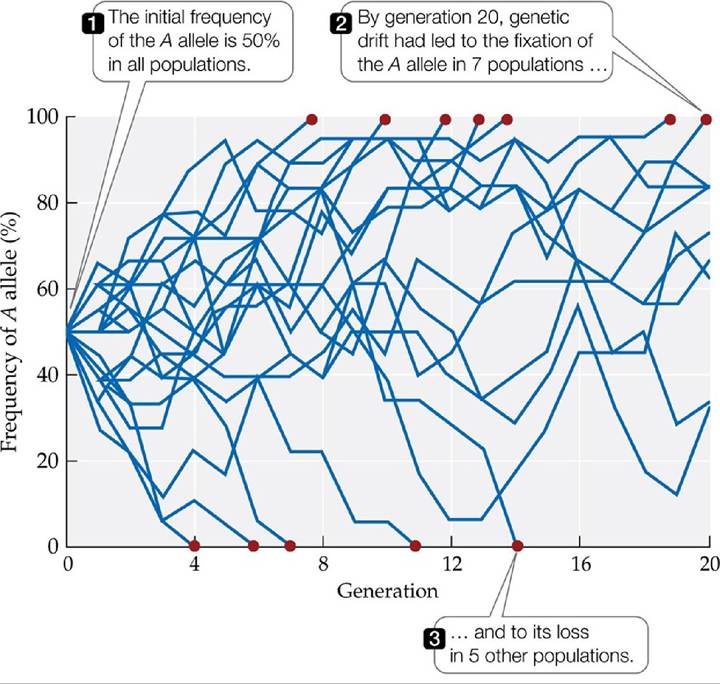
FIGURE 6.7 Genetic Drift Causes Allele Frequencies to Fluctuate at Random Results of a computer simulation of genetic drift in 20 populations for a gene with two alleles, A and a. Each population has nine diploid individuals (18 alleles) in each generation. In small populations such as these, genetic drift has rapid effects.
At the start of the simulation, how many A alleles and how many a alleles did each population have? At generation 20, how many populations still had both alleles? Predict what would eventually happen to the frequency of the A allele in those populations.
(After D. Hartl and A. Clark. 1989. Principles of Population Genetics, 2nd ed. Oxford University Press/Sinauer: Sunderland, MA.) View larger image
2. By causing alleles to be lost from a population, genetic drift reduces the genetic variation of the population, making the individuals within the population more similar genetically to one another.
2. Genetic drift can increase the frequency of a harmful allele. This may seem counterintuitive because in general, genetic drift acts on alleles that neither harm nor benefit the organism, and we would expect natural selection to reduce the frequency of a harmful allele. However, if the population size is very small and the allele has only slightly deleterious effects, genetic drift can “overrule” the effects of natural selection, causing the harmful allele to increase or decrease in frequency randomly.
3. Genetic drift can increase genetic differences between populations because random events may cause an allele to reach fixation in one population yet be lost from another population (see Figure 6.7).
The second and third of these effects can have dire consequences for small populations. A loss of genetic variation can reduce the capacity of a population to evolve in response to changing environmental conditions, potentially placing it at risk of extinction.
Likewise, an increase in the frequency of harmful alleles in a population can hinder the ability of its members to survive or reproduce, again increasing the risk of extinction. This effect presents an ongoing problem for small populations. Although mutation is unlikely to produce harmful alleles of any particular gene from one generation to the next (because mutations are rare), it is highly likely to produce new deleterious alleles in some of an organism's many genes—and genetic drift can cause those alleles to increase in frequency.Such negative effects of genetic drift are thought to have contributed to the near extinction of the Illinois populations of the greater prairie chicken (Tympanuchus cupido). In the early 1800s, there were millions of these birds in Illinois. Over time, their numbers plummeted as more than 99% of the prairie habitat on which they depend was converted to farmland and other uses. By 1993, fewer than 50 greater prairie chickens remained in Illinois. By comparing the DNA of birds in the 1993 Illinois population with that of birds that lived in Illinois in the 1930s (obtained from museum specimens), Juan Bouzat and colleagues (1998) showed that the drop in population size had reduced the genetic variation of the population (FIGURE 6.8). In addition, more than 50% of the eggs laid by birds in the 1993 Illinois population failed to hatch, suggesting that genetic drift had possibly led to the fixation of harmful alleles. This hypothesis was supported by the results of experiments begun in 1992: when greater prairie chickens from other populations were brought to Illinois, new alleles entered the Illinois population, and egg-hatching rates increased from less than 50% to more than 90% in just 5 years (Westemeier et al. 1998). Unfortunately, since the late 1990s genetic diversity of the greater prairie chickens has declined back to the preintroduction levels and is a cause of concern for the conservation of those species that fall within the former range (Mussmann et al.
2017). (Concept 11.3 covers the increased risk of extinction borne by small populations in greater detail.)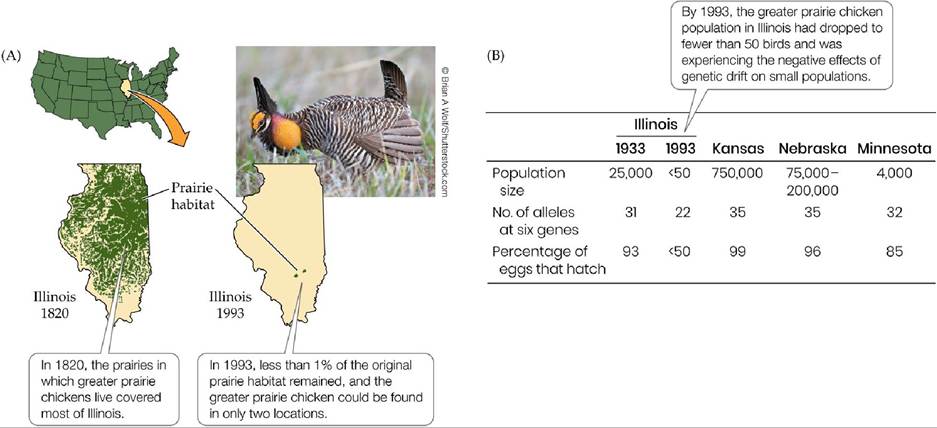
FIGURE 6.8 HarmfulEffectsofGeneticDrift (A) As a result of habitat loss, the Illinois population of greater prairie chickens dropped from millions of birds in the 1800s to 25,000 in 1933 and, finally, to fewer than 50 birds in 1993. (B) As the Illinois population shrank in size,
genetic drift led to a loss of alleles and to a rise in the frequencies of harmful alleles, thereby reducing egg-hatching rates. The table compares the 1993 Illinois populations with historical populations in Illinois and with populations in Kansas, Nebraska, and Minnesota, none of which experienced as severe a drop in population size. (After J. L. Bouzat et al. 1998. Am Nat 152: 1-6; R. C. Anderson. 1970. Trans Illinois State Acad Sci 63: 214. CC BY-NC-SA 4.0.) View larger image