Climate controls where and how organisms live
Where organisms live, their geographic distribution, and how they function are determined by climate. Temperature regulates the rates of biochemical reactions and physiological activity for all organisms.
Water supplied by precipitation is an essential resource for terrestrial organisms. Freshwater organisms are dependent on precipitation for the maintenance and quality of their habitats. Marine organisms depend on ocean currents that influence the temperature and chemistry of the waters they live in.We usually characterize climate—or any aspect of the physical environment—at a given location by the average conditions. However, the geographic distributions of organisms are influenced by extreme conditions more than average conditions because extreme events are important determinants of mortality. Temperature and moisture extremes can affect even long-lived organisms such as forest trees. For example, record high temperatures, along with a severe drought from 2000 to 2003, contributed to widespread mortality in large stands of pinon pines (Pinus edulis) in the southwestern United States
(Breshears et al. 2005) (FIGURE 2.3). These long-lived plants could no longer survive in the region where they had existed for centuries. Thus, the physical environment must also be characterized by its variability over time, not just by average conditions, if we are to understand its ecological importance. The frequency and severity of extreme climate events have increased in association with global climate change (Seneviratne et al. 2021; Jentsch et al. 2007). Climate change has increased the probability of large-scale mortality of vegetation such as the die-off in pinon pines, as well as extreme fires and floods.
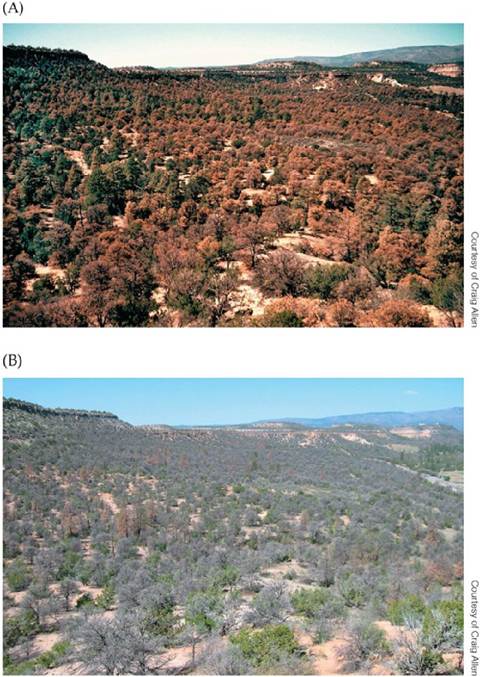
FIGURE 2.3 WidespreadMortalityinPinonPines Extremehightemperaturesanda historic drought from 2000 to 2003 killed large areas of pinon pines (Pinus edulis) throughout the southwestern United States. (A) Here, stands in the Jemez Mountains, New Mexico, begin to show substantial needle death due to water and temperature stress, combined with a bark beetle outbreak in October 2002.
(B) By May 2004, most of the trees had died. View larger imageThe timing of changes in the physical environment is also ecologically important. The seasonality of rainfall, for example, is important in determining the availability of water for terrestrial organisms. In regions with a “Mediterranean-type” climate, the majority of precipitation falls in winter. Although these regions receive more precipitation than most desert areas, they experience regular dry periods during summer. Lack of water during summer limits the potential growth of plants and promotes fires. In contrast, some grasslands have the same average annual temperature (the average temperature measured over an entire year) and precipitation as these Mediterranean-type ecosystems, but precipitation during the summer is higher.
Climate also influences the rates of abiotic processes that affect organisms. The rate at which rocks and soil are broken down to supply nutrients to plants and microorganisms, for example, is determined by climate. Climate can also influence the rates of periodic disturbances, such as fires, floods, and avalanches. These events kill organisms and disrupt biological communities, but they subsequently create opportunities for the establishment and growth of new organisms and communities. As noted above, climate change is increasing the frequency and intensity of disturbances.
More on the topic Climate controls where and how organisms live:
- Throughout this book, we have emphasized the role that climate plays in ecological processes, including the distributions and physiological performance of organisms, the rates of resource supply, and the outcomes of biological interactions such as competition.
- Explain how interactions between organisms and their environment can affect other organisms and potentially lead to unexpected consequences.
- Temperature controls physiological activity
- Environmental Controls on NPP
- Chilean-style capital controls
- Endoparasites live inside their host
- Live Attenuated Whole-Cell Vaccines
- This chapter is about how to live with this disease and stay in one piece.
- Vegetation affects climate via surface energy exchange
- Ectoparasites live on the surface of their host
- A population is a group of individuals of the same species that live in the same area at the same time and interact with one another.