Global energy balance drives the climate system
The energy that drives the global climate system is ultimately derived from solar radiation. On average, the top of Earth's atmosphere receives 342 watts (W) of solar radiation per square meter each year.
About a third of this solar radiation is reflected back out of the atmosphere by clouds, fine atmospheric particles called aerosols, and Earth's surface. Another fifth of the incoming solar radiation is absorbed by ozone, clouds, and water vapor in the atmosphere. The remaining half is absorbed by land and water at Earth's surface (FIGURE 2.4).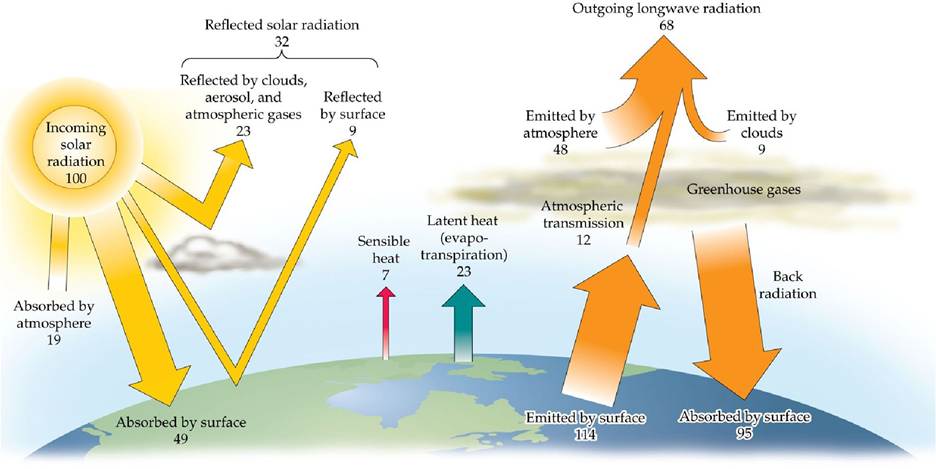
FIGURE 2.4 Earth's Energy Balance Average annual energy balance for Earth's surface and atmosphere, including gains from solar radiation and gains and losses due to emission of infrared radiation, latent heat flux, and sensible heat flux. The numbers are gains and losses of energy, given as percentages of the average annual incoming solar radiation at the top of Earth's atmosphere (342 W/m2).
What component of Earth's energy balance would be influenced by an increase in greenhouse gases? What would the effect on Earth’s energy balance be if there were an increase in atmospheric aerosols?
(After J. T. Kiehl and K. E. Trenberth. 1997. BullAm Meteorol Soc 78: 197-208. © American Meteorological Society. Used with permission.) View larger image
If Earth's temperature is to remain the same, these energy gains from solar radiation must be balanced by energy losses. Much of the solar radiation absorbed by Earth's surface is emitted to the atmosphere as infrared radiation (also known as longwave radiation). Earth's surface also loses energy and is cooled when water evaporates, because the change in phase from liquid water to water vapor absorbs energy. Heat loss due to evaporation is known as latent heat flux.
Energy is also transferred through the exchange of kinetic energy by molecules in direct contact with one another (conduction) and by the movement of currents of air (wind) and water (convection). Energy transfer from the warm air immediately above Earth's surface to the cooler atmosphere by convection and conduction is known as sensible heat flux.The atmosphere absorbs much of the infrared radiation emitted from Earth's surface (and from clouds) and reradiates it back to Earth's surface. This reradiation represents a major energy gain. The atmosphere contains gases that absorb and reradiate infrared radiation, known as greenhouse gases. These gases include water vapor (H2O), carbon dioxide (CO2), methane (CH4), and nitrous oxide (N2O). Some of these greenhouse gases are produced through biological activity (e.g., CO2, CH4, N2O), linking the biosphere to the climate system. Without these greenhouse gases, Earth's climate would be considerably cooler than it is (by approximately 33°C, or 59°F). As noted earlier, increases in atmospheric concentrations of greenhouse gases due to human activities are altering Earth's energy balance, changing the climate system, and causing global climate change (FIGURE 2.5; see Concept 25.2).
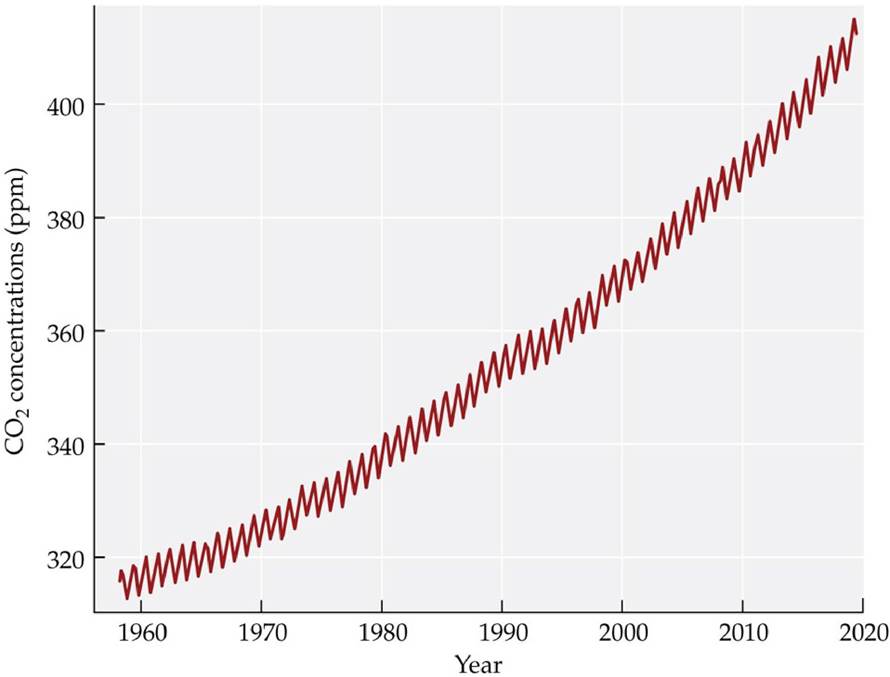
FIGURE 2.5 Increasing Atmospheric Carbon Dioxide The trend in monthly atmospheric carbon dioxide concentrations measured at Mauna Loa Observatory. Average annual carbon dioxide concentrations have risen by 301% since they were first monitored at the Mauna Loa Observatory in 1958 by Charles Keeling. Similar measurements are now made globally by the U.S. National Oceanic and Atmospheric Administration. (After U.S. NOAA, Earth System Research Laboratory, Global Monitoring Division. (⅛⅝https://www.esrl.noaa.gov/gmd/ccgg/trends/full.html; C. D. Keeling et al. 2001.1. Global Aspects, SIO Reference Series, No. 01-06. Scripps Institution of Oceanography: San Diego, CA. Data last updated August 2019.) View larger image
Our discussion of Earth's energy balance has focused on average annual transfers of energy to and from Earth as a whole. But not every location on Earth receives the same amount of energy from the sun. Let's consider how these differences in solar radiation affect the circulation of Earth's atmosphere and ocean waters.