Corridors can help maintain biodiversity in a fragmented landscape
Habitat corridors—narrow patches that connect blocks of habitat—have become a staple of urban, suburban, and rural planning (FIGURE 24.18). Connectivity among habitat patches might lessen the impact of fragmentation on small populations by enhancing dispersal through corridors of habitat that link them together.
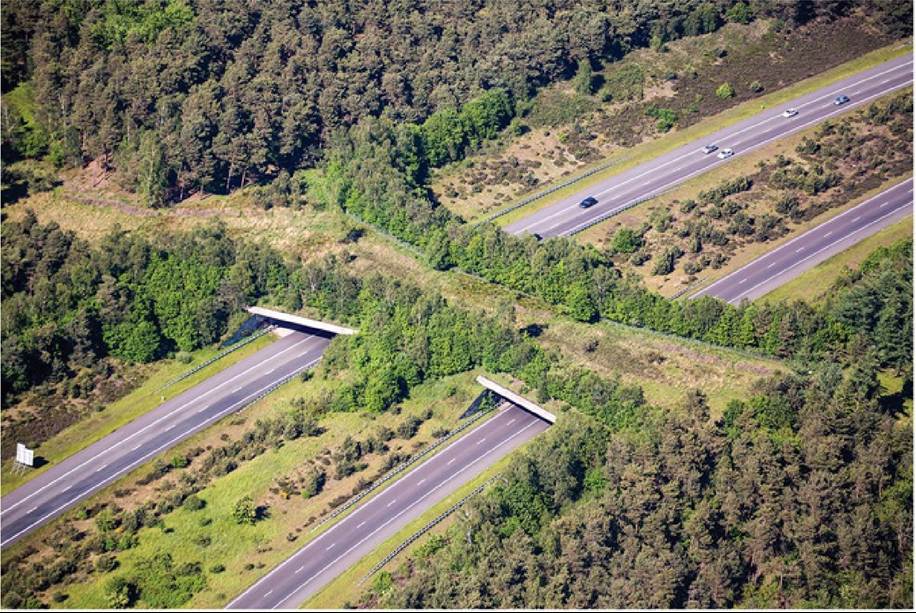
O frans IemmensZAIamy Stock Photo
FIGURE 24.18 A Habitat Corridor Wildlife can cross this highway overpass over the A1 highway in the Netherlands. View larger image
When designing Masoala National Park discussed earlier, Kremen and her colleagues looked at the larger landscape and anticipated corridors that would be important in the future. Many of Masoala's target species are found in areas northwest of the park that lie between Masoala and two important protected areas to the north. The park plan included three corridors to those protected areas. The researchers developed this part of the plan by examining maps, but out of expediency, they did not actually do studies of animal movements (Kremen et al. 1999).
The intended function of habitat corridors is to prevent the isolation of populations in fragments. But do we know that corridors actually help to overcome this isolation? And is the effectiveness dependent on body size? For example, do corridors work for beetles as well as for wolves? Is a stream corridor in the suburbs providing necessary landscape connectivity for some species? At the continental scale, could we link the GYE to the Yukon through habitat corridors, as some have proposed? Experimental and observational studies of corridors' utility have shown mixed results.
Nick Haddad and his colleagues established a test of the utility of corridors at the Savannah River Ecology Laboratory in South Carolina. They set up patches of early successional habitat in a matrix of pine forest, some of them connected by corridors, and observed the movements of organisms between patches (FIGURE 24.19).
Their results showed that the corridors did indeed serve to facilitate the movement of butterflies, pollen, and bird-dispersed fruits (Tewksbury et al. 2002).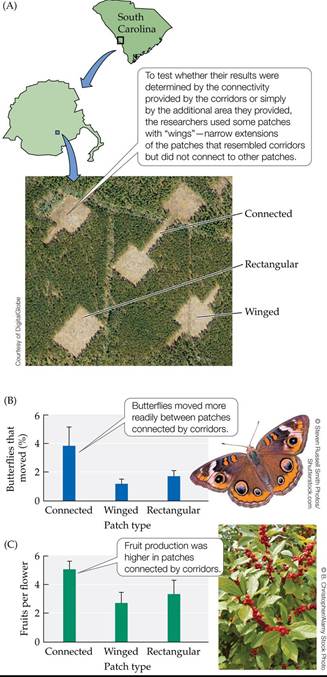
FIGURE 24.19 How Effective Are Habitat Corridors? (A) Nick Haddad and his colleagues tested the effectiveness of habitat corridors by creating experimental patches of early successional habitat within a pine forest and creating corridors between some of the patches. They then observed (B) movements of the common buckeye butterfly (Junonia coenia) between patches and (C) fruit production (which provides evidence of pollination) in winterberry (Ilex verticillata) in patches. Error bars in (B) and (C) show one SE of the mean. (After J. J. Tewksbury et al. 2002. Proc NatlAcad Sci USA 99: 12923-12926. © 2002 National Academy of Sciences U.S.A.) View larger image
Other studies, however, have found no benefits of corridors, and still others have found negative effects (reviewed in Haddad et al. 2014). For example, in the same experimental system at the Savannah River Ecology Laboratory, predation on indigo bunting (Passerina cyanea) bird nests was higher in patches connected by corridors (Weldon 2006). There are also concerns that corridors could facilitate the movement of pathogens (Hess 1994) or invasive species
(Simberloff and Cox 1987). However, in general, corridors have been found to be effective for facilitating conservation of diversity (Resasco 2019).