Ecological restoration can increase biodiversity in degraded landscapes
What if habitat corridors are lacking and organisms' ability to move is impaired by an unsuitable matrix of degraded habitat? This was the case in Guanacaste Province on the Pacific coast of Costa Rica, where Santa Rosa National Park, in a lowland area of tropical dry forest, was largely separated by 35 km of cattle pasture and forest fragments from the upland forest habitat of the nearby mountains.
Tropical ecologist Dan Janzen knew that many insects, birds, and mammals needed to migrate between these lowland and upland forests. He also saw that the tropical dry forest that he had spent his career studying was fast disappearing. Janzen's effort to reverse this trend became one of the largest and most ambitious ecological restoration projects ever undertaken in the Neotropics. Now covering some 120,000 ha (300,000 acres) of land and 28,000 ha (70,000 acres) of marine reserve, the Area de Conservacion Guanacaste (ACG) includes three national parks, a protected corridor linking them, and the surrounding agricultural areas. The ACG is home to some 230,000 species, or 65% of the species in Costa Rica (Daily and Ellison 2002).
Within the ACG, cattle ranches have occupied much of the land between the three parks for decades. Janzen has launched an effort to restore 75,000 ha (185,000 acres) of these pasturelands to the original forest types. His strategies include planting trees, suppressing fires, and limiting hunting to maintain mammalian and avian seed dispersers. Fire suppression is necessary to halt fires that burn readily in pastures covered in jaragua grass (Hyparremia rufa), an invasive plant introduced from Africa. Grazing will be maintained for some time in some areas to suppress the jaragua grass.
Ecological restoration is being applied in many other ecosystems, with varying degrees of success. To be successful, restoration ecologists must assess the current ecosystem in the context of a desired ecosystem state (e.g., native biodiversity, function) and then apply their understanding of ecological processes to recreate the desired type of ecosystem. Anthony Bradshaw, a founder of restoration ecology, referred to this process as the “acid test” of ecology: “Each time we undertake restoration we are seeing whether, in the light of our knowledge, we can recreate ecosystems that function, and function properly” (Bradshaw 1987).
In some cases, such as the recovery of native oyster populations highlighted in FIGURE 24.20, results quickly suggest that we've passed this acid test. But in others, such as Janzen's efforts to restore tropical dry forests in Guanacaste, the process is likely to take decades if not centuries. In the next section, we will look more closely at how ecological principles are applied in making decisions about how to manage natural resources sustainably. Additionally, in the context of environmental change, particularly the spread of invasive species and climate change, it is unlikely that conserving and restoring communities to a perceived “original state” is possible (Hobbs et al. 2009).
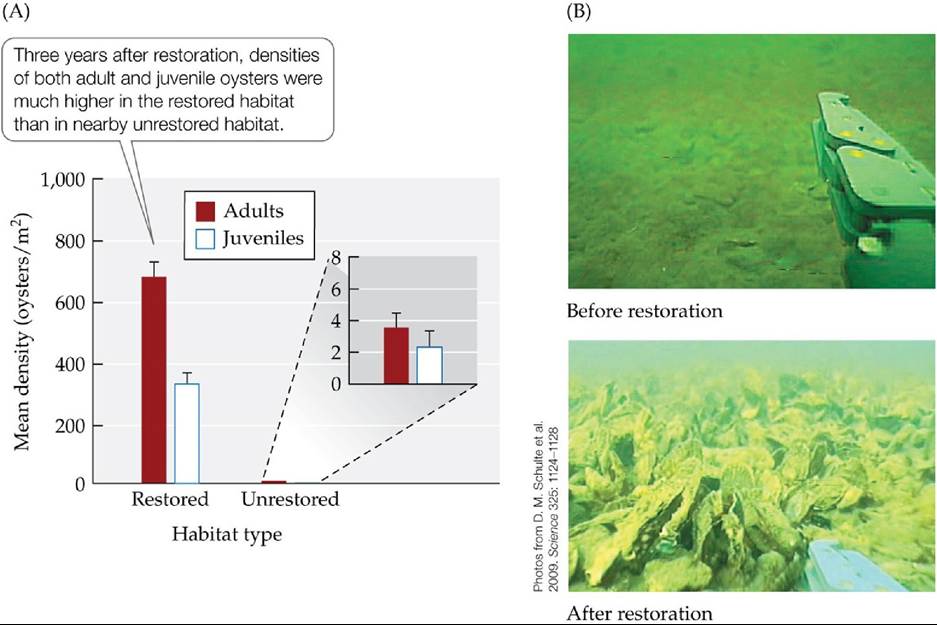
FIGURE 24.20 Dramatic Effects of an Ecological Restoration Project Native oyster populations have collapsed worldwide as a result of habitat loss and overharvesting. (A) In an ecological restoration experiment that began in 2004, oyster reefs were constructed in nine protected areas along the Great Wicomico River in Virginia. Three years later, native oyster populations had recovered dramatically across the 35-ha restoration project. Error bars show one SE of the mean. (B) Oyster habitat before and after restoration. The object on the right in each photograph is a robotic arm that can be used to pick up an individual oyster. (A after D. M. Schulte et al. 2009. Science 325: 1124-1128.) View larger image