PART III THE ECUMENIC TURN
Eclipse ofthe Old World and the Rise of Islam (600-1200) Peter Fibiger Bang
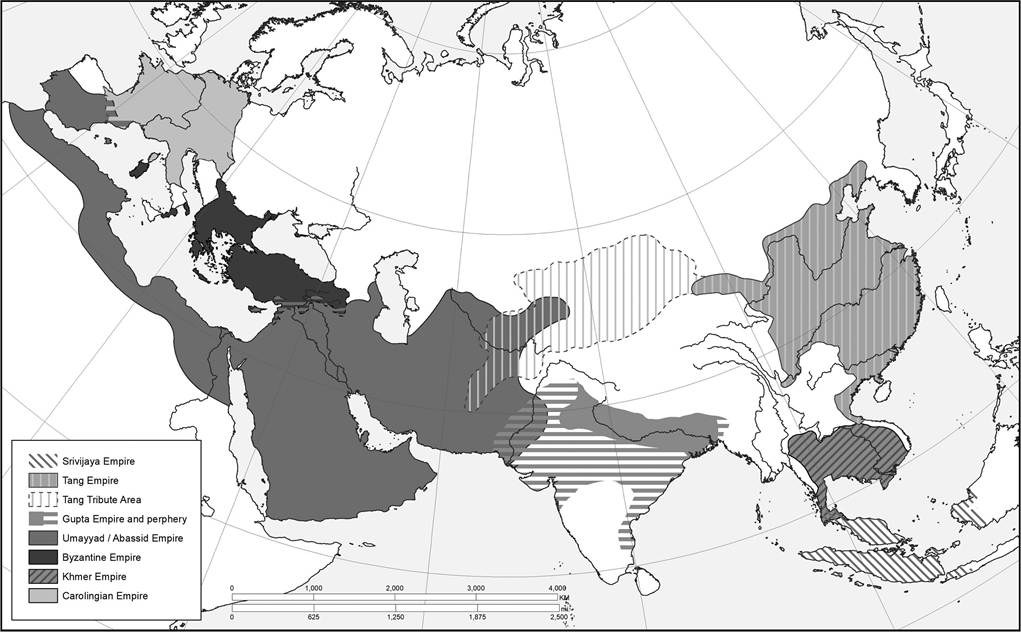
Map III.
The Ecumenic Turn: Eclipse of the Old World and the Rise of Islam (600-1200). Copyright: Peter Fibiger Bang with Jonathan Weiland.
As extensive empires had spread their hold across Afro-Eurasia during the classical age, the consolidation of cosmopolitan rule slowly saw power seep away from the central courts and toward subject provincial societies. Yet, even as the centrifugal forces of government increased in strength and gradually pushed the league of universal empires toward decentralization and fragmentation, a countervailing force emerged. The cultural dialogue fostered by these empires and dominated by elites and literati, gradually widened its reach and became more densely textured. Out of the far-flung worlds of the imperial dominions, a number of civilizational ecumenes developed.
The word is Greek in origin and was used within the Roman world to denote what may be translated as “the civilized world,” and also, at times, simply “the empire.” In the fourth century, when the caesars allied with the church, the word entered Christian theology to signify the unity of creed and church across local congregations. Bent on restoring the political cohesion of the empire, Constantine the Great had made this policy a central concern of his reign (305-337 ce). Having overcome a series of rivals with whom he had had to share the realm, he mirrored the universality of his power in the Christian church. Barely had the last competitor been defeated than a council of all bishops was called at Nicea in Asia Minor to agree on a common creed. The new dispensation of Constantine, sole ruler of the world, demanded a set of beliefs be defined for the Christians.
A single formula would ensure and reinforce the unity of the community ofbelievers that venerated the god by whom the unopposed imperial lord thought himself favored. Ruler, empire, church —the Roman world of Constantine would be articulated in a language of several overlapping universalisms.The bishops went dutifully to work at Nicea, but could not avoid divisive dispute and clashing interpretations of the scriptures. Arguably, the intensification of the theological dialogue that followed the admittance of the Christians into the charmed circles of power and government may even have increased tensions and conflict. Schism and division followed right after the attempt to place the universal church on firm foundations. The intensified cultural ecumene of the empire did not constitute a tightly coherent universe; it was a thin and fractious sphere. Stronger integration and denser literary cultures, visible across the league of universal monarchies, may have produced more unitary visions of the world—a phenomenon which was reflected in the monotheistic trend in divine matters—but it also sparked a competition of messages (see further the discussion by Bennison, Chap. 9, Vol. 1, of the complex relationship between empire, religion, legitimacy and resistance).
Several creeds were on offer within the great space of western Eurasia. The neighboring and rival court of the Sasanids, no less universalist in its ambitions, even staged debates where Christians, Jews, and the hegemonic Zoroastrians could be found disputing the true character of god.[991] Eventually, however, an unexpected winner emerged to eclipse both of the two old universal powers—Islam. For centuries, both Rome and Persia had managed a grudging modus vivendi. Both knew no greater success than defeating the other in war. Several Roman emperors had died on campaign while chasing a Persian triumph. Never was an opportunity missed to assert symbolic superiority over the other. Even so, neither of the two had normally been willing to stake everything on an all-out victory.
Usually rulers chose to cut their losses before it was too late or quickly to cash in on a momentary advantage. Competition had been contained within these bounds. But in the late sixth century, the uneasy equilibrium broke down. A series of uncompromising wars saw the fates of both powers fluctuate between absolute despair and total triumph. In the end, though, it seemed that the old status quo would, more or less, be re-established.That was a trick of the light. In fact, the two eyes of the earth, as they have poetically been termed, were completely exhausted, ripe for the taking.[992] A bubonic plague pandemic, very similar to the paradigmatic Black Death ofthe fourteenth century, rampaged across Eurasia, mercilessly culling sedentary populations during the sixth and seventh centuries.[993] The reduction in the number of potential taxpayers may well have made it more difficult to sustain two grand rival dynasties and favored amalgamation instead. In between the two old great realms, occupying the proverbial third space, several Arab tribes and chiefdoms had thrived and developed their military strength while serving as auxiliary troops in the great inter-imperial wars. When Muhammad united the tribes across the entire Arabian Peninsula, under a new revelation that claimed to supersede both the Jewish and Christian faiths, a formidable force was born. In less than a generation, the richest areas of the Roman Empire and all of Sasanian Persia were conquered. The Romans only managed to retrench themselves in Anatolia and the Balkans in the rump state that we now describe as the Byzantine Empire (Kaldellis, Chap. 16). Meanwhile the new great monotheist power could begin to consolidate a loose hegemony in the name of Islam. Under the gaze of the Umayyad Caliphs, who resided in Damascus as universal emperors, followed within a century by the Abbasid dynasty in Baghdad, a world of unprecedented extent was brought together. The writ of the caliphs ran from the straits of Gibraltar to Central Asia (Marsham, Chap.
12).This was the dawn of a new era; ecumenic empire had come fully into its own. The last of the Sasanids, the remnants of the royal line and family, like the debris of bygone ages, were forced to flee further east. Among the historical records of the then recently established Tang dynasty is preserved a short notice that the Persian prince Piruz came to pay homage to the emperor Gaozong and to seek refuge at his court. Projecting his power from Chang'an in Central China, on a grander and more ambitious scale than ever before in Chinese history, the Tang ruler was only too happy to oblige. The prince of the deceased Sasanian king was notionally appointed commander of Persia and even managed to secure the support of a Chinese army with which to stage a comeback. Little came of this, though. After the collapse of the Han dynasty and the third-century breakup of their empire, the competition between rival monarchies had, by the end of the sixth century, resulted in a new universal empire in the greater Chinese world. The Tang took this further, pushing their armies across the Tarim Basin to reach into the center depths of Asia (Lewis, Chap. 13). Sporting the title of Khaghan, they claimed predominance among the peoples of the almost infinite steppe lands. But when the army set out with the prince of Persia to embark on his campaign of reconquest, the troops had to give up midway. Eventually, the armies of the Caliphate and the Tang emperors would clash in central Asia —but only once and ending in a Chinese defeat. Going further than the Tarim Basin was beyond the logistical capacities of that time; lines had been stretched too far. Transoxiana could not effectively be subjected to imperial control from China when the area was contested by others. Nevertheless, these seemingly inconsequential episodes reflect how the world dominated by the great empires across Afro-Eurasia continued to expand and grow closer together.[994]
A more forceful marker was the gradual percolation of Buddhism into China from India.
The Temple of the White Horse in the capital city of Luoyang is believed to date back to the Eastern Han of the first and second centuries ce and marks the rise of a religious current that continued to gain in strength. Under the early Tang, Buddhist monasteries enjoyed the strong backing of the imperial dynasty. The pagodas of Chang'an or modern Xi'an still stand as tall testimonies to the project, supported by the rulers, of importing Buddhist scripture and translating its salvationist messages from Sanskrit into Chinese. Another strand had been added to ecumenic Confucian literary culture, whose position was simultaneously firmed up by the consolidation of the system of exams that has become emblematic of Chinese imperial government. Over the next several centuries, this formalized arrangement continued to expand, drilling ever growing numbers of potential officeholders in the classical works of Confucian thought. The civilizational ecumene was strengthening.In India, Buddhism had been able for a long time—since the Mauryan emperor Asoka of the third century bce—to attract the sponsorship of rulers. Not least under the imperial dynasties of the Kushanas and then the Guptas, a model of courtly culture came together that combined Sanskrit literature with various forms of divine worship connected with Buddhism and the cult of the Hindu gods administered by the Brahmins. Cultivating a radically trans-local idiom, the elaborate refinement of Sanskrit proved attractive to monarchs and priestly elites across South and Southeast Asia; it could be transplanted anywhere and still seem the same. Sheldon Pollock has seen in this an example of the pure power of symbolism, for no empire ever extended its sway over the entire Sanskrit cosmopolis. Yet, there was no shortage of dynasts trying to conquer their neighbors and acquire control over larger territories.[995] In the Mahabharata—one of the grand epic reflections on kingship and aristocratic life, which served as a foundational text for this expanding ecumene—the final achievement of peace after devastating battle is crowned by performing the Ashvamedha.
In this ritual, the new king and overlord proclaims the arrival of his order by letting a horse roam freely “over the whole earth,” everywhere forcing rulers into submission. At the end, these then had to come to his court to demonstrate their respect by participating in a vast ceremonial celebration in which the horse is to be sacrificed and the attending grandees overawed with an opulent shower of gifts.[996]Sanskrit culture did not arrive in a power vacuum, but rather followed in the wake of the ever, but slowly expanding process of state formation as peasant populations gradually made a dent into the jungle and became dense enough to support religious and governmental elites. Victor Lieberman has pointed out a parallel process, visible at the same time in Europe as royal, priestly, and mercantile elites slowly pushed the frontier of urban and literary society in its Christian versions north, west, and east. Both macro-regions in the making, however, were still too young to sustain vast empires.[997] Several attempts can be observed, such as the early Holy Roman Empire under Charlemagne in Europe (McKitterick, Chap. 17), or the Khmer Empire in Indochina (Coe, Chap. 15). But in general, fragmentation prevailed, leaving room in the interstices for very slender polities such as the Srivijaya to extend an extremely loose control over a set of commercial choke points (Miksic, Chap. 14). Even so, state-building elites continued to widen the reach of imperial ecumenic and literary cultures across the vast expanse of Afro-Eurasia: Romano-Christianity in Europe, Islam in North Africa, the Middle East and Central Asia, Confucian-Buddhist culture in East Asia, and the Hindu/Buddhist Sanskrit cosmopolis of South and South East Asia (see Majeed Chap 10, Vol. 1 for further discussion of empire and literature).
Bibliography and Guidance
The works of Pocock (2006) and Fowden (1993 and 2014), in combination, have forcefully identified the universalist, ecumenic trend across the imperial cultures of
Eurasia in the late antique and early medieval world. Canepa (2009) has examined Roman and Sasanian symbolic rivalry, while Hofert (2015) has shown the strength of the interconnected universalisms of the Arab, Byzantine, and Carolingian empires. Brown (1971) and Hodgson (1974) have been a pivotal inspiration for rethinking this period in world historical terms. Little (2007) is a good starting point for the so- called Justinianic plague.
Bibliography
Ali, D. 2004. Courtly Culture and Political Life in Early Medieval India. Cambridge.
Brown, P. 1971. The World of Late Antiquity from Marcus Aurelius to Muhammad. London.
Canepa, M. 2009. The Two Eyes of the Earth: Art and Ritual of Kingship between Rome and Sasanian Iran. Berkeley and Los Angeles.
Compareti, M. 2009. “Chinese-Iranian Relations xv. The Last Sasanians in China.” Encyclopedia Iranica. http://www.iranicaonline.org/articles/china-xv-the-last-sasanians-in-china
Fowden, G. 1993. Empire to Commonwealth: Consequence of Monotheism in Late Antiquity. Princeton, NJ.
Fowden, G. 2014. Before and after Muhammad: The First Millennium Refocused. Princeton, NJ. Hodgson, M. 1974. The Venture of Islam, 3 Vols. Chicago.
Hofert, A. 2015. Kaisertum und Kalifat: Der Imperiale Monotheismus im Früh-und Hochmittelalter. Frankfurt am Main.
Lieberman, V. 2003-2009. Strange Parallels. Southeast Asia in Global Context, c.800-1830. 2 vols. Cambridge.
Little, L. K. 2007. Plague and the End of Antiquity: The Pandemic of541-750. Cambridge.
Payne, R. E. 2016. “Iranian Cosmopolitanism: World Religions at the Sasanian Court.” In M. Lavan, R. E. Payne, and J. Weisweiler, eds., Cosmopolitanism and Empire: Universal Rulers, Local Elites, and Cultural Integration in the Ancient Near East and Mediterranean, 209-230. Oxford.
Pocock, S. 2006. The Language of the Gods in the World of Men. Berkeley and Los Angeles.
Twitchett, D., ed. 1979. The Cambridge History of China, Vol. 3: Sui and Tang China, 589-906, Part 1. Cambridge.