PART VIII THE TWENTIETH CENTURY
The Collapse of Colonial Empires and the Rise of Superpowers Peter Fibiger Bang
1112 THE TWENTIETH CENTURY
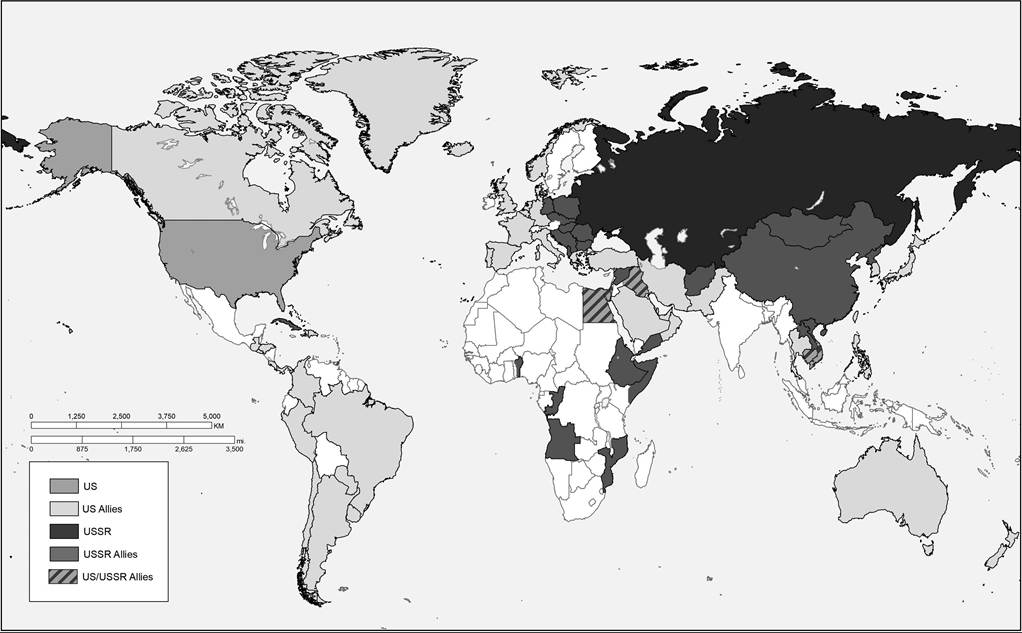
Map VIII.
The Twentieth Century: The Collapse of Colonial Empires and the Rise of Superpowers during the Cold War. Copyright: Peter Fibiger Bang with Jonathan Weiland.
“The day of conquest and aggrandizement is gone by!” These words have resonated as a promise through the twentieth century and into the twenty-first. They belong to President Woodrow Wilson in a speech delivered to the US Senate in January 1918 and were uttered in sympathy with revolutionary Russia during its peace negotiations with imperial Germany at Brest-Litovsk.[2506] They have subsequently seemed to be a declaration that imperialism was a thing of the past. Since then, the world has seen three great waves of imperial dissolution and the birth of numerous nation-states in their wake. Two extensive international organizations—the League of Nations, followed by the United Nations—have been established to ensure peaceful cooperation among the steadily growing number of independent sovereign peoples of the planet. Yet, this international infrastructure was the outcome of three vast global inter-imperial confrontations: the First and the Second World Wars and the Cold War. Each conflict saw the concentration of power escalate to levels hitherto unseen. In the end, the United States stood paramount in the world, a power of unrivaled reach and potential in the history of empire.
At the beginning, with the biggest and most global empire, Britain still stood tall among European colonial powers. Yet, the worldwide economic system, itself a product of European colonialism, was too dynamic to allow a stable status quo. Everywhere competition spurred on rivals to catch up, both in the Euro-Atlantic core and among the great societies of Asia.
The Meiji Restoration of Japan, beginning in 1868, was the most successful of these latter attempts to respond to the challenge. The old regime of shoguns and samurais was tossed aside and a modern army, along with the necessary administration and economic modernization, was built on the strongest European models. In 1894-1895 the reforms passed the test when East Asia's traditional power relations were suddenly upended. Japan dealt a devastating blow and military defeat to the Qing dynasty, causing it to lose control of Taiwan and Korea. A decade later, Japanese strength was further confirmed. Imperial Russia was roundly defeated and its expansion eastward checked. Japan had now asserted for itself a place among the great European powers and, from there, the road to empire lay open: Korea first, then Manchuria. Empire, as had been made abundantly clear, was not simply the source of national riches. On the contrary, it was a prize for states that had succeeded in developing their economy, organizational capacity, and military force at home.Mobilization of the wider population—now a necessity—became a burning issue. The long nineteenth century had seen an international discourse develop over how to awaken the wider population and muster its resources. If this discourse originated among intellectuals of the Euro-Atlantic, they were quickly joined by interlocutors from around the world. As so often before in history, provincial elites chose to opt into the cosmopolitan ideologies of the imperial metropolitan society. India, not least, fostered a long series of reformist interventions that came together in the program of the Congress Party. Under Gandhi in the first decades of the twentieth century, it became a strong force for independence. These aspirations were informed by a generic liberalism, its key values focusing on autonomy and liberation, of the individual as well as the people. But to achieve these ends, this discourse also pushed to increase the control of the state over society, in order to break up old privileges, traditions, and loyalties while subjecting the population to new forms of regimentation and governmentality.
The politics of liberation were, in short, contradictory. The right to self-determination of peoples and nations was celebrated. At the same time, however, this made it all the more important to determine just who belonged to the nation. States began to demarcate the boundaries of populations more firmly, and territorial empires suddenly found themselves confronted by a minority problem and separatist demands (Hall, Chap. 16, Vol. 1). Colonial governments, meanwhile, reinforced ethnic differences, sorting groups into a segregated, racist hierarchy in which the ruling people, most often Westerners, sat at the top.[2507] Even so, this same discourse nourished the formation of an international group of radical reformers and revolutionaries (see further, Majeed, Chap. 10, Vol. 1). Sun Yatsen, the first president of the Republic of China after the revolution in 1911, which retired the Qing dynasty and initiated national reform, had spent considerable time in exile in Japan, Europe, and the United States, as well as in Southeast Asian locations such as Singapore.[2508]The winds of revolutionary change were gathering. They were unleashed at gale force when the rivalries among the great powers ofinternational society finally erupted into all-out, full-scale war in 1914. The rise of a rapidly industrializing Germany had pushed the empires of Russia, France, and Britain into alliance. Together they sought to balance the muscular power in the center of Europe, which had formed a rival axis with Austro-Hungary (the remnants of the old Habsburg empire) and eventually the Ottomans. An extreme stress test and a slaughterhouse, the Great War became a graveyard of the old extensive continental empires. They found it difficult to mobilize as intensively as necessary to wage prolonged war on the unprecedented scale that had been made possible by industrial technology. Soon they were threatened by the prospect of revolution and popular uprising. Desperate measures were introduced to secure the internal cohesion required for the war effort.
In some regions, ethnic cleansings wrought terror among the victimized populations. The Ottoman government, for instance, distrustful of the Christian Armenians in regions bordering Russia, resorted to genocide. Massacres and death marches were graphically reported in the international press to a horrified public.[2509] But not even such extreme measures could save the imperial conglomerates.Russia was the first to cave in. Wrecked by two revolutions in the course of 1917, its war effort collapsed. The new Bolshevik revolutionary government, whatever the solidarity professed by President Wilson, had to concentrate on securing power and negotiated a losing peace with Germany, one that gave up much of Russia's empire in the Baltic and Eastern Europe. But by then the United States, the other major new industrialized heavyweight, had already entered the war. This tipped the balance decisively in favor of the Western powers, and an exhausted Germany was eventually forced to give up in November 1918. At that time, the governments of its allies were in full collapse. The Arabs, in a British-supported revolt and in cooperation with the famous Lawrence, who would go on to immortalise their campaign in The Seven Pillars of Wisdom, had severed themselves from the Ottomans. Across the Habsburg domains, the regional territories had ceased to obey the imperial government and declared independence. From St. Petersburg to Istanbul, the old dynasties fell like dominoes and were succeeded by a large number of states, each asserting their national independence.
The right of the peoples to self-determination increasingly gained ground as the new governing principle of international law. At the instigation of the United States, the newcomer to the war, it became a central theme of the official peace negotiations in 1919 attempting to forge a durable settlement for the postwar international order. President Wilson, whose Fourteen Points speech we have already had occasion to hear, found inspiration in Kantian philosophy and suggested the creation of a League of Nations that would peacefully manage relations among states and peoples.
Anti-imperialism had been elevated to a cornerstone of the world order. Implementation of the new principles, however, only really applied to the losing empires. To the outsiders, the hypocrisy of the allies' ethically inspired foreign policy was obvious (and remains so today). Victorious Britain and France were handed control of large parts of the Middle East in so-called mandate areas, to be held in trust within the context of the new international organization. In spite of ideological posturing, European colonial empire seemed to have come out of the pandemonium strengthened, not weakened. Both France and Britain had been able to reinforce their large national armies with contingents recruited from their far-flung colonial dominions. Australians had died in droves on the beaches of Gallipoli, and Indian troops had seen action everywhere from Basra to Neuve Chapelle, while France had deployed soldiers from its African possessions.[2510]But looks were to some extent deceptive. The truth was that a large and cohesive state, with a strong economy, but with relatively few overseas possessions, had been too much for the two leading colonial powers. Colonial empire represented, in relative terms, a less intensive way of mobilizing force; it could not substitute for a vigorous national buildup within metropolitan society. This had become necessary to wage war on the industrial scale now required. Where formerly army totals had at most reached into a few 100,000s, the new type of unbounded war involved drafting millions of soldiers and intensively harnessing the national economy to serve the needs of the military (see also Morris, Chap. 4, Vol. 1). Soon the bluff was about to be called.
Already in 1919, a limited form of parliamentary home rule or power-sharing was introduced in India in recognition of its contribution to the war. The British might in this have seen a strategy to placate the demands of India's elites. Instead it became a platform for fueling the ambitions for national independence that were shaping up among the more successful and dynamic groups of Indian society.
Meanwhile, the League of Nations soon turned out to be incapable of regulating international power politics. The United States, unwilling to bind itself, never even ratified the treaty. Japan proceeded apace with muscling its way to the front and became steadily more militaristic. In 1931, it invaded Manchuria. Puyi, the demoted last emperor of China and the object of an unforgettable 1987 movie by Bernardo Bertolucci, was installed as the figurehead of Japan's new colonial regime in the city of Changchun. Residing from a new purpose-built palace in Europeanising style, the scion of the Qing dynasty was free to indulge in illusory dreams of resurrecting the glory of Manchu power, while the Japanese went about their work undisturbed. Further escalation followed in 1937 with the invasion of China proper, the infamous rape of Nanjing, and extensive war against the nationalist Kuomintang government under General Chiang Kai- shek, who fought in an uneasy alliance with the communists. Vigorously attempting to build up its power, the Japanese colonial government promoted industrial development more than usual in its imperial possessions. A fearsome challenge to the Western colonial order was taking shape (Hedinger and Von Brescius, Chap. 41).Japan was not the only power seeking to combine state- led industrialization, mass mobilization, and a militaristic, aggressive government. A wave of totalitarianism, in various guises, swept through states under severe pressure to strengthen themselves. This was especially true among the losers of the First World War. Germany, struggling with crisis and the repercussions of defeat, turned to a Nazi dictatorship under a charismatic strongman, Hitler (gov. 1933-1945). No more room for divisive politics, doubt, or debate: society was to be concentrated toward one purpose, the forceful reclamation of German greatness and empire—Lebensraum. Wary of the prospect of renewed full-scale military confrontation, the other great powers in Europe first tried appeasement. But the fascist and rabidly nationalist regime was bent on war, to some extent even drew its very raison d’etre from war, and continuously increased its demands. War was inevitable and eventually broke out when the Soviet Union under Stalin reached an accommodation with the Nazi regime. No less totalitarian than National-Socialist Germany, the Soviet regime had conducted a ruthless and often murderous campaign of forced industrialization and kept together much of the ethnically composite empire of the czars. The Communist Party, with its universalist ideology, not only provided the core personnel to run the state, it also offered a transregional identity to keep the varied local elites together under the same umbrella (Hosking, Chap. 43). Negotiating a pact with Nazi Germany now enabled Stalin to take back a vast portion of the Baltic and Eastern European territories that had become independent from the Russian Empire at the end of World War I. Germany, on the other hand, was free to claim half of Poland and wage war undisturbed against the Western European powers. The assault came in 1939, and the victorious Nazi battalions blitzed through Europe. A new thousand-year Reich had been created.
History, however, would soon prove this proclamation to be the megalomaniacal outpourings of a fevered fanatic. Britain, under the inspired leadership of Churchill, held out on the fringes of Europe; it was impossible to believe that the empire could survive complete fascist domination on the European continent. Rising to the occasion, the British entered what their prime minister, in a speech that has become legend, predicted would be “their finest hour.”[2511] But alone, even the empire would have proved insufficient. Behind Britain, however, across the Atlantic, was the United States, the world’s biggest industrial power. Realizing that German domination was not in its interest, America propped up the tottering British colonial empire with loans and supplies. At the same time, with its command of the Philippines, the United States was also intent on curbing Japanese ambitions in East Asia.
In 1941, Germany and Japan decided to up the ante. Perhaps also drunk on their spectacular successes, they redoubled their efforts in order to break the deadlock and force a peace: shock and awe. In June 1941, Germany broke the pact with Stalin and invaded the Soviet Union. The German army was approaching Moscow when Japan launched a surprise attack on Pearl Harbor, the Pacific base of the US fleet, before rolling up the American, French, Dutch, and British colonies in Southeast Asia. The Philippines, Vietnam, Indonesia, Malaya, Burma, and the massive fortress of Singapore all fell within months. Only India stood firm, but only just. While the government was desperate shoring up the war-effort, Bengal was left to suffer a gruelling famine on its own that further undermined the legitimacy of the colonial order.[2512] However, the policy of occupation pursued by both Nazi Germany and imperial Japan was, even when viewed against the long global history of imperialism, unusually brutal and ruthless. Death marches, ethnic cleansing, the systematic conscription of women from occupied territories into sexual slavery—these atrocities, and more may be added, accumulate into a vast catalogue of crimes, culminating in the horrifying Holocaust, the attempt to simply round up all Jews across Europe, inter them in concentration camps, and finally kill them on an industrial scale. In spite of such incomprehensible ruthlessness and racist extremism, both powers managed to mobilize societies across the occupied territories to cooperate in their own exploitation.[2513] Japan, not least, sought to capitalize on its claim to have liberated colonies from Western powers.
But these efforts were insufficient to match the enormous resource and population bases available to both the Soviet Union and—to an even greater extent—the United States. Once the two powers were pulled into the war, thereby merging the European and Asian theaters into one global inter-imperial battlefield, the tide was bound to turn against Germany and Japan. They had pursued the war with such pitiless intensity that compromise was impossible. This was already clear by the end of 1942. The battles of Stalingrad, El Alamein, and Midway dealt devastating blows to the armed forces of both powers. Even so, both clung on with such tenacity that they managed to drag the final defeat into 1945. By then, most large cities in Germany had been reduced to rubble, the total number of war deaths was approaching 100 million, and two nuclear bombs had been dropped on the Japanese cities of Hiroshima and Nagasaki. This had been total war and the world would never be the same.
Out of the wreckage, a new world order emerged, dominated by the United States and the Soviet Union. Both powers, subscribing to histories of revolution against an ancien regime, professed to be beacons of anti-imperialism. Yet both were in command of greater and more destructive military might than any previous state in history. Their global predominance was unmistakable, and the term “superpower” was anything but misleading. In this way, their domination accentuated a paradox that seems built into the foundations of the modern world, in which the reality of imperial supremacy coexists with the celebration of sovereignty as the sole legitimate principle of statehood. Chinese nationalism, to name another example, was articulated around the aspiration of preserving the territory of the old poly-ethnic Qing empire from the onslaught of modern colonialism.[2514] Sovereignty could only be achieved by saving the old imperial realm: this was a tenet that was central to the Kuomintang, as well as the Communists who finally won the struggle for power and the political mobilization of the peasantry in 1949. Anti-imperialism, it turned out, primarily manifested in resistance to the re-establishment of European colonial empire.
The postwar colonies seethed with hopes for national liberation and independence. Many had experienced the fall of their European “masters” during the Second World War, and all had seen examples of it happening. Exhausted by the massive war and needing money to rebuild their own metropolitan and national societies, European colonial states found that, as they tried to reassert control, it was now beyond their means. Starting with India in 1947, a new wave of decolonization, sometimes hard fought, spread through Asia and Africa (Ward, Chap. 42). In India, for instance, the transfer of power occurred after a voluntary agreement, while in countries such as Malaya, Vietnam, and Algeria prolonged and heavy fighting occurred. However, with the humiliating and ignominious failure of France and Britain to jointly hold on to the Suez Canal in 1956, the writing was unmistakably on the wall. Their troops had to be withdrawn when the United States threatened to pull the plug on the British financial system that had come to depend on transatlantic credits. European colonialism had drawn to a close, and in the roughly two decades that followed, their far-flung empires were dismantled.
Vast numbers of people, former rulers and subalterns alike, were left stranded and even homeless in the process, as the world of empire—with its interconnected diasporic communities and ethnically mixed populations—gave way to the supposedly separate peoples of the new nation-states. Some white settler groups sought to hold on to power in the changing political landscape through various policies of apartheid that have left deep scars on their societies; and some of today's most interminable international conflicts originated in this period. This includes the frozen, armed confrontation between the new nations of India and Pakistan over the province of Kashmir. It also includes the struggle in Palestine between the Arabs and the new state of Israel, which was founded by European Jews who immigrated there in search of a national homeland, safe from persecution. Communal violence, ethnic cleansing, population transfer, and military suppression of minorities by fragile governments attempting to turn former colonial territories into functioning states—these phenomena constituted the horrifying downside of an age otherwise filled with hope and the enfranchisement of previously silenced groups. At the Bandung Conference in 1955, the leaders of the decolonized nations assembled to proclaim a new era, free from traditional power politics. New forms of theory developed to overcome the racist and Eurocentric biases of the predominant concepts, theories and worldviews of the prewar period. Under the broad banner of postcolonialism, they continue their work to reshape hierarchies, modes of thought, curricula and the culture of commemoration in schools, universities and society at large across the world. Meanwhile, a revamped version of the world community—inspired, as with the League of Nations, by Kantian idealism—had been founded in 1945. The United Nations, with its seat in New York, was intended as a peaceful, postimperial framework within which to organize international relations.
In practice, though, things were more complicated. The two superpowers conceived themselves to be in a global competition that pitted their respective systems, communism and capitalism, against one another. Communism rejected the market and opted for command, control, and a planned economy. Under Soviet leadership in the framework of the Warsaw Pact, Eastern Europe was pressed into a system of imperial subjection (Hosking, Chap. 43). The United States, on the other hand, advocated the market. This made territorial control less significant. More important was access to economic flows and energy supplies (see Hornborg, Chap. 13, Vol. 1). A system of military bases and alliances, which it is difficult to call anything but imperial, was created to enable the global projection of force and to provide a firm foundation for a world economic system, at the center of which stood the United States (Preston, Chap. 44). The nuclear bomb, however, had changed the rules of great power competition. All-out war would result in mutual and complete destruction. Competition, therefore, hardened into Cold War, with two blocks pitted against one another in a relatively stable and contained form of hostility expressed through a nuclear arms race. Lesser regional wars or wars by proxy did take place, for instance the Korean War, the Vietnam War, and the Soviet invasion of Afghanistan. Occasionally, the two superpowers intervened in their own “backyards” to maintain the loyalty of their clients. In 1956 and 1968, the Soviets intervened in Hungary and Czechoslovakia to keep the local communist governments in line. In 1973, the CIA helped orchestrate a military coup in Chile against its communist president, Salvador Allende, and brought the right-wing military dictatorship of Pinochet into power. The new and fragile regimes of many African states were also often caught up in the rivalries of the superpowers. But the system turned out to be surprisingly stable. When, in the end, the Soviet bloc began to crack and then collapse, it came mostly as a surprise. The Berlin Wall, closing off communist East Germany from the Western world, fell in 1989 because of a loss of morale. The peoples of the Eastern Bloc wanted access to Western consumerism.
With the collapse of the communist alternative, US-led globalization stood poised to take over the planet. The United States remained alone at the top, it was the hyperpower, and for the first time in history a real global hegemony seemed to have materialized. Saddam Hussein's regime in Iraq was the first state significantly to feel the winds of change. Following the Iraqi invasion of small, oil-rich Kuwait at the bottom of the Persian Gulf, a US-led coalition, with the full support of the UN, intervened in 1991 to oust the occupying army. A stable Pax Americana was spreading, a unipolar order emerging, and history, pundits could muse, had come to an end. Order and freedom, stability and prosperity, that was what the future held in store; the struggle was over. Among the allies of the victorious superpower, governments eagerly cashed in on the imperial peace-dividend and cut back on military expenditure.
Three decades on, however, the American world order looks more beleaguered, and we are left, instead, with a forceful reminder of the endurance of competition within the international political and economic system (Cooper, Chap. 45). Russia has done its best to claw its way back to great power status and to subvert the United States as a superpower. The Middle East, for which the first Iraq War had held out hope for a new, freer, and more peaceful order, has been thrown into complete turmoil. Several new American invasions have revealed the limited capacity of the “unipolar empire” to order the world. War and revolution have produced mostly disappointment, suffering, and societal collapse. Vast numbers of refugees and a high death toll have been the outcome so far. Finally, and perhaps even more importantly, Communist China has found a way to generate explosive economic growth. With hindsight, 1989 was pivotal in more ways than one. It was also the year when protests on Tiananmen Square in Beijing were crushed, cementing the strong leadership of the Communist Party and its market-oriented reforms. A generation on, China now presents a viable alternative political model and seems destined to challenge and perhaps overtake the position of US leadership. The period in which these volumes took shape has seen a steadily more assertive “Middle Kingdom” appear on the international scene. Some Chinese intellectuals have even toyed with the idea of a future Chinese world order based on the old principles of Tianxia, “All under Heaven.”[2515] The last chapter has yet to be written in the history of competition for imperial predominance which started with Sargon five millennia ago.
Bibliography and Guidance
As empire has re-emerged as a strong area of interest for historians of modernity, the two world wars of the twentieth century are increasingly seen as great interimperial wars. As a consequence, the contribution and significance of societies and theaters outside of Europe to the war effort have moved higher up on the agenda. Bayly and Harper (2007) serve as one example from a growing literature. Burton and Balantyne (2012) have extended the narrative of the interweaving of empire and modern globalization deep into the twentieth century, pointing to the international discourse of anti-imperialism as a hallmark of this era, from the perspective of world history. The reader should consult Mazower (2012) for an illuminating survey of how the internationalism generated by global empire gave rise to notions of world government that ultimately led to the formation of the UN. Bayly (2018) expands the vision of his 2004 book, central to Part VII of this volume, right up to the present. Mann (2012) is an impressive survey of the leading imperial powers of the late nineteenth and twentieth centuries, stressing the need to balance the present interest in globalizing processes with an understanding of the enormous internal buildup inside the empires and their metropolitan societies of the time.
Bibliography
Ak^am, T. 2012. The Young Turks' Crime against Humanity: The Armenian Genocide and Ethnic Cleansing in the Ottoman Empire. Princeton.
Bayly, C. A. 2018. Remaking the Modern World 1900-2015: Global Connections and Comparisons (Blackwell History of the World). Hoboken, NJ.
Bayly, C. A., and T. Harper. 2007. Forgotten Wars: The End of Britain’s Asian Empire. London. Bayly, S. 2007. Asian Voices in a Post-Colonial Age: Vietnam, India and Beyond. Cambridge. Bethencourt, F. 2013. Racisms: From the Crusades to the Twentieth Century. Princeton.
Burton, A., and T. Ballantyne. 2012. Empires and the Reach of the Global: 1870-1945. Cambridge, MA. Conrad, S. and D. Sachsenmaier eds. 2007. Competing Visions of World Order: Global Moments and Movements, 1880s-1930s. Basingstoke.
Fennell, J. 2019. Fighting the People’s War: The British and Commonwealth Armies and the Second World War. Cambridge.
Fogarty, R. S. 2008. Race and War in France: Colonial Subjects in the French Army, 1914-1918. Baltimore.
Gerwarth, R. and E. Manela eds. 2014. Empires at War: 1911-1923. Oxford.
Mann, M. 2012. The Sources of Social Power, Vol. 3: Global Empires and Revolution, 1890-1945. Cambridge.
Mazower, M. 2008. Hitler’s Empire. Nazi Rule in Occupied Europe. London
Mazower, M. 2012. Governing the World: The History of an Idea. London.
Yan X. 2011. Ancient Chinese Thought, Modern Chinese Power. Princeton, NJ.
Zhao T. 2006. “Rethinking Empire from a Chinese Concept All- under-Heaven' (Tian-xia).” Social Identities 12, no. 1: 29-41.