Partition and the end of the mandate
From the end of the Second World War onwards Britain's hold on Palestine became increasingly tenuous as Arab and particularly Jewish violence increased in a last concerted push for independence.
The final British decision to relinquish its mandate and withdraw from Palestine was the result of a combination of factors, the most important of which was the need to focus on domestic post-war reconstruction and economic recovery from a war that had cost Britain £7 billion.Another factor that should not be underestimated was the series of concerted attacks on British targets in Palestine which started in 1944 and became known as the Jewish Revolt. The revolt was carried out by all of theyishuvs paramilitary organizations, the mainstream Haganah, its strike force the Palmah, and the extremist Irgun and Lehi. It aimed at sabotaging British installations such as radar posts, police stations, airfields, railways and the British-owned Iraqi Oil Company pipeline. While the Haganah and Palmah limited their attacks to British property, the Irgun and Lehi also targeted British military personnel and civilians, as exemplified by the Irgun s July 1946 bombing of the King David Hotel, a section of which was used as the British military headquarters. Ninety-one lives were lost, including many civilians, among them British, Jews and Arabs.
Haganah (Hebrew: Defence)
Jewish underground organization established in 1920 following Arab riots and the British failure to defend the Jews. It became the core of the IDF in 1948.
The need for additional troops, the growing number of casualties and the increased cost of maintaining the mandate under such circumstances at a time when the economy was failing and the public's tolerance for military conflict had dropped to an all-time low, resulted in domestic pressure on the British government to withdraw.
Added to this was growing international pressure as a result of Britain's continuation of its naval blockade to prevent Jewish immigration to Palestine. The images of ships full of Holocaust survivors either being sent back to their port of origin or re-routed to Cyprus where their passengers were again interned in camps turned international opinion against Britain. Moreover, the end of the war saw expectations that colonialism was coming to an end and that a new age of independence and self-determination was beginning, as embodied by the newly formed United Nations (UN).United Nations (UN)
An international organization established after the Second World War to replace the League of Nations. Since its establishment in 1945, its membership has grown to 192 countries.
Thus it was not wholly surprising that on 14 February 1947 Britain decided to refer the Palestine problem to the UN. At the first special session of the General Assembly in May 1947 the United Nations Special Commission on Palestine (UNSCOP) was set up to investigate the causes of the conflict and to recommend solutions. For the next four months UNSCOP conducted hearings in New York, Jerusalem, Beirut and Geneva, virtually replicating the work of the previous commissions of inquiry. It also came to a similar conclusion: both Jewish and Arab claims to the land were of equal validity but their national aspirations were irreconcilable. The majority opinion in UNSCOP was that only partition of the territory would recognize these claims, allow both peoples self-determination and thus resolve the conflict. The minority considered partition unworkable and suggested a federal union of an Arab state and a Jewish state with a common foreign and defence policy under a central power-sharing government.
The Zionists rejected the minority proposal but accepted partition. The Arabs, who had earlier decided to boycott the UNSCOP inquiry, rejected both proposals. These decisions ultimately deprived the Palestinians of an opportunity to make their case and to influence the debate, as well as the subsequent vote, in the UN General Assembly.
The combination of Arab non-cooperation, general sympathy for the Jews following the Holocaust and immense lobbying efforts by the Jewish Agency resulted in a vote of thirty-three in favour of partition, thirteen against and ten abstentions. The partition plan, drawn up by UNSCOP, divided Palestinesee Map 5.1
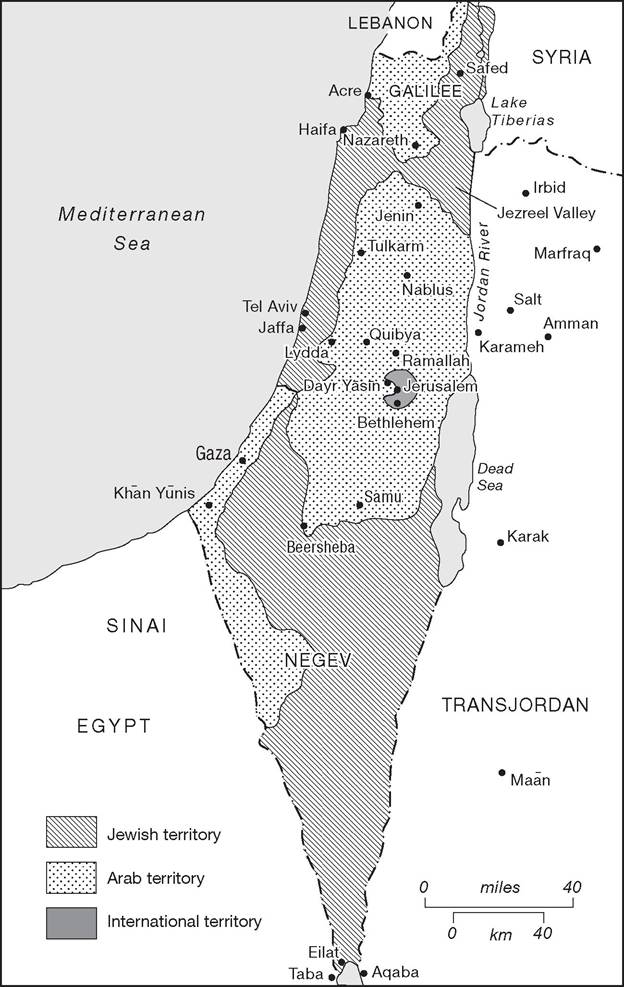
Map 5.1 UN partition plan for Palestine, 1947
Source: After Schulze (1999)
in accordance with existing settlement patterns, and meant that the proposed Arab state was to consist of the coastal strip of Gaza, Galilee in the north, and the area around Nablus, Hebron and Beersheba, while the proposed Jewish state would consist of the coastal area around Tel Aviv and Haifa, the Negev in the south, and the Jezreel and Huleh valleys. Jerusalem was to come under international control.
However, the lack of territorial contiguity for either state and the problem that small populations of either side were ‘trapped’ in the state of the other did not augur well. Added that the Palestinian Arabs held on to their rejectionist position and that neighbouring Arab countries vowed to destroy any Jewish state, this unsatisfactory compromise ensured that the partition resolution was not the end of the Palestine conflict but rather the beginning of years of Arab-Israeli war.
More on the topic Partition and the end of the mandate:
- Mandate (Mandatum)
- 4 Empire, Imperialism and the Partition of Africa
- Colonial partition of the Coral Sea
- The mandate and British policy
- The Mandate of Heaven
- From the Second World War to the Post-Partition State(s)
- The Legacy of the British Mandate: Islamic Law Encounters Colonial Politics
- AS IN THE BEGINNING, SO IN THE END
- The end of the Raj
- The End of Ukrainization
- Globalization: Peace at the End of History
- THE TWELVE AT THE END
- The Mysterious End of the Minoans
- The End of Slavery