Piracy in the Americas
If the Portuguese introduced a significant upsurge in piracy to Asian seas, perhaps the Spanish did the same in greater America. Columbus came to trade, not raid, but the pattern soon shifted in favour of the razzia.
On his very first voyage, Columbus claimed to have helped native ‘friends' on Hispaniola (nowadays called Tainos) to protect themselves from seaborne marauders from the Windward Islands, the so-called Caribs. Piracy in the Caribbean might thus have been an ancient or at least ‘pre-Hispanic' practice, but it is clear that the volume of seaborne raiding, mostly for captives, rose drastically soon after the arrival of Spaniards on Hispaniola, Cuba and Puerto Rico. Laws protecting native peoples from unjust enslavement were routinely bent or flouted.In connection with gold mining and pearl diving, piratical raiding for Carib slaves was the principal economic activity of the Spanish Caribbean for a generation, and it nearly annihilated native peoples of the region. Cortes, Pizarro and other veterans of these Caribbean raids could be seen as pirates, too, yet their mainland conquests were royally sanctioned private enterprises that soon gave way to imperial control under Charles V and Philip II. Men like Cortes would have bristled at the term ‘corsair', much less ‘pirate', but in descending from the sea to seize innocent captives and take away huge amounts of gold, Spanish conquistadors were in some ways the ultimate pirates. Only their licences and the shares paid to their king made them seem more like corsairs. The companies they formed and signed onto were perfectly familiar to any European maritime raider. Las Casas could have easily made the comparison, but his focus was on the conquistadors' unwarranted and thus mortally sinful violence.[728]
American treasure drew foreign traders to the Caribbean, but Spain was jealous in trying to control its flow.
Contraband trade, pioneered to some extent by the French, soon sparked reprisal, which in turn spurred piracy. Perennial conflicts with the French made piracy legal in the form of corsair- ing, and French raiders made the most of their licences as they ravaged Havana, Sanjuan de Puerto Rico, Cartagena and other towns. Legal or not, the initial period of raiding, headed by men like Jacques de Sores and Francois Leclerc, ended with the Treaty of Cateau-Cambresis in 1558.[729] Catholics stole from Catholics, but many early French corsairs were Protestants. The Spanish called them Lutheran heretics, even if most were Calvinists. Protestants were assumed alike when they destroyed religious images and killed priests.English contraband traders were similarly rebuffed in the Spanish Caribbean beginning in the 1560s, leading them to turn violent and ultimately piratical. As we have seen, Drake and his contemporaries cast their raids as acts of vengeance against the king of Spain, even as they robbed innocent subjects and forced the sale of African slaves. When war was declared between England and Spain after 1585, the Elizabethans felt justified, and more so after the 1588 defeat of the Armada. What better way to punish evil King Philip than to pinch off his American money supply?
The Dutch had more to complain about when it came to Spain. The rebels who turned sea raiding to punishing effect beginning in 1568 would ultimately bring the Spanish and Portuguese to their knees by the 1640s. Along the way, Dutch corsairs captured an entire silver fleet on the north coast of Cuba in 1628, helped seize north-east Brazil in 1630, and supplanted the Portuguese all over Africa and Asia by the mid 1640s. To call the Dutch pirates, as the Spanish routinely did, was not entirely fair. Many corsairs sailed for the two great Dutch trading companies and few won more than harsh treatment and short rations - those that survived. It should also be remembered that Spanish subjects also took to corsairing, first from Dunkirk, then from the ports of Biscay.[730] Dutch, French and English fishermen and merchants complained of piracy.
Pirate or corsair violence in American waters in the era of Piet Heyn and Cornelis Jol, aka Houtebeen or Peg-leg, was arguably no harsher than the violence endured by European peasants during the Thirty Years War. These were violent times, and human life seems to have counted for little. The sometimes piratical slave trade developing along Africa's west coast was but another sad example of how ‘man was wolf to man', often in the name of profit. By Luso-Hispanic logic, ‘justly taken' African captives were ‘ransomed' into Christendom, only to repay their debt with eternal labour. African folktales sometimes rendered Europeans as cannibal pirates.[731]
The first self-proclaimed pirates of the Caribbean were the buccaneers who emerged in the wake of the 1648 Peace of Münster. The origins of the buccaneers are obscure, but by the 1650s they were a recognisable force, the first truly ‘transnational' pirates to rove across western seas. Only the Barbary corsairs exceeded them in ethnic diversity, but the difference was more in methods and motives than national origins. Starting in Tortuga, Jamaica, Providence and other contested Caribbean islands, the buccaneers grew to be a global menace by 1680.[732]
Whereas the Barbary corsairs might rob fellow Muslims from time to time, the Caribbean buccaneers displayed little loyalty when it came to attacking soft targets. It was indeed after they began to pick on ships and towns not claimed by the king of Spain that their greatest troubles began. Henry Morgan was rewarded for leading the 1671 raid on Panama City, but officially this was denounced as an act of piracy. After his return to Jamaica, Morgan became a judge of his fellow brethren when they turned their energies on the wrong targets. In the 1680s the buccaneers were flushed into the Pacific to avoid prosecution in the Atlantic, and soon after they found their way to the Indian Ocean, establishing the cycle described above as ‘the pirate round', a seasonal hopping from sea to sea in search of booty.[733]
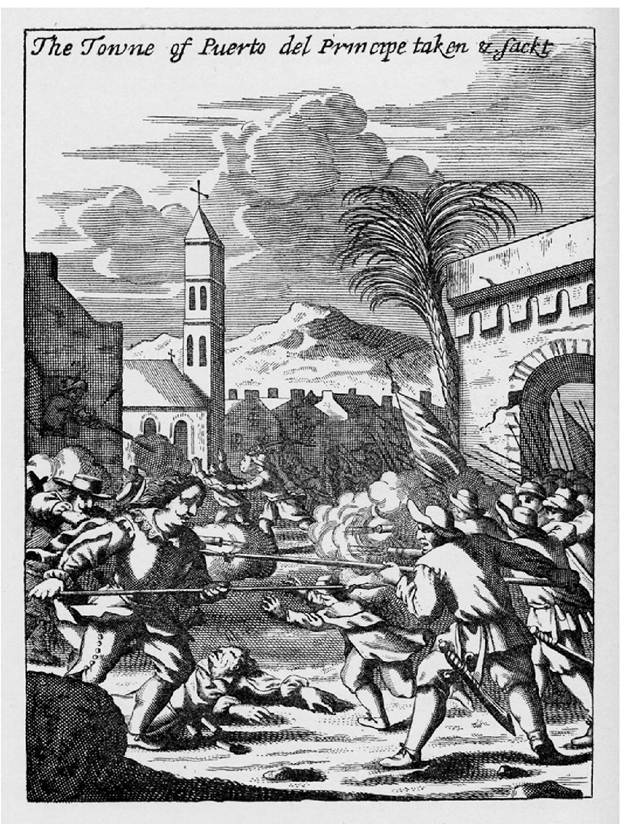
Figure 23.4 Henry Morgan's sacking of Puerto del Principe in 1671.
The term vrijbuiter goes back to the earlier Dutch (for the French, flibustier), but some historians refer to the last Atlantic pirates to flourish in the eighteenth century as freebooters. Mainly Anglo-Americans, the freebooters terrorised the Caribbean and parts of the Atlantic coast of Africa from the 1710s to about 1725. This was the age of famous sea robbers such as Bartholomew Roberts, Ann
Bonny and Mary Read, and Edward Teach, aka Blackbeard. The violent behaviour of these last of the golden age pirates is well recorded in victim testimonies, confessions and even sermons, some of them collated, reworked and published by Daniel Defoe. The fact that the mostly Anglo-American freebooters faced an emerging British Navy charged with exterminating them seems to have given a new edge to their actions, adding more defiance to their attempts at terror.
But it was the terror of the state, led by the Whigs and the great trading companies, that won out, turning pirates into an immutable category of human-as-vermin, thus infecting anyone who associated with them or received their stolen wares. Like the alleged deviants who crowded Newgate prison or who swung from Albion's ‘fatal tree' after the War of the Spanish Succession, the last pirates were crushed on the orders of a vengeful new social class.[734]
American piracy did not disappear with the extermination campaigns of the early eighteenth century, but it only truly blossomed when the new royal navies were tied up in major conflicts such as the Napoleonic Wars. One piracy cycle exploded amid the Spanish-American wars of independence, only to draw fire from both Britain and the United States.[735] Many private raiders sailed with state sanction as privateers but none wanted to be called pirates now that the label won a death sentence. ‘Pirate' became a term reserved mostly for non-Western raiders in the nineteenth century, and the new world of free trade - promoted already by Thomas Jefferson and the United States - helped justify the violent destruction of the Barbary corsairs, followed by the colonial takeover of much of North Africa by France and other European powers.