Preface
In the making of connections between human societies, the role of the sea is particularly fascinating. Connections across large open spaces have brought together peoples, religions and civilizations in stimulating ways.
Sometimes this has been through individual encounters, as travellers, including pilgrims and merchants, found themselves visiting alien environments; sometimes it has been the result of mass migrations that have changed the character of regions; sometimes it has been the result as much of the movement of goods as of people, when the inhabitants of distant lands saw, admired, and imported or copied the art works of another culture, or read its literature, or were taken aback by some rare and precious item that opened their eyes to its existence. Such contacts were made overland and up and down river systems, as well as by sea; but overland they were mediated by the cultures that lay along the routes being followed, whereas links across the sea could tie together very different worlds, as far apart as Portugal and Japan or Sweden and China.This book is intended to sit alongside my earlier book, The Great Sea: A Human History of the Mediterranean, first published in 2011. Like that book, it is a human rather than a natural history, emphasizing the role of often adventurous traders in making and maintaining contact. Whereas the Mediterranean accounts for 0.8 per cent of the maritime surface of the globe, seas as a whole account for about 70 per cent of the world’s surface, and most of this watery space consists of the vast open areas we call oceans. From outer space, the Earth is mainly blue. The oceans have distinct but gigantic wind systems, generated by the movement of air over vast masses of both warm and cold water: one has only to think of the seasonal monsoons in the Indian Ocean. The Roaring Forties that would helpfully sweep sailing vessels from the Atlantic into the Indian Ocean were the same winds that made entry into the Pacific from the southern Atlantic, around Cape Horn, so frightening.
Currents such as the Gulf Stream, which keeps the British Isles relatively warm, or the not dissimilar Kuroshio or Japan current, stretch across thousands of miles.1 We divide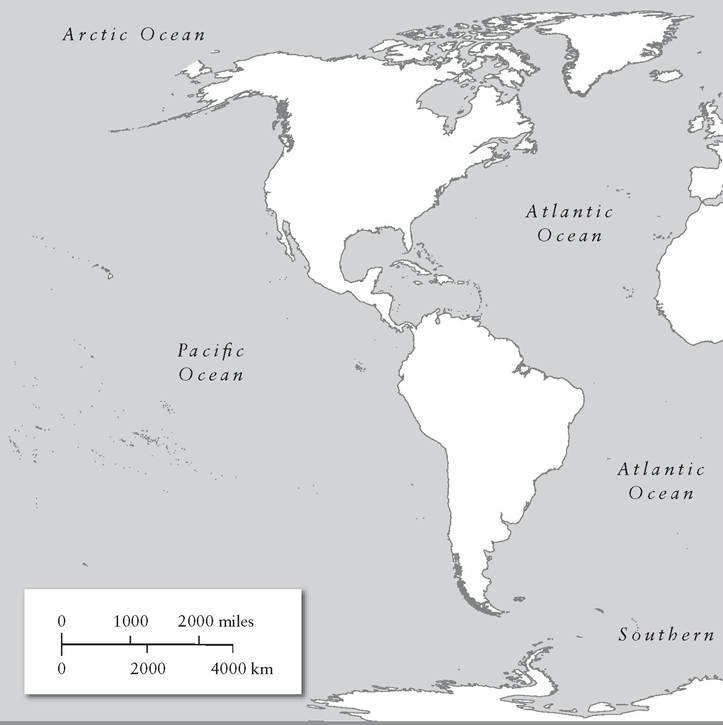
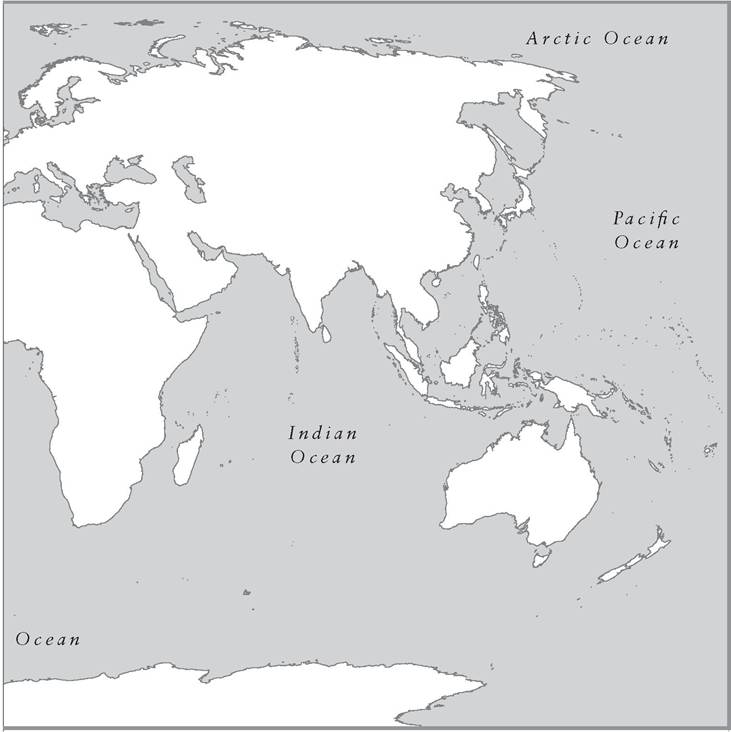
the all-encompassing global sea into the three great oceans; but ancient geographers, with some justice, imagined it to be a single Okeanos of intermingled waters, a concept revived in modern use of the term ‘World Ocean’ to describe all the oceans as a single unit.2
The three major oceans have attracted increasing interest as the study of maritime history has expanded beyond what might more properly be called naval history, which concentrates on warfare (or peace-keeping) on the surface of the sea, to greater involvement with the wider questions of how, why and when people crossed large maritime spaces, whether for trade or as migrants, and what sort of interdependence was created between lands far apart from one another by this movement across the oceans. This has led to debates about the origins of globalization, some
of which have been conducted at cross-purposes, since the concept of ‘globalization’ is a vague one that can be defined in many ways. A question related to the theme of globalization that has often been raised is why Europeans opened up routes across the world after 1500, in the wake of Columbus and da Gama, while the Chinese, under Zheng He, launched extraordinarily ambitious voyages in the early fifteenth century that came to a sudden stop. This leads into a range of questions about the ‘Great Divergence’ between Europe and Asia or other continents, although, as with globalization, much depends on the criteria one adopts to measure the process. This book makes plain the dramatic effect of the entry of European traders and conquerors into distant oceans following the voyages of Columbus and da Gama, while also insisting that Columbus, da Gama and the worlds they explored can only be explained by looking at their long antecedents.
This book also insists that the European presence around the shores of the oceans can only be understood by taking into account the less well- documented activities of non-European merchants and sailors, some of whom were indigenous to the lands in which they lived, others of whom formed part of widespread diasporas - Greeks and later on Jews from Egypt, Armenians, Chinese, Malays, and so on. Sometimes the sea routes were managed by a sort of relay team, as goods passed from one set of traders to another, and from one type of ship to another, and as local rulers exacted their customs duties at each stopping point. And sometimes, even in the Greco-Roman Indian Ocean, they were managed by entrepreneurs who travelled the whole route from, say, Berenike on the Red Sea coast of Egypt to Pondicherry on the south-east coast of India. This is not to deny the transformative effect of the arrival of the Europeans in nearly every corner of the oceans. After Columbus and da Gama, the oceans and their islands were bound together in new ways. Ambitious new routes, longer than anything attempted before, criss-crossed the world, linking China to Mexico via Manila or the East Indies to Lisbon and Amsterdam. A further revolution occurred when steamships began to replace sailing vessels along the ocean routes in the nineteenth century, while two great canals at Suez and Panama transformed the routes themselves. And further revolutions in the late twentieth century introduced massive ships capable of carrying thousands of containers, and cruise ships that carry as many thousands of passengers.
Insofar as this book has heroes, they are not so often the explorers who opened up routes across the oceans, but the merchants who followed in their wake. Traders saw opportunities and made the tenuous links established by those who found new routes into firm, reliable and regular connections, whether in the era of Greco-Roman commerce across the Indian Ocean or in the aftermath of Columbus’s voyages to the Caribbean.
They settled down in trading stations that became major ports - Aden, Havana, Macau, Melaka, Quanzhou, to give just a few examples. But right up to the early days of the steamship maritime travel involved risk from shipwreck, piracy, disease, and - not l east - rajahs, sultans and other rulers who saw merchants as fair game in their hunt for funds, which they raised from confiscation as well as taxation. The history of l ong- distance travel across the seas is the history of people willing to take risks, both physical and financial: men (mainly) who gambled on business opportunities in faraway lands, in the search for profit. Using a loose definition, we could call these people capitalists, businessmen reinvesting their resources in the hope of generating greater and greater wealth. Such people are visible at the very start of the history of Indian Ocean trade, in the cities of Bronze Age Mesopotamia, and throughout the centuries that followed.The history of maritime trade is not all concerned with exotic items such as the spices of the Indies. Increasingly, historians have laid emphasis on humdrum local trade networks bringing primary produce - grain, oil, wine, wool, and so on - towards markets and towns. Yet those looking for really big profits were tempted to stray much further afield, eventually creating links across the oceans that had the power to stimulate economic growth at both ends of lengthy lines of communication: cities in China producing fine porcelain, for instance, and cities in Holland buying large quantities of it. Sometimes trade was masked as the payment and receipt of tribute, particularly in medieval China and Japan. Princely palaces might set the agenda by making clear what exotic objects they craved, but rulers could never prevent their diplomats from trading on the side, and attempts to close ports only generated new unofficial ones, as at Quanzhou in medieval China, which became a meeting point for merchants from Java, Malaya, India, the Arab world, and even Venice and Genoa.
Alongside the peaceful merchants, to be sure, there were plenty of sea raiders, most famously the Vikings; but here too the search for profit made raiders into at least part-time traders. There is undeniable fascination in looking at the exotic objects and foodstuffs that were carried across sometimes enormous distances, and in thinking about what these things meant to the people among whom they arrived - whether walrus tusks from Greenland or lacquer boxes from Japan or sacks of cloves and nutmeg from the Moluccas. The eternal appeal of rare and beautiful items from far-off lands, along with curiosity about those lands, prompted merchants and mariners to try out new routes and to chance upon unknown lands (not least the two vast continents of the Americas). But it is also important not to forget the human beings who were themselves treated as disposable cargo - notably the millions of slaves who were carried across the early modern Atlantic. When looking for female travellers across the oceans, it is here that we shall find significant numbers of women. Women also appear among the migrants who arrived in places as diverse as Viking Iceland, Puritan North America and Maori New Zealand - even among the Norse travellers who attempted to settle in North America in the Viking age. Too often, though, the documents are silent about the women’s history of the sea, other than legends about sea goddesses.
It is instructive to compare movement across the sea with movement across land. Many of the problems of carrying large quantities of goods and people overland were only resolved when railways were constructed in the nineteenth century, facilitating, for instance, the transfer of vast amounts of tea from remote quarters of India to the Indian Ocean and, ultimately, the teeming tea shops of London. Further back in time, the famous Silk Road that linked China to western Asia and, at some periods, Europe as well, flourished for relatively short periods, notably the ninth century and the late thirteenth to early fourteenth century.
Its cultural significance is not in doubt, as the ideas and arts of Buddhism and Islam were carried across the expanse of Eurasia. But the Silk Road carried only a small fraction of the goods that could be and were conveyed by ship from China and south-east Asia by way of Malaya and India towards Egypt and the Mediterranean. This ‘Silk Route of the Sea’ that crossed the Indian Ocean has an uninterrupted history going back 2,000 years, to the age of Emperor Augustus, and the astonishing quantities of porcelain found on board ships wrecked in the South China Sea makes this point as clearly as anything: the hundreds of thousands of plates and bowls loaded on late medieval junks for transfer to the Red Sea simply could not have been carried overland on the backs of camels - one eleventh-century wreck contains half a million pieces of Chinese porcelain. Chinese porcelain was greatly prized in medieval Egypt, to the point where attempts were made to imitate it: at least 700,000 sherds have been found underneath Fustat, or Old Cairo. These figures are nothing compared to the quantities of porcelain shipped from China to Europe in the eighteenth century.Historians have debated when and how widely the terms ‘Atlantic’, ‘Pacific’ and ‘Indian’ Ocean came into use, and whether they are appropriate. After all, the Indian Ocean bathes east Africa, Arabia and the Malay Peninsula as well as India; and early modern geographers tended to distinguish the northern Atlantic from its southern or ‘Ethiopic’ twin. The central and southern Pacific was often described as the ‘South Sea’. Nonetheless, schools of Atlantic, Pacific and Indian Ocean historians have emerged; indeed, a recent survey showed that more publications about Atlantic history have been juddering off the presses than publications about the Mediterranean, which was long the favourite pool of water among historians, beginning with the pioneering writings of Fernand Braudel. ‘We are all Atlanticists now,’ the eminent Harvard historian David Armitage proclaimed, as he set out different ways of writing Atlantic history, whether comparative, local or transatlantic (that is, about connections across the ocean).3 But the sense that maritime history is being compartmentalized into four main disconnected chunks, Atlantic, Pacific, Indian Ocean and Mediterranean, has attracted increasing criticism; their interaction with one another must not be ignored. This book is an attempt to write the history of the three great oceans together. That does mean, in the millennia before Columbus, treating them separately, because they constituted three spheres of human movement that were not directly connected to one another by the movement of humans from one ocean to another, even though goods (mainly spices) reached the ports of the medieval Atlantic from as far away as the East Indies, having passed through a non-oceanic sea, the Mediterranean. After 1492, though, I have laid as strong an emphasis as possible on the interconnections between the oceans, so that even chapters about (say) the English and their rivals in the seventeenth-century Caribbean have been written with an eye on the global context. This makes the last five centuries more manageable. But it also represents reality: the oceans had become intimately interconnected, as a quick glance at the Portuguese, Dutch or Danish maritime networks quickly shows. This interconnection of the oceans was the great revolution that followed the discovery of the Americas and of the route from Europe to Asia by way of the southern tip of Africa, and it has received too little attention.
One important theme of this book is the human occupation of previously uninhabited islands, beginning with the extraordinary achievements of Polynesian sailors in settling the scattered islands of the largest ocean of all. Within the Atlantic, Madeira, the Azores, the Cape Verde Islands and St Helena had an importance far greater than their tiny size would suggest. In the Indian Ocean, one very large island, Madagascar, was a miniature continent with its own distinctive wildlife; it was settled by Austronesians from the East Indies during what historians of Europe call the Middle Ages. In some cases humans, and the animals they brought with them, totally transformed these island environments: the most famous example is the extinction of the dodo after humans occupied Mauritius.4 Inevitably, though, immeasurably more has to be left out than included, and I have not attempted to write what pretends to be a complete or comprehensive history of the oceans, which would take up many volumes, but a rounded history of the oceans that homes in on what I think are the best illustrations of long-distance maritime connections. Some of these, such as the trade in Chinese tea and porcelain, had an enormous cultural and economic impact on places as far from China as Sweden and New England.
Another reservation about the way oceanic history has been written concerns its chronological span. The Atlantic, in particular, has suffered from an assumption that its history only begins with Columbus, allowing for a quick reference to the brief stay of Norse men and women somewhere in North America (though their stay in Greenland was by no means brief, lasting over 400 years). Quite apart from evidence for trade and migration in the pre-Columbian Caribbean, going back millennia, we have the rich evidence for trade in eastern Atlantic waters from Neolithic times onwards, linking Orkney and Shetland, as well as Denmark, to Atlantic France and Iberia; much later, we can watch the Hanseatic merchants of the late Middle Ages trading from Danzig to Lisbon. The close relationship between the Baltic and the North Sea, and then the Atlantic beyond, means that these seas need to be considered as extensions of the Atlantic. The ancient and medieval Indian Ocean has attracted much more attention than the early Atlantic, and it too has extensions. One is the South China Sea, at the entrance to the Pacific; but the seas all the way up to Korea and Japan have interacted strongly since ancient times. These seas have looked away from the Pacific of the Polynesian navigators, which was a separate world consisting of often tiny islands scattered across a vast and, it must have seemed, unbounded space. For this reason the maritime history of Japan, Korea and China before about 1500 will be found in the Indian Ocean chapters. Another extension is the Red Sea, which gave access to Egypt and beyond that the Mediterranean; that too receives close attention in this book.5 As for the Arctic Ocean, if it can be called an ocean rather than, as some have argued, a confined and largely frozen ‘Mediterranean’ stuck between Eurasia and North America, the history of the human presence has been told here through the repeated attempts to carve a route through Arctic ice and water to the Far East by way of the North-West and North-East Passages - if they existed. And the Southern or Antarctic Ocean is simply a label for the cold waters at the bottom of our planet, which are in effect part of the three major oceans, starting somewhere in the latitude of New Zealand - though the search for the assumed Southern Continent, which was thought to be much more temperate than Antarctica, does feature here.6
There is a great deal that this book is not about. Although it is, as the subtitle insists, a ‘human history’, rather than natural history, it is not concerned with the impact of human beings on the oceanic environment - what has been described as the ‘submarine’ history of the oceans. This book remains on the surface of the sea, with the exception of frequent use of evidence from shipwrecks, the remains of ships that were after all intended to stay on the surface. Ocean ecology is an important and urgent issue in the twenty-first century and has been discussed with passion by environmental experts.7 Humans are destroying the oceans by dumping plastics and effluents, and marine life pays a heavy price. Climate change may at last render accessible sea routes carrying large quantities of goods through the Arctic Ocean from Europe to and from the Far East. These are crucial matters, but this book is concerned instead with contacts between humans across the oceans, linking shores and islands, mostly in epochs when human impact on the seas themselves was limited, even though human impact on mid-sea islands such as Madeira or Hawai’i was massive. I am also not much concerned with fishing, except where it has generated long-distance contacts; so I do have a fair amount to say about herrings and cod in the Atlantic aboard Hanseatic and Dutch vessels, and about English ships that probably ventured close to Newfoundland fishing for cod before John Cabot’s arrival there in 1497. Later, American whalers briefly feature, in a discussion of the worldwide trade in whale products, and here one can point to severe ecological damage well before 1900, as whale populations of large areas of sea were hunted almost to extinction.
One very important result of the creation of new contacts between distant landmasses has been the importation and cultivation of alien crops far from their place of origin. The great example is the potato, a South American product that became the staple food of the Irish poor (with tragic consequences); well before that, the Islamic world provided conduits carrying oranges and bananas as far west as Spain, while Asiatic sugar struck roots in the Mediterranean, in Atlantic islands such as Madeira, and eventually in Brazil and the Caribbean. Only part of that story can be told here, the part concerned with the routes these products took. A classic work by Alfred Crosby and a pioneering study of the movement of foodstuffs within Islamic lands by Andrew Watson have looked at the bigger picture.8 These were developments in which the Mediterranean was heavily involved; but in this book the Mediterranean lurks offstage. As a largely closed inland sea, long and narrow, with constant and intensive contact between its shores, it is as different in character from the open oceans as mountains are from plains. Besides, I have written about it at length in my previous book.
Writing this book has taken me into periods and places that are far removed from the Mediterranean. But the origins of this book lie in an essay simply entitled ‘Mediterraneans’ that I wrote for a book entitled Rethinking the Mediterranean, edited by William Harris of Columbia University, in which I compared the ‘classic’ Mediterranean with other closed or semi-closed watery spaces such as the Baltic and the Caribbean.9 This led me deeper into the history of other, much larger seas, as did a book I wrote about a very different aspect of the Atlantic at the end of the Middle Ages entitled The Discovery of Mankind, in which I observed the surprise of western Europeans at their first encounters with peoples in the Canaries, the Caribbean and Brazil, peoples whose very existence they had not suspected.10 Longer ago, I wrote a lengthy chapter about ‘Asia, Africa and the Trade of Medieval Europe’ for a new edition of part of the Cambridge Economic History of Europe, at the invitation of the great economic historian Sir Michael (‘Munia’) Postan.11 Over lunch in Peterhouse (where I observed some of its Fellows cruelly baiting the Master, Hugh Trevor-Roper) Postan asked me what I would be saying in my chapter about medieval Malaya. I realized that I knew nothing about it, and started on a trail that led me via the problematic empire of Èri Vijaya in Sumatra to early Singapore and Melaka as they are portrayed in the remarkable Malay Annals ; this interest in early south-east Asia has never abated.
This book, written mainly in Cambridge and to a lesser extent in Oxford, could not have been written without the facilities and companionship that Gonville and Caius College, Cambridge, supplies. I am particularly grateful to one of the college’s generous alumni, Andreas Papathomas, for the foundation of the Papathomas Professorial Fellowship, which it is my privilege to hold; it reflects his own interest, as a prominent shipowner, in maritime affairs. Among the college’s many History Fellows, Sujit Sivasundaram and Bronwen Everill have been ready with thoughts and suggestions, and I have benefited also from many conversations with John Casey, Ruth Scurr and K. C. Lin, and with members of the ever-lively Sherrington Society, who listened to an early draft of parts of my Polynesian chapters. Two Oxford colleges have very kindly opened their doors to me, for which I am very grateful: my thanks are due to the Principals (Alan Bowman and John Bowers) and Fellows of Brase- nose College, sister college to Caius; and to the Principals (Frances Lannon and Alan Rusbridger) and Fellows of Lady Margaret Hall, not least Anna Sapir Abulafia, Professorial Fellow and President of the Common Room at LMH. I am also very grateful to those who have attended talks based on the book or concerned with my views about how to write maritime history at (among other places) the Legatum Institute and Erasmus Forum in London, the British Academy Soiree, the èStoria Festival in Gorizia, the Perse School, North London Collegiate School, St Paul’s School, the Universidade Nova in Lisbon, the University of Greifswald (with warm thanks to Michael North), the University of Rostock, the University of Heidelberg, John Darwin’s seminar at Oxford, the Oxford Centre for Hebrew and Jewish Studies, Harvard University, Princeton University, La Trobe University (Melbourne), Nanyang Technological University and the Asiatic Museum, both in Singapore, the College of Europe in Warsaw (with particular thanks to Richard Butterwick-Pawlikowski and Nicolas Nizowicz), and the newly founded University of Gibraltar, with which it is a special pleasure to be closely associated, thanks to Daniella Tilbury, its imaginative and energetic first Vice-Chancellor. On the other side of the strait, I am grateful to the Instituto de Estudios Ceuties in Ceuta for its hospitality in 2015, during the conference commemorating the Portuguese conquest of the town in 1415. Members of the Algae, a literary circle at the Athenaeum in London, notably Colin Renfrew, Roger Knight, David Cordingly and Felipe Fernandez-Armesto, have fruitfully discussed aspects of this book with me as it was being put together. John Guy kindly explained the upbringing of Sir Thomas Gresham. I am also grateful to Arturo Giraldez for advice about the Manila galleons, to Andrew Lambert for his thoughts about the nature of sea power, to Barry Cunliffe for discussing the early Atlantic with me, to Sidney Corcos (Jerusalem) for rich data about the Corcos family, and to Chang Na (Nanjing) for her enthusiastic and invaluable help with the pinyin version of Chinese names.
Special thanks are due to those who have been of such enormous help during my travels across the oceans, beginning with a word of praise for the British diplomatic service in several countries. I was seated by chance next to Steven Fisher, formerly British ambassador to the Dominican Republic, at a dinner in Cambridge, and he urged me to visit Santo Domingo, with the largest, oldest and best-preserved colonial quarter anywhere in the Americas; he made contact for me with Chris Campbell, his successor, who introduced me to Thelma de la Rosa Garcia, a counsellor at the embassy, and she provided outstanding support in the Dominican Republic, especially in arranging museum visits and a very valuable meeting with Juan Rodriguez Acosta, director of the Museo del Hombre Dominicano. Steven Fisher also arranged for me to meet His Excellency Bernardo Vega, president of the Academia Dominicana de Historia, where it was my privilege to lecture; and he introduced me to Esteban Priete Vicioso, architect in charge of the cathedral and other ancient buildings in Santo Domingo, who very kindly took me around all the major sites. To all of these, as well as the delightful staff of the magnificent Nicolas de Ovando hotel in Santo Domingo, based in Ovando’s palace dating back to 1502, my immeasurable thanks for their exceptional hospitality. Joe Moshenska in Cambridge provided valuable information on the eve of my visit to Santo Domingo. I also received very generous help during my visit to the Cape Verde Islands, thanks to the enthusiastic support of Marie-Louise Sorensen and Chris Evans, the leaders of the archaeological team from Cambridge that has been excavating the earliest European church in the Tropics at Cidade Velha. Jose Silva Lima and Jaylson Monteiro, from the Ministry of Culture, very kindly showed me the World Heritage Site at Cidade Velha and the museums in Praia.
On the other side of the world, A. T. H. (Tony) Smith welcomed me to Wellington, New Zealand, and James Kane showed me places I needed to see in Sydney, NSW. Judge William Waung was a delightful host in Hong Kong, showing me the splendid new maritime museum with which he has been closely involved; my warm thanks too to Arun and Christine Nigam, Anthony Phillips, Paul Serfaty and the Royal Geographical Society (Hong Kong). In Singapore, Antony Phillipson, British High Commissioner, directed me to the Fort Cannon excavations; John Miksic enlightened me about his exciting discoveries; Patricia Welch was very hospitable during my two visits to the city-state; Andrea Nanetti was my kind host at Nanyang Technological University. My wife and I benefited from the limitless hospitality of Hiroshi Takayama and his colleagues and students in Tokyo, Kamakura, Kyoto and Nara, including Minoru Ozawa, Keizo Asaji and Noriko Yamabe - it is difficult to express sufficient thanks when the hospitality is so generous and gracious. The same applies to my hosts in Shanghai, Hangzhou and Nanjing: Michelle Garnaut and the staff of the Shanghai Literary Festival; Lu Dapeng from the Social Sciences Academic Press; Dr Jia Min from Fudan University; Prof. Zhu Feng and Dr Chang Na from Nanjing University; and many others.
I am particularly grateful to the Joukowsky Institute, under Peter van Dommelen, and John Carter Brown Library, under Neil Safier, for their welcome to Brown University in Rhode Island during November- December 2017 - for listening to my presentations and also for allowing me to spend an all-too-brief period as a Fellow at the JCB using its superb collection of material from the earliest days of European exploration onwards. I owe my invitation to Brown to two very delightful hosts, Miguel-Angel Cau Ontiveros and Catalina Mas Florit. David Gonzalez Cruz of the University of Huelva very amiably guided me and others around the sites connected to Columbus, including Palos and the convent of La Rabida, during a lively conference to mark the 525th anniversary of Columbus’s arrival in the New World. Yasir Suleiman and Paul Anderson at the Centre for Islamic Studies in Cambridge arranged a number of visits by a team from Cambridge to universities in the Islamic world; particular thanks go to my fellow travellers Alice Wilson, now at the University of Sussex, in Morocco and the UAE, and Yonatan Mendel, then at the Centre for Jewish-Arab Relations at the Van Leer Institute in Israel and now at the University of the Negev, in the UAE and Qatar. The Lines from Seamus Heaney’s translation of Beowulf are quoted by permission of Faber and Faber.
None of this would have been possible without the support of my editor at Penguin Books, Stuart Proffitt, and my editor at Oxford University Press New York, Tim Bent, nor that of my agent, Bill Hamilton of A. M. Heath. Candida Brazil has done superb work on my text, as have my copy-editor, Mark Handsley, and proofreaders, Stephen Ryan and Chris Shaw, my picture researcher, Cecilia Mackay, and Ben Sinyor at Penguin. I could not be in better hands. Nor could I have written the book without the unrivalled facilities of Cambridge University Library, and of Gonville and Caius College Library, where special thanks are due to Mark Statham. Meanwhile Anna has put up with all the maritime museums and bookshops that somehow intruded into our holidays abroad. My thanks to her and my daughters, Bianca and Rosa, are ‘as boundless as the sea’.
David Abulafia Gonville and Caius College, Cambridge 8 May 2019