Revolutionary Changes
In June 1774 a political cartoon appeared in the Royal American Magazine that used rape to illustrate how the American colonies were being treated by the British government. During the preceding ten years parliamentary laws such
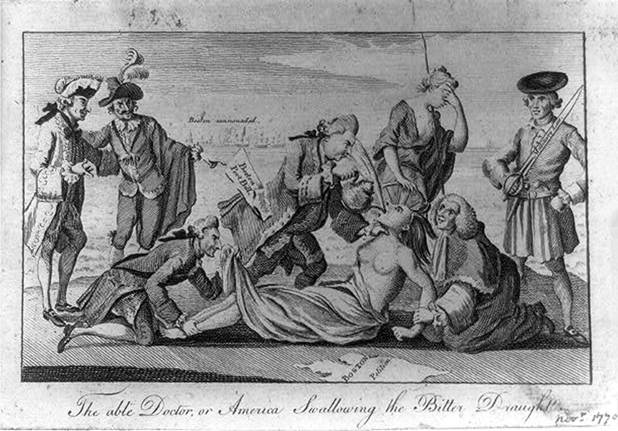
Figure 13.1 ‘The Able Doctor, or, America Swallowing the Bitter Draught'.
Cartoon [London, 1774].as the Stamp Act had aroused anger and defiance in the colonies, culminating in the Boston Tea Party. In early 1774 Parliament attempted to bring the colonies to heel by closing the port of Boston and other coercive measures. For the defenders of America, the cruelty of Britain was akin to physical abuse. To make this point, ‘The Able Doctor, or, America Swallowing the Bitter Draught' depicted the colonies as a Native American woman held down by Britain's Chief Justice and force-fed tea by Prime Minister Frederick, Lord North. The sexual abuse of the scene is undeniable: America's breasts are exposed while the First Lord of the Admiralty peers up her dress. Rakish France and Spain look on, while Britannia hides her head in shame and the sword of military law legitimates the scene.[444]
‘The Able Doctor' is arresting not only for its political commentary, but for what it suggests about how ideas of gendered violence were changing. For most of the colonial era rape had been ignored, especially when the perpetrator was a master and the victim an Indian, servant or slave. But sensibilities were changed with the Enlightenment and the American Revolution. Sexual abuse became problematic and rapists were not forgiven easily. Sex was supposed to be loving and companionate, with women empowered to escape abusive relationships. Indeed, the message of ‘The Able Doctor' was clear: America needed to escape her abusers.
Perhaps the only part that had not changed was the race of the victim. Native American women had suffered from the gendered violence of European men since Columbus, and despite the depiction of America as an Indian, the Revolution did not end the sexual exploitation of women of colour.[445]Ideas about gendered violence began to change in the eighteenth century with the Enlightenment. French philosophes such as Voltaire and Jean-Jacques Rousseau prized reason and individual liberty over religious authority and communal order. As these ideas filtered into the American colonies, the absolutism of the household head was called into question. Although he was not deposed, the master was expected to be less cruel and capricious in his governance of dependants. The Enlightenment also initiated a reassessment of slavery as a violation of individual freedom, although the nascent abolitionist movement was confined to northern colonies where African Americans were few and slavery economically insignificant.[446]
One concrete result of the Enlightenment was the use of the language of freedom and individual rights by American Revolutionaries. Following the Seven Years War (1756-63), Parliament sought greater control over the American colonies through taxes and the deployment of British soldiers. Gendered violence was an important part of the political discourse leading to independence. Americans feared that the constant presence of British soldiers in cities like Boston led to increased incidents of rape. Such worries repeated older perceptions of rapists as a foreign presence and prompted American men to take arms in defence of their women. Ultimately, ideas of gendered violence influenced the Declaration of Independence, which likened the relationship between the king and the colonists to a marriage, reasoning that like a cruel husband King George III had visited ‘repeated injuries and usurpations' upon Americans. The only solution was ‘to throw off such government': a divorce.[447]
The Revolutionary War (1775-83) escalated incidents of gendered violence.
War itself was a gendered and violent experience as soldiers in the Continental (US) Army quickly discovered. In addition to death and injury on the battlefield, men faced deprivations and disease in camp. Moreover, the army enforced strict discipline through corporal punishments such as floggings and running the gauntlet. Open hostilities also emboldened soldiers to sexually abuse women. When Connecticut was raided by British soldiers in 1779, Christiana Gatter reported that two redcoats broke into her house, ‘laid hold of me and threw me on the Bed'. Frightened for her life, Gatter testified: ‘I was oblidged to Submit'.[448] Sharon Block notes that women were more likely to immediately notify the authorities that they had been raped during the war, and that they achieved a higher conviction rate than during peacetime. In this way, women became active agents in their own defence, politicised to join the American cause.[449]The creation of the United States called much of the existing social order into question. Aristocratic privilege was assailed in a new nation where ‘all men are created equal' and nearly all white men gained the right to vote within two generations. This further weakened the household head and empowered dependants to be independent actors. Religious tests were prohibited by the US Constitution of 1787 and states disestablished their churches, thus removing ecclesiastical constraints as well. In place of church and state, American society looked to women to regulate the nation's morals. This had profound effects on gendered violence.
Illustrative of changing social mores was Susanna Rowson's 1791 novel Charlotte Temple, the story of a young woman who was seduced, only to be abandoned and die in childbirth. Rowson largely absolves Charlotte's seducer of fault, placing the blame on the title character for allowing herself to become a victim. Although Charlotte's father offered advice, the household head was unable to protect his daughter from ravishment.
The lesson of Charlotte Temple was the lesson for all young women, with Rowson hoping that her novel ‘should save one hapless fair one from the errors which ruined poor Charlotte'.[450] Clare Lyons argues that such stories endorsed male sexualprivilege while confusing notions of consent. In the early republic, American women were on their own against the sexual passions of men.[451]
Shifting gender mores affected notions of marriage. Early nineteenthcentury marriages were expected to be companionate and loving with the husband a genteel patriarch rather than an absolutist governor. This delegitimised most physical violence within the household, especially among the growing middle class. Women resisted wifely correction and began to abandon abusive husbands. With the Revolution, some Americans asked why ending an abusive marriage should be any different from ending a tyrannical regime, and the right to divorce was recognised by twelve of the sixteen states by 1799. Pennsylvania legalised divorce in 1785, and over the next thirty years the number of women petitioning to end their marriages spiked, with one in four citing cruelty alone and many more citing mistreatment among other causes.[452]
To be sure, the transition was incomplete and contested. Some men continued to claim the right to correct their wives. Pennsylvanian Michael Fisher testified that for his wife, ‘beating was necessary to make her a good housekeeper and that she must have more of it'. In response, Fisher's wife filed for divorce, reflecting a division among some husbands and wives over the role of physical violence within a marriage.[453] The courts were also resistant to accepting domestic abuse as sufficient grounds for divorce. In turn-of-the-century Pennsylvania, half the divorce petitions filed by women on the grounds of cruelty alone were denied. Moreover, physical abuse continued unreported in many households, concealed by a growing expectation of domestic privacy.
Early nineteenth-century legal codes did not recognise rape within marriages, and husbands continued to enjoy unfettered access to their wives' bodies. Likewise, the family was excluded from early tort laws, leaving battered wives with little recourse against abusive husbands beyond divorce.[454]Finally, domestic murder persisted. In Vermont and New Hampshire the legalisation of divorce in the last decades of the eighteenth century coincided with a decline of spousal murder. By the 1820s murder rates of spouses and children had increased and kept increasing through the American Civil War (1861-5).[455]
Gendered violence outside of the household changed as well. Following the Revolution, Americans questioned the widespread application of capital punishment for crimes including rape. By 1800 at least six states had substituted incarceration for death in rape convictions. Simultaneously, prosecutions increased. In Chester County, Pennsylvania, rape cases per 100,000 residents per year rose from 0.58 in 1718-93 to 1.57 in 1794-1801. However, the prosecution of attempted rapes declined over the same period. Before 1770, attempted rape cases outnumbered rape in Pennsylvania by a ratio of three to one, but after 1770 there were more than five rape cases for every one attempted rape case. Conviction rates also declined in Pennsylvania to 18.2 per cent in the 1790s. A growing disinterest in attempted rape and falling rates of conviction correlate to the growing sexual licence of men in the early nineteenth century.[456]
The growth of male sexual licence only applied to white men. With the Revolution, an emergent criticism of unfree labour called sexual exploitation of enslaved women into question for the first time. In response, southern planters committed to a ‘conspiracy of silence' and refused to acknowledge their role in interracial sex. President Thomas Jefferson maintained a sexual relationship with his slave Sally Hemings for decades, fathering several children by her, but he refused to ever acknowledge the connection. Although Jefferson's opponents divulged the president's relationship for political effect, the embarrassment did little to end Hemings's exploitation.[457] Conversely, perceptions of African Americans as unable to control their lust remained unchallenged. Changes in rape law did not apply to black men, who continued to face death for crossing the colour line, while black women still had little recourse for their sexual exploitation. In Philadelphia, bastardy law was increasingly racialised as single black women lost the ability to sue their sexual partners for support.46