Sacrifice: Children
In ancient times k'ex sacrifice also included the offering of children, whose remains are found in ceramic vessels, caves, royal tombs and other contexts across the Maya lowlands.
Child sacrifice dates at least as early as the Late Preclassic period, as evidenced by a recently discovered deposit at El Palmar, Guatemala. It continued into the conquest era, as reported in a number of early Spanish accounts. Although the significance of child sacrifice probably varies by context, the overall value of child offerings presumably relates to their significance as unblemished emblems of fertility and vitality. Children would thus have been ideal substitutions, valued exchanges that were offered during episodes of extreme crisis to placate the supernatural realm.[1011]Royal death was one such crisis that seems to have warranted child sacrifice. Throughout the Maya lowlands, kings and queens were interred in the company of children. The number varies by tomb, from as few as one child in Piedras Negras Burial 110 to as many as six at El Zotz Burial 9 and eight children and an adult in Burial 10 at Tikal.[1012] All of these tombs are from the Early Classic period and at some sites, like Tikal, the practice diminished in the Late Classic period, while at other sites, such as Piedras Negras, it continued throughout the Classic period.
Due to the poor skeletal preservation in the Maya lowlands, much of the evidence for child sacrifice comes from context and the distinct demographic profile of the victims. Moreover, some of the child sacrifices may have been carried out with poison or suffocation, acts that would not leave marks on the bone. In El Zotz Burial 9 the primary occupant was laid out on a funerary bier underneath which were placed six sacrificed children ranging in age from newborn to 5 years old, each placed within a large, lidded ceramic dish.[1013] Although only one possible cutmark was detected on one of the children's cranium, the two oldest individuals were represented by detached heads.
Outside the tomb, archaeologists found two other ceramic vessels containing children's skeletons, one of whom was also decapitated. In this case, context, the distinct demographic profile of the skeletons and the unusual pattern of representation (heads only for the two oldest children) provide good evidence for sacrifice. Moreover, the children's remains show moderate thermal alteration, consistent with exposure to fire (but not full immolation) as would be expected based on imagery of fiery offerings of child sacrifices.The transition between major periods of time and perhaps during the accession of a new king required child sacrifice, as evidenced on monuments such as Piedras Negras Stela 11 and 14 (Figure 25.3). These sculptures show sacrificed children lying on ceramic vessels. Kings sit on scaffold thrones in scenes that are generally interpreted as their royal accession. However, a careful reading of the texts indicates that instead these monuments were probably erected to celebrate the ending of a k'atun period (a roughly twenty-
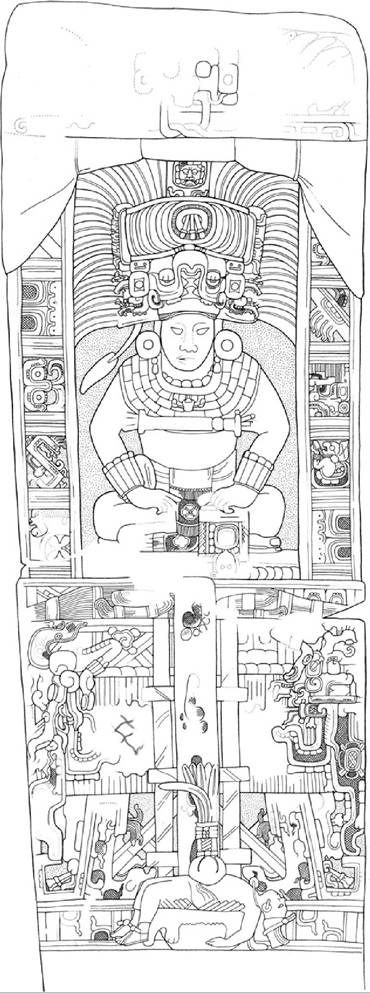
Figure 25.3 Child sacrifice on Piedras Negras Stela 11.
year cycle in the Maya calendar). In these rituals and through these monuments the Maya conflated the cycling of time to the changing of kings dangerous but necessary transitions in the flow of the world. The associated imagery indicates these rites were framed within the metaphor of the primordial dawning that marked the passage to a safer more ordered state of existence that was wrought by the gods through sacrifice at the start of creation. Such sacrificial rites have a parallel in the famed New Fire Ceremony of the Aztecs, celebrated every fifty-two years at the completion of the ritual calendar. The Aztec New Fire Ceremony and the period ending rites of the Maya involved sacrifice, as well as the burning of the slain victims as a means of replicating the mythic dawning enacted by the gods. The burning of the children is alluded to on the Piedras Negras stelae, by what is probably a ball of copal resin in the children's open chests and kindling underneath the body. Further evidence for the burning of children comes from the remains at El Zotz, as noted above. Early Spanish accounts describe the burning of captive children as sacrificial offerings. We do not know the identity of the children sacrificed in Pre-Columbian times. According to Spanish chroniclers, ‘some in their devotion gave their little children, who were made much of, and feasted up to the day'. Yet other reports indicate that young boys and girls, particularly orphans, were kidnapped or purchased for sacrifice.[1014]
More on the topic Sacrifice: Children:
- Although Nietzsche was referring to slavery in this early essay of his, and not to animal sacrifice, he might well have included sacrifice as a ‘cruel trait', for it involved literally tens of millions of animal victims, many of which did not provide any food.
- Children with special health care needs (CSHCN) are those children who have been or are at risk for a chronic physical, developmental, behavioral, or emotional condition
- Sacrifice: Adults
- Amerindian Human Sacrifice and Ritual Violence
- The Meaning of Human Sacrifice
- Aztec and Inca Human Sacrifice Compared
- Ritual Violence and Human Sacrifice in the Americas
- Malignancy is the ninth leading cause of childhood morbidity globally. In India, children account for lt;1% of all reported cancer patients with an estimated incidence of ~14/lac children, which seems to be rising. Childhood malignancies differ markedly from adult cancers in their nature, distribution and prognosis.
- Sacrifice: Self
- Sacrifice, Martyrdom and Persecution
- Sacrifice: Animals and Other Foods